NEW YORK, NY — In an era where the "low-end theory" dominates global music charts—from the subterranean 808s of modern trap to the cinematic thrum of Hollywood scores—the quest for the perfect bass tone remains a primary challenge for producers. Addressing this perennial need, Baby Audio has officially announced the release of SubCulture, a sophisticated pitch-tracking bass enhancer designed to provide surgical control and musical weight to monophonic audio signals.
Launched on July 20, 2026, SubCulture represents a significant leap in the evolution of sub-harmonic synthesis. By moving beyond static EQ boosts and simple sine-wave triggering, the plug-in utilizes a real-time pitch-detection engine to ensure that every added frequency remains harmonically aligned with the source material.
Main Facts: A New Paradigm in Bass Processing
SubCulture is not merely a "sub-bass generator" in the traditional sense. While older technologies often relied on generating a fixed frequency or a simple octave-down signal that could easily become muddy or dissonant, Baby Audio’s latest offering is built on the principle of "intelligent reinforcement."
The core of the software lies in its ability to analyze incoming monophonic signals—such as a bass guitar, a vocal line, or a synth lead—and track the fundamental frequency with micro-tonal precision. This allows the processor to "lock" its enhancement engines to the specific notes being played.
Key Technical Specifications:
- Processing Engines: Three distinct modules (Sub Layer, Root Boost, and Resonance).
- Pitch Tracking: Real-time detection for monophonic inputs.
- Saturation/Dynamics: Analog-modeled compression and harmonic distortion circuits.
- Presets: 177 professionally crafted presets from industry leaders.
- Pricing: $79 introductory offer ($129 MSRP).
- Compatibility: VST, VST3, AU, and AAX for macOS and Windows.
Chronology: From Analog Sub-Synths to Intelligent Algorithms
To understand the significance of SubCulture, one must look at the history of low-frequency enhancement in the recording studio.
The Analog Origins (1970s – 1990s)
In the late 20th century, engineers relied on hardware units like the DBX 120A Subharmonic Synthesizer or the legendary Pultec EQP-1A to "trick" the ear into hearing deeper bass. These units used analog circuitry to create a version of the signal one octave lower. While effective, they were often unpredictable, occasionally generating frequencies that clashed with the song’s key or created phase issues.
The Digital Transition (2000s – 2015)
The early digital era introduced "MaxxBass" and similar psychoacoustic processors that focused on generating upper harmonics to make bass audible on small speakers. While useful, they didn’t always provide the "physical" weight required for modern club systems or high-end home theaters.
The Baby Audio Era (2019 – Present)
Since its inception, Baby Audio has built a reputation for "retro-modern" tools—plug-ins that capture the soul of analog gear while utilizing the power of modern DSP. The development of SubCulture follows years of research into how modern listeners consume audio. With the rise of mobile listening, the challenge for producers is creating bass that is felt on large subwoofers but remains "defined" on small smartphone speakers. SubCulture was conceived as the ultimate solution to this "translation" problem.
Supporting Data: The Three Pillars of SubCulture
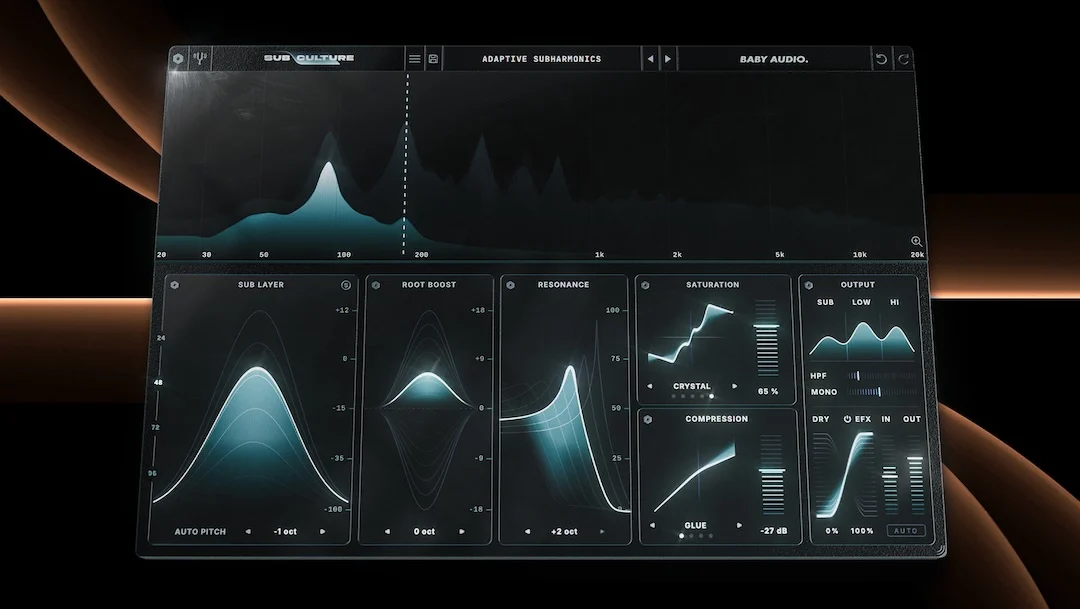
The architecture of SubCulture is divided into three primary processing engines, each designed to handle a specific aspect of the low-frequency spectrum.
1. The Sub Layer
This module is the engine’s powerhouse. It generates a pitch-shifted version of the input signal, capable of reaching up to two octaves below the original source. Unlike a standard synthesizer, the Sub Layer retains the character of the original performance, ensuring that if the input is a gritty bass guitar, the sub-octave carries a hint of that organic texture rather than a sterile sine wave.
2. The Root Boost
The Root Boost functions as a "smart" EQ. Traditional EQs are static; if you boost 60Hz, that boost stays at 60Hz regardless of what note the bassist plays. Root Boost, however, tracks the fundamental frequency (the "root") of every note. If the bassist moves from an E to a G, the 18dB boost moves with them. This ensures a consistent "weight" across the entire frequency range of the instrument, eliminating "dead notes" or unevenness in a performance.
3. Resonance
Inspired by classic analog filter networks, the Resonance section adds a parallel filter that provides a "blooming" effect to the low end. By emphasizing specific resonant peaks, it gives the bass a three-dimensional quality that helps it sit forward in a dense mix without clashing with the kick drum.
Shaping Tools and Saturation
Beyond the three engines, SubCulture includes a "Mix Tools" section. This features:
- Analog-Modeled Saturation: Essential for adding upper-mid harmonics that allow sub-frequencies to "cut through" on smaller speakers.
- Dynamics Control: A custom-tuned compressor that ensures the added low-end doesn’t overwhelm the mix’s headroom, keeping transients sharp and "punchy."
Official Responses: Industry Perspectives
The release of SubCulture has already garnered significant attention from the professional audio community. Baby Audio collaborated with several high-profile sound designers to showcase the plug-in’s versatility.
Craig Bauer, a Grammy-winning mix engineer known for his work with Kanye West and Lupe Fiasco, contributed to the preset library. "Low end is the hardest thing to get right in a mix," Bauer noted during the launch phase. "SubCulture provides a level of consistency and musicality that usually takes a chain of five or six different plug-ins to achieve."
Dakota G, a rising producer in the electronic scene, highlighted the sound design potential: "It’s not just for bass. I’ve been using it on dry vocal takes to create this ‘god-like’ depth. The pitch tracking is so fast that it handles complex melodic runs without any noticeable artifacts."
Baby Audio’s official statement emphasizes the plug-in’s philosophy:
"We wanted to create a tool that removes the guesswork from the bottom end. SubCulture is about giving producers the confidence that their sub-bass is perfectly in tune and perfectly compressed, every single time."
Implications: A New Era for Home and Pro Studios
The introduction of SubCulture has several long-term implications for the music production landscape.
Democratizing High-End Low-End
Historically, achieving a "pro" low-end required expensive outboard gear and perfectly treated acoustic environments. By automating the pitch-tracking and harmonic-balancing process, SubCulture allows producers working in home studios to achieve a level of bass clarity that was previously the domain of elite mixing houses.
The "Sub-Bass Wars" and Streaming
As streaming platforms continue to normalize loudness, the "perceived" power of a track often comes down to how well the low-end is managed. SubCulture’s ability to add harmonics through its saturation circuit means that tracks will likely translate better across the vast spectrum of modern playback devices—from AirPods to festival sound systems.
Versatility Beyond the Bass
Perhaps the most intriguing implication is the plug-in’s application in sound design. By applying SubCulture to non-traditional sources—like cinematic foley, percussion, or lead vocals—producers are discovering new ways to add "weight" to a mix. This "layering" capability suggests that SubCulture may become a staple in film scoring, where the demand for "larger-than-life" textures is constant.
Market Positioning
At an introductory price of $79, Baby Audio is positioning SubCulture as an aggressive competitor to established favorites like Waves Submarine or Plugin Alliance’s Subsynth. Given Baby Audio’s track record of sleek, user-friendly interfaces (often referred to as "one-knob-style" depth), SubCulture is likely to appeal to the "creator" demographic that values speed and inspiration over overly technical menus.
Conclusion
Baby Audio’s SubCulture arrives at a time when the demand for high-quality bass has never been higher. By combining intelligent pitch-tracking with analog-inspired character, the plug-in offers a comprehensive solution for one of the most difficult tasks in audio engineering. Whether it is used to save a thin bass recording, add "thump" to a kick drum, or create otherworldly vocal textures, SubCulture stands as a testament to the power of modern DSP to solve age-old acoustic problems.
SubCulture is available now via the Baby Audio website and authorized retailers. As the industry moves further into 2026, it is clear that the "culture" of the sub-bass is only getting deeper.