BROOKLYN, NY — In an era where the music industry is rapidly pivoting toward spatial audio and immersive experiences, Paul “Willie Green” Womack has announced a significant milestone for the New York independent recording scene. The GreenHouse Recording Co., a staple of the Carroll Gardens creative community, has officially transitioned from a specialized mixing suite into a comprehensive, multi-room production environment. Central to this transformation is a sophisticated integration of ADAM Audio monitoring systems, positioning the facility as a premier destination for high-fidelity immersive mixing and collaborative music production.
The expansion, finalized in June 2026, marks a pivotal chapter for Womack, an acclaimed producer, engineer, and songwriter whose credits read like a "who’s who" of modern hip-hop and R&B. By scaling his operations, Womack is not merely increasing square footage; he is redefining the workflow of the independent producer in an age where Atmos-ready content has become the new industry standard.
Chronology: From Boutique Mix Room to Full-Scale Production Hub
The journey of The GreenHouse Recording Co. is one defined by organic growth and technical precision. Paul Womack, known professionally as Willie Green, originally established his presence in Carroll Gardens five years ago. Occupying a single, well-regarded mix room, Womack built a reputation for delivering punchy, nuanced, and culturally resonant mixes for artists such as Wiz Khalifa, The Roots, Donnie McClurkin, Open Mike Eagle, Billy Woods, and The Alchemist.
As the demand for his specific sonic signature grew, so did the limitations of a single-room setup. The industry-wide shift toward Dolby Atmos and immersive audio formats created a new set of requirements that necessitated a total rethink of the facility’s architecture.
In early 2026, the opportunity arose for Womack to take over the entirety of the building he had previously shared. This acquisition allowed for a ground-up redesign of the space. The transition involved moving from a stereo-centric workflow to a specialized 7.1.4 immersive environment, while simultaneously adding dedicated spaces for tracking, live performance, and songwriting. This chronological shift reflects a broader trend in the New York recording landscape, where mid-sized independent studios are evolving to provide the high-end technical capabilities once reserved for "mega-studios," but with the intimate, artist-focused atmosphere of a boutique shop.
Supporting Data: The Technical Architecture of the New GreenHouse
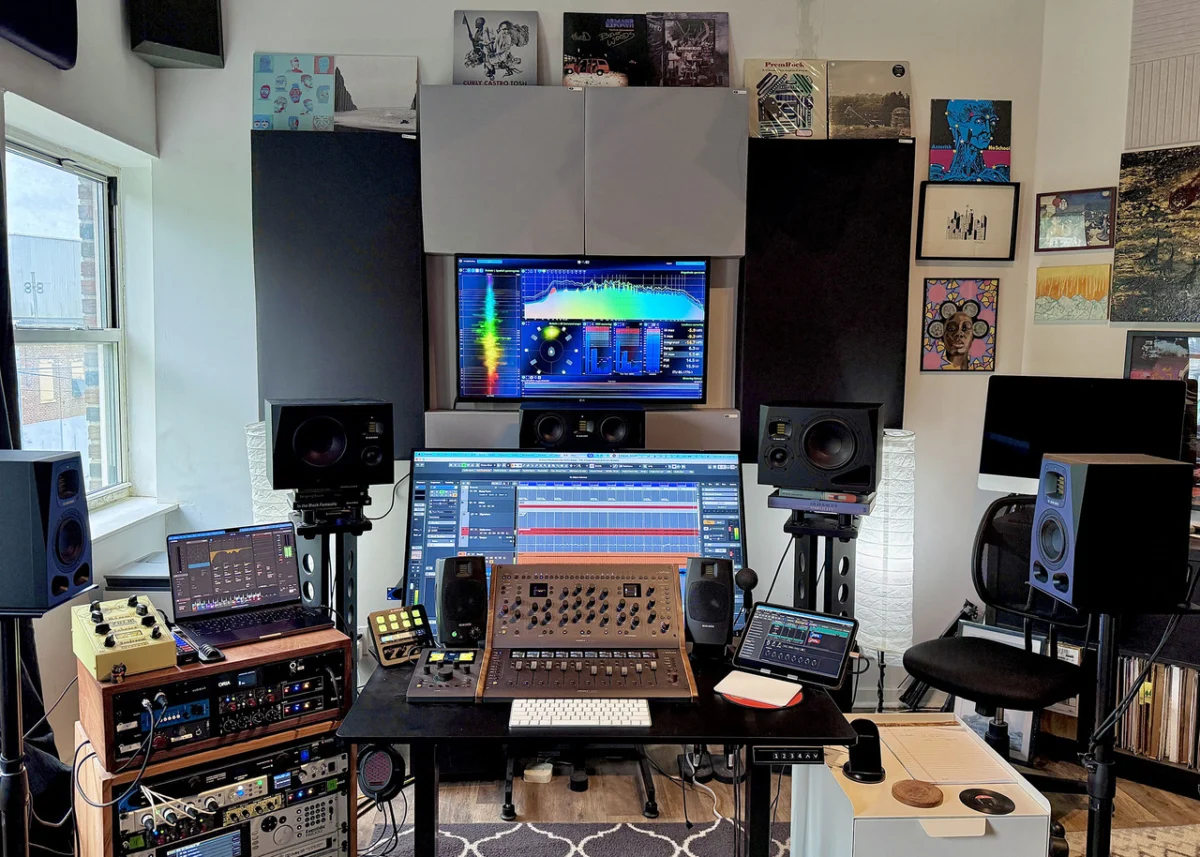
The cornerstone of the expansion is Studio B, Womack’s flagship immersive mix room. To meet the rigorous demands of Dolby Atmos certification and professional music mixing, Womack selected an array of ADAM Audio monitors, a brand he has championed since his early career.
Studio B: The 7.1.4 Immersive Environment
The 7.1.4 configuration in Studio B is engineered for phase-accurate, high-SPL monitoring with a focus on transparency and "translation"—the ability for a mix to sound consistent across various playback systems. The setup includes:
- Left and Right Mains: ADAM Audio A8H monitors. These three-way speakers provide the power and detail necessary for the primary stereo image, featuring a dedicated midrange driver and the signature X-ART tweeter.
- Center Channel: An A44H monitor. Designed with a low-profile, horizontal orientation, the A44H provides clear dialogue and phantom-center stability without obstructing sightlines or screen placements.
- Surrounds and Heights: Eight A4V monitors. These compact yet powerful units handle the surround and overhead height channels, ensuring a seamless "hemisphere" of sound that is critical for object-based audio placement.
- Low-Frequency Effects (LFE): An ADAM Sub10 MK2 subwoofer. This provides the deep, controlled low-end extension required for hip-hop and modern electronic music production.
Studio C: The Production and Writing Suite
Recognizing that the creative process often begins with a beat or a lyric rather than a full mix, Womack established Studio C. This room is optimized for speed and inspiration, featuring:
- Monitoring: ADAM Audio A3X monitors.
- Function: Dedicated to beat-making, songwriting, and pre-production, allowing artists to work in a comfortable environment before moving into the larger rooms for tracking or final mixing.
The Tracking and Live Room
The facility also includes a tracking room connected to a live room, facilitating full-band recordings and vocal sessions. Plans are currently in motion to standardize ADAM Audio monitoring across this space as well, ensuring sonic consistency as projects move through different stages of the production pipeline.
Official Responses: Insights from the Control Room
For Paul Womack, the choice of monitoring was as much a matter of professional history as it was technical specs. Reflecting on his long-standing relationship with the brand, Womack noted the reliability and "musicality" of the ADAM sound.
"The first studio I worked in after college had ADAM monitors, and I loved the way music sounded through them," Womack stated. "Years later I did a shootout with some A7s, and I haven’t turned back since. I just keep buying more of these speakers. They provide a level of detail that allows me to make critical decisions with confidence."
Womack’s shift into the immersive realm was driven by a desire to push creative boundaries. "Once I started working in immersive, I found it hard to go back to stereo," he explained. "With stereo, you’re creating the illusion of space. In immersive, you’re already inside the space and working outward from there. It opens up a much wider palette creatively. It changes how you think about the relationship between instruments and the listener."
Representatives from ADAM Audio have highlighted The GreenHouse as a prime example of the "A-Series" versatility. By utilizing different models within the same series (A8H, A44H, A4V), Womack has achieved a timbre-matched environment where sound objects move through the 3D space without changing their tonal character—a prerequisite for high-level Atmos mixing.
Implications: A New Paradigm for the Independent Studio
The expansion of The GreenHouse Recording Co. carries significant implications for the Brooklyn music scene and the broader recording industry.
1. The Democratization of Immersive Audio
For years, Dolby Atmos mixing was the exclusive domain of high-budget film post-production houses and a handful of elite music studios. Womack’s expansion proves that independent, artist-driven facilities can successfully implement 7.1.4 systems. This allows independent artists—particularly those in the hip-hop and indie-soul genres—to compete on a level playing field with major-label acts who have access to massive corporate studios.
2. The Studio as a Holistic Creative Hub
Perhaps the most forward-thinking aspect of the new GreenHouse is Womack’s vision of the facility as a "creative hub." Beyond the racks of outboard gear and high-end monitors, the space is designed to host rotating art installations and collaborative social areas.
- Cultural Synergy: By integrating visual arts with sonic arts, Womack is fostering an environment where producers, rappers, and visual artists can cross-pollinate ideas.
- Community Impact: In a neighborhood like Carroll Gardens, which has seen significant gentrification, the presence of a thriving, Black-owned, high-tech creative space provides a vital anchor for the local artistic community.
3. Workflow Efficiency in the "Atmos-First" Era
As streaming platforms like Apple Music and Amazon Music increasingly prioritize spatial audio, the ability to record, produce, and mix in an immersive environment from day one is a competitive advantage. The GreenHouse’s multi-room setup allows a project to stay "in-house" from the first drum hit in Studio C to the final 7.1.4 print in Studio B, ensuring the artist’s vision remains uncompromised by moving between disparate environments.
4. Technical Standardization
The reliance on ADAM Audio’s DSP-driven A-Series monitors suggests a shift toward more intelligent studio hardware. With integrated Sonarworks Room Correction and remote control capabilities, these monitors allow Womack to maintain acoustic accuracy even in the challenging architectural environments often found in Brooklyn’s converted industrial and residential buildings.
Conclusion
The transformation of The GreenHouse Recording Co. is a testament to Paul "Willie Green" Womack’s dedication to the craft of sound. By marrying the legacy of Brooklyn hip-hop with the cutting edge of immersive audio technology, Womack has created more than just a recording studio; he has built a laboratory for the future of music. As the industry continues to navigate the transition from two channels to three dimensions, facilities like The GreenHouse will serve as the blueprints for the next generation of sonic excellence.