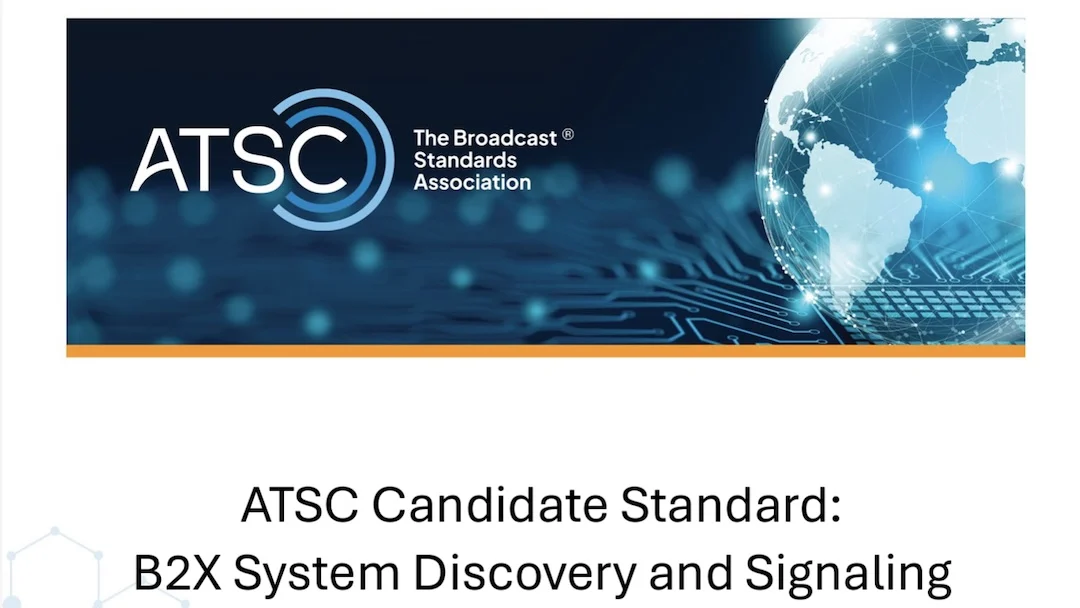
WASHINGTON, DC – In a move that signals a tectonic shift in how digital content is distributed, the Advanced Television Systems Committee (ATSC) has officially approved a new Candidate Standard aimed at revolutionizing the interplay between terrestrial broadcasting and mobile networks. The standard, designated S44-2-002r6, “B2X System Discovery and Signaling,” serves as the foundational architecture for the emerging B2X (Broadcast-to-Everything) platform.
By formalizing this framework, the ATSC is not merely updating technical specifications; it is laying the groundwork for a future where broadcast technology acts as a primary, high-efficiency backbone for the global mobile ecosystem. This development marks a significant milestone in the organization’s long-term vision: a unified, hybrid communications environment where one-to-many broadcast efficiency seamlessly integrates with the one-to-one responsiveness of unicast mobile networks.
The Genesis of B2X: Main Facts and Technical Context
The approval of S44-2-002r6 by the ATSC Technology Group 3 (TG3) represents the first formal step toward a broader, more integrated communications infrastructure. Unlike previous iterations of ATSC standards, which were primarily focused on improving the quality and delivery of linear television, B2X is designed to transcend the traditional "TV-as-receiver" paradigm.
Defining the B2X Architecture
B2X is an ambitious initiative designed to bridge the gap between broadcast signals and the massive, fragmented universe of connected devices. The core value proposition of broadcast—its inherent ability to transmit identical data to an infinite number of receivers simultaneously without network congestion—is being repositioned as a solution to the "data bottleneck" currently facing mobile carriers.
As mobile networks struggle to cope with the skyrocketing demand for high-bandwidth content (such as software updates, high-definition video streaming, and emergency alerts), B2X offers an offload mechanism. By using the high-powered, wide-area coverage of broadcast transmitters to push massive data files to mobile devices, the network can reserve unicast spectrum for personalized, low-latency traffic.
Why Discovery and Signaling Matter
The "System Discovery and Signaling" aspect of the new standard is critical. For a mobile device to transition from a cellular-only state to a hybrid cellular-broadcast state, it must first "find" the broadcast signal and understand the services available within it. This Candidate Standard defines the handshaking protocols, metadata structures, and discovery mechanisms that allow a smartphone, IoT sensor, or vehicle infotainment system to seamlessly identify and ingest broadcasted data streams.
Chronology of a Paradigm Shift
The journey toward B2X did not begin in a vacuum. It is the culmination of years of iterative development following the successful, albeit gradual, rollout of ATSC 3.0.
- 2017–2020: The ATSC 3.0 Foundation: The deployment of the "NextGen TV" standard proved that IP-based broadcasting was viable. This period established the necessary technical comfort with MPEG-DASH, ROUTE, and the IP-stack-based broadcast delivery model.
- 2023–2025: Identifying the "Convergence Gap": Industry stakeholders began recognizing that while ATSC 3.0 was great for TV, it lacked a formal, standardized way to interoperate with non-television devices (smartphones, automotive telematics). The concept of "B2X" was incubated as an industry-wide exploration of these limitations.
- October 9, 2026: The Milestone Approval: ATSC TG3 formally elevated the B2X System Discovery and Signaling specification to "Candidate Standard" status, opening it for public comment and rigorous industry peer review.
- 2027 (Ongoing): The Public Review Window: The organization has set a deadline of late June 2027 for the public review period, inviting contributions from technology developers, silicon manufacturers, and telecommunications standards bodies.
- 2028 and Beyond: Expected Standardization: Following the review, the ATSC aims to refine the standard, finalize the suite of B2X specifications, and begin the certification process for hardware that supports the B2X protocol.
Supporting Data: The Efficiency Mandate
The push for B2X is driven by cold, hard data regarding network utilization. Current mobile networks operate on a unicast basis; every user requesting a specific piece of data—such as a 4K video or a major software update—creates a unique data stream from the base station to the user. When thousands of users in a single geographic area request the same content, the network experiences severe congestion, leading to latency and service degradation.
The "One-to-Many" Advantage
Broadcast technology, by contrast, is inherently one-to-many. The energy and bandwidth required to send a file to one person are exactly the same as the energy and bandwidth required to send it to one million people.
- Bandwidth Efficiency: By offloading popular content (which accounts for a significant percentage of mobile data traffic) to broadcast channels, carriers can reduce network congestion by an estimated 30–50% in dense urban environments.
- Device Proliferation: According to recent market analysis, the number of connected devices—from smart cars to edge-computing nodes—is projected to reach 30 billion by 2030. Unicast networks alone will be unable to handle the aggregate traffic demand of these devices without astronomical infrastructure costs.
- Energy Consumption: Broadcasting consumes significantly less energy per gigabyte delivered compared to cellular towers, making it a critical sustainability play for mobile operators under pressure to reduce their carbon footprints.
Industry Perspectives: Who Stands to Gain?
The B2X initiative is a collaborative endeavor designed to benefit a broad spectrum of the technology ecosystem. The ATSC has positioned itself as the "glue" that binds these disparate industries together.
Broadcasters: A New Revenue Stream
For traditional television broadcasters, B2X is a lifeline to relevance in a cord-cutting era. By transforming their spectrum into a data-delivery pipe, broadcasters can pivot from being content providers to becoming "data utility" providers. This opens up entirely new markets, including data casting for automotive manufacturers, firmware-over-the-air (FOTA) updates for consumer electronics, and real-time sensor data distribution for smart cities.
Wireless Providers: Solving the Capacity Crunch
Mobile network operators (MNOs) have historically been wary of broadcast technology, viewing it as a competing entity. However, the B2X philosophy promotes "cooperation over competition." By integrating broadcast into their service offerings, MNOs can offload heavy content, improve customer experience, and defer the cost of massive infrastructure upgrades.
Device Manufacturers: Enabling "Always-On"
Manufacturers of mobile devices and IoT hardware see B2X as a way to provide "always-on" service even in areas with poor cellular coverage. If a device can receive software updates or emergency information via a broadcast signal regardless of its cellular connectivity, it becomes a more resilient, higher-value product.
Implications: The Road to a Unified Network
The implications of the B2X Candidate Standard extend far beyond the technical documentation. It represents a fundamental reimagining of the radio frequency (RF) landscape.
A Hybrid Future
As the standard moves toward finalization, we should expect to see a new generation of chipsets capable of simultaneously tuning into LTE/5G and ATSC B2X signals. This hybrid reception will allow devices to intelligently switch between networks based on the task: using the broadcast network for massive data downloads or broad-spectrum alerts, and the cellular network for interactive, two-way communication.
Impact on Smart Cities and Autonomous Vehicles
One of the most promising applications for B2X lies in the automotive sector. Autonomous vehicles require constant updates—high-definition map data, weather alerts, and emergency notifications. Using broadcast to push these updates to thousands of vehicles in a city simultaneously ensures that all vehicles are running on identical, up-to-date data, significantly enhancing safety and efficiency.
Maintaining the Integrity of ATSC 3.0
It is crucial to note that B2X does not replace or "break" existing ATSC 3.0 standards. The ATSC has been deliberate in ensuring that B2X operates as an independent mechanism that sits alongside the current framework. This modular approach allows for backward compatibility while providing the flexibility required to evolve the technology as new use cases emerge.
Conclusion: Closing the Review and Looking Ahead
The release of the S44-2-002r6 Candidate Standard is a clarion call to the global technology industry. The ATSC is not just asking for comments; it is inviting the industry to build a new layer of the internet—one that is distributed, efficient, and broadcast-powered.
As the June 2027 deadline approaches, the success of B2X will depend on the degree of industry buy-in. If the mobile, broadcast, and device sectors can align on this unified discovery and signaling protocol, we are on the precipice of a new era of digital connectivity. By shifting from a world where we "connect to the web" to one where the web is constantly "broadcasted to us," the B2X platform promises to make our digital lives faster, more efficient, and more reliable than ever before.
For stakeholders interested in participating in the review process, the ATSC portal provides the necessary technical documentation and submission guidelines. The window of opportunity to shape the future of this standard is now open, and the potential for a more efficient, broadcast-integrated future has never been more tangible.