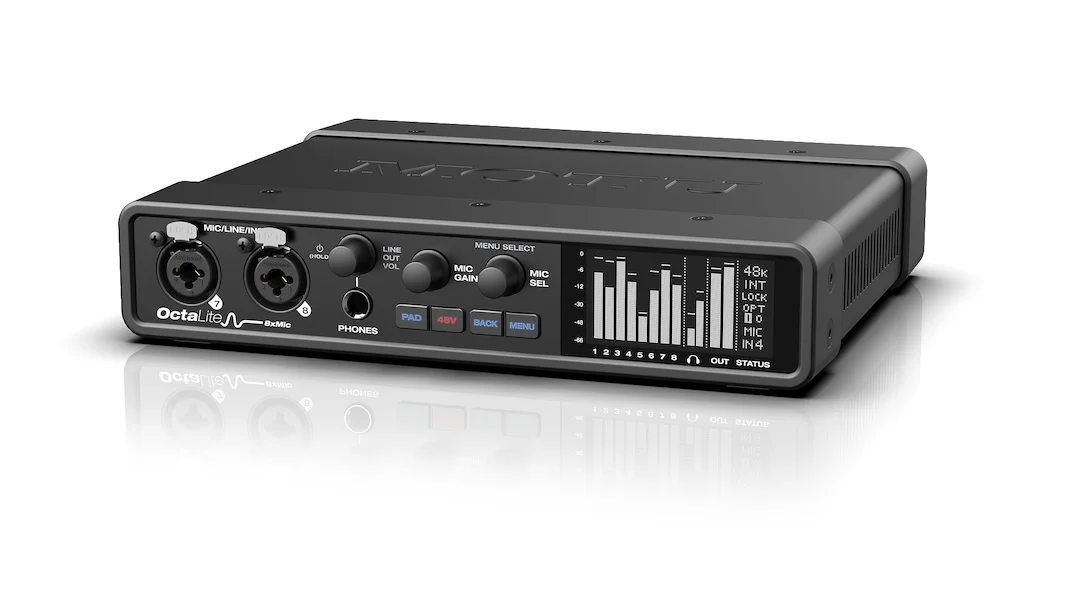
CAMBRIDGE, MA — In an era where studio footprints are shrinking and mobile production requirements are becoming increasingly complex, Mark of the Unicorn (MOTU) has long stood as a titan of reliability and technical precision. Today, the company reinforces that reputation with the announcement of the OctaLite, a 16×12 USB audio interface that manages to pack a formidable amount of I/O and processing power into a chassis small enough to fit in a laptop bag.
Designed to serve both the traveling producer and the space-conscious home studio owner, the OctaLite bridges the gap between massive rack-mount systems and ultra-portable desktop interfaces. By merging high-fidelity Burr-Brown preamps with flexible DSP routing, MOTU is aiming to redefine the "half-rack" category.
Main Facts: The Anatomy of the OctaLite
The OctaLite is, at its core, a 16-input, 12-output USB-C audio interface designed for cross-platform compatibility, including macOS, Windows, and iOS. Its most striking feature is the density of its analog section: eight combo XLR/TRS inputs, all capable of handling microphone, line-level, or high-impedance (Hi-Z) guitar signals.
Core Technical Specifications:
- I/O Configuration: 8 analog inputs (combo XLR/TRS), 8 channels of ADAT digital I/O, and dedicated stereo outputs.
- Connectivity: USB-C 2.0 (fully compatible with USB 3.0/4.0 and iOS devices).
- Conversion: Support for sample rates up to 192 kHz.
- Preamp Quality: Burr-Brown engineered Texas Instruments preamps providing up to +74 dB of gain with a noise floor of -129 dB EIN.
- DSP Processing: Onboard hardware-based mixing and effects, allowing for zero-latency monitoring and dry/wet signal routing.
- Form Factor: Half-rack width, compatible with modular rack-mounting solutions.
The device is built for speed. MOTU reports low-latency round-trip (RTL) times of approximately 2 milliseconds, depending on the buffer settings and host system. Furthermore, for users who need a "plug-and-play" experience without software installation, the unit functions in a class-compliant mode, making it an ideal candidate for mobile recording sessions where driver configuration might otherwise impede the creative flow.
Chronology: The Evolution of the "Lite" Series
To understand the significance of the OctaLite, one must look at the trajectory of MOTU’s product design over the last decade. MOTU has spent years iterating on the "UltraLite" series, a line that defined the portable rack-mount interface market.
- 2015–2020: MOTU established dominance with the UltraLite-mk4, which introduced the company’s powerful internal DSP mixer. This allowed users to route signals internally without taxing the host computer’s CPU.
- 2021: The release of the UltraLite-mk5 marked a shift toward high-end ESS Sabre32 DAC technology, signaling that MOTU was no longer willing to compromise on audio quality in exchange for portability.
- October 2026: The launch of the OctaLite represents the next logical step. By stripping away some of the legacy connectivity found in larger units and focusing strictly on a high-density, eight-preamp input stage, MOTU has created a device that functions as a "Swiss Army Knife" for engineers who require clean, high-gain inputs in a format that fits inside a standard equipment rack alongside other half-rack gear.
The development of the OctaLite was driven by feedback from the location-recording community—specifically, engineers who required a dedicated hardware solution that could function both as a standalone interface and as an ADAT expander for larger studio setups.
Supporting Data: Performance and Signal Integrity
The audio industry often treats "portable" and "professional" as mutually exclusive categories. MOTU is attempting to dismantle this narrative through the implementation of premium componentry.
The Preamplifier Section
The decision to utilize Burr-Brown engineered preamps is a calculated move to appeal to the "prosumer" and professional markets. With a +74 dB gain range, the OctaLite is capable of driving gain-hungry ribbon microphones and low-output dynamic mics—the kind typically associated with high-end studio work—without requiring external "cloud-lifter" style preamps. The -129 dB EIN (Equivalent Input Noise) figure ensures that even at high gain settings, the noise floor remains effectively silent, preserving the transient detail of delicate sources.
Digital Expansion and "Octa" Functionality
The "Octa" moniker is not merely a branding choice; it highlights the unit’s dual-purpose functionality. In a standard setup, the interface connects to a computer via USB-C. However, in a secondary mode, the unit can serve as a standalone optical expander. By connecting the OctaLite’s ADAT output to another interface’s ADAT input, a user can instantly add eight channels of high-quality preamplification to an existing system. This makes the OctaLite an "evergreen" purchase—it remains useful even if the user eventually upgrades their primary interface to a larger unit with fewer built-in preamps.
Routing and DSP
The internal DSP engine provides individual control over 48V phantom power, -20 dB pads, and phase inversion for every input. This is critical for modern tracking, where engineers often need to print a dry signal to the DAW while monitoring with zero-latency reverb or compression via the hardware mixer. The "pre/post FX" option for these sends allows for complete control over the signal chain, ensuring that the artist hears a polished, finished mix while the raw, clean data is recorded for later processing.
Official Responses and Industry Context
In a statement accompanying the launch, MOTU representatives emphasized that the OctaLite was developed with the "hybrid studio" in mind.
"Modern recording is no longer tethered to a fixed room," said a lead developer at MOTU. "We wanted to ensure that whether you are in a professional tracking room, a makeshift vocal booth, or on a film set, the quality of the input signal is never the bottleneck. The OctaLite provides the transparency that professionals expect, while maintaining the modularity that modern setups require."
Industry analysts have noted that the price point of $849.95 places the OctaLite in direct competition with high-end desktop interfaces from brands like RME and Universal Audio. However, the OctaLite’s specific focus on eight preamps in a half-rack chassis gives it a unique competitive advantage. Many competing units at this price point offer fewer physical preamps, forcing users to invest in additional ADAT expansion hardware. MOTU has effectively integrated that expansion hardware into the box.
Implications: The Future of the Portable Studio
The arrival of the OctaLite has significant implications for how studios will be built in the coming years.
1. The Death of the "Large Console" Requirement
For many mid-sized production houses, the need for a massive 32-channel mixing console has been supplanted by the need for high-quality, high-count I/O. The ability to couple two OctaLites—or an OctaLite and an UltraLite-mk5—using the Half-Rack Coupler Kit allows for a scalable, custom-built rack that can grow with the user’s project requirements.
2. The Rise of the "Road-Warrior" Pro
As the line between touring musicians and studio producers continues to blur, the demand for gear that survives the rigors of travel without sacrificing sonic fidelity has reached an all-time high. The OctaLite’s rugged construction and flexible power options suggest a shift toward hardware that is "studio-first" but "tour-ready."
3. Workflow Efficiency
The inclusion of low-latency drivers and a driver-less USB class-compliant mode ensures that users are not bogged down by software conflicts. By removing the technical barriers between the instrument and the computer, MOTU is allowing engineers to focus on the performance rather than the signal chain.
Conclusion
With the OctaLite, MOTU has delivered a device that feels like a culmination of years of engineering refinement. It is not just an interface; it is a signal-management tool that respects the user’s time, space, and sonic expectations. Whether used as the centerpiece of a home studio or as a high-quality expansion rack for a large-format facility, the OctaLite stands as a testament to the fact that when it comes to professional audio, sometimes the most powerful tools are the ones that take up the least amount of space.
For engineers, producers, and artists, the message is clear: the era of compromising on quality for the sake of portability has officially come to an end. The OctaLite is available for purchase immediately through authorized retailers worldwide.