By Audio Journal Correspondent
October 2026
In the rapidly evolving landscape of high-fidelity personal and home audio, few companies have demonstrated the cross-market agility of FiiO. Historically recognized as a heavyweight champion in the portable audio sector—dominated by high-resolution digital audio players (DAPs), portable DAC/amps, and planar magnetic headphones—FiiO has steadily expanded its footprint into desktop speakers like the SP5 and even nostalgic analog hardware like the CP13 cassette player.

Now, FiiO is plunging headfirst into pure desktop and home speaker amplification with a decidedly traditional approach: a Class-A integrated vacuum tube amplifier. Priced at $769.99, the FiiO EA13 abandons internal DACs, Bluetooth streaming modules, and digital signal processors in favor of pure analog amplification. Utilizing a hybrid setup of Sylvania NOS and JJ Electronic tubes, the EA13 aims to deliver authentic, old-school warmth to modern hi-fi speaker setups.
Main Facts: Architecture, Specifications, and Component Selection
The FiiO EA13 is an integrated, Class-A vacuum tube amplifier designed specifically for passive loudspeaker setups. At its core, the device relies on a meticulous combination of vintage and modern tube architecture:

- Pre-Amplification Stage: Two Sylvania NOS (New Old Stock) PCF80 triode-pentode compound tubes handle the initial voltage amplification and driver duties.
- Power Amplification Stage: Four JJ Electronic EL34 power-amplifying tubes drive the output stage.
- Power Output: Delivers 18 watts per channel (wpc) at up to 1% Total Harmonic Distortion (THD), scaling up to 28wpc if pushed to a 5% threshold.
- Speaker Matching: Features dedicated 4Ω and 8Ω speaker taps alongside ground terminals to accommodate varying loudspeaker impedances.
- Inputs: Four single-ended analog RCA line-level inputs located on the rear panel.
- Price Point: Retails globally for $769.99.
Unlike traditional tube amplifiers that require manual, tedious bias adjustments using a multimeter, the EA13 features an auto-biasing circuit. This simplifies maintenance significantly, making it accessible to audiophiles who may be intimidated by the upkeep typically associated with vintage tube gear.
Chronology: The Evolution of FiiO’s Desktop Ambitions
FiiO’s journey toward the EA13 did not happen overnight; it represents a calculated chronological expansion out of pure portability into the broader consumer audio ecosystem.

- The Portable Foundation: For over a decade, FiiO built its brand on portable dongles, IEMs, and DAPs. However, market saturation pushed the company to diversify.
- The Desktop Shift: The introduction of active desktop systems like the FiiO SP5 powered speakers proved the company could successfully engineer larger, room-filling gear that retained a retro aesthetic while maintaining modern acoustic standards.
- The Analog Experiment: The surprise market success of the FiiO CP13 portable cassette player signaled to management that consumers possessed a powerful appetite for tactile, analog hardware.
- The Flagship Tube Debut: Culminating years of internal acoustic R&D, FiiO unveiled the EA13, merging vintage vacuum tube topologies with modern industrial design and safety standards.
Supporting Data: Design, Build Quality, and Thermal Management
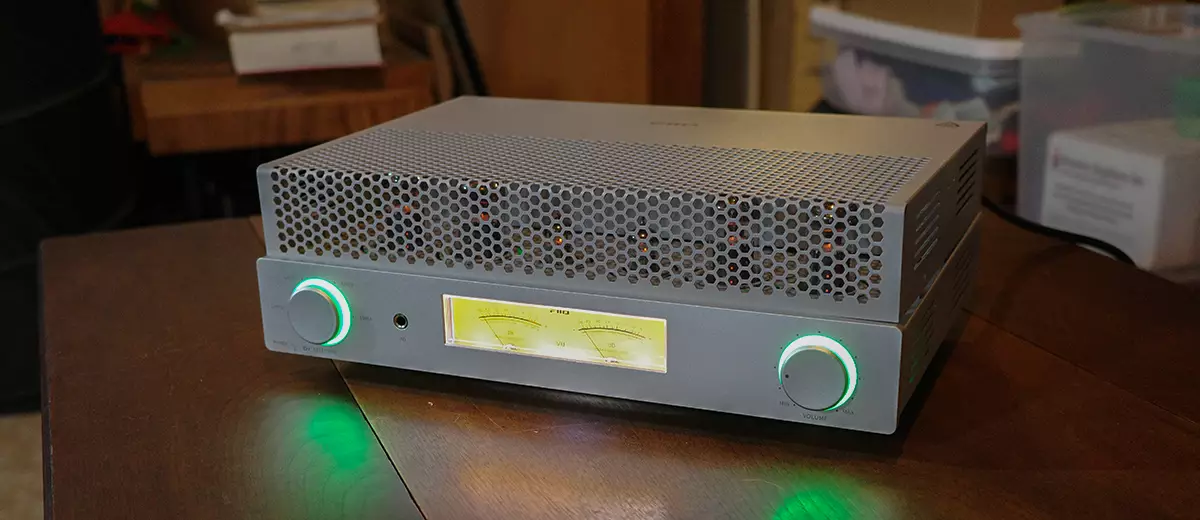
Measuring wider and deeper than many compact desktop units, the FiiO EA13 is built like a tank. Its structural integrity is anchored by a sandblasted, CNC-machined, thickened aluminum front panel engineered to suppress acoustic resonances. Vented side panels assist with passive thermal dissipation, though users should prepare for significant heat output. During rigorous stress testing, the EA13 ran as hot—if not hotter—than modified vintage reference amplifiers like the Bob Latino-tuned Dynaco ST-70.
Front Panel and Controls
The front layout features a balanced symmetry. Six tubes—four JJ Electronic EL34s flanked by the two Sylvania PCF80s—stand proudly across the upper chassis, protected by a safety grille designed to meet strict EU compliance standards.

Two analog VU meters dominate the front aesthetic, serving as fully functional, highly accurate retro indicators rather than mere cosmetic novelties. Rotary controls include a volume wheel and a source selector. While the visual indicators are striking, critics have noted minor ergonomic drawbacks: the continuous rotary source wheel lacks a definitive tactile "click," and the light-blue source indicator LED tends to blend too closely into the default operational green background lighting.
Rear I/O and Connectivity
The rear panel maintains a clean, minimalist layout:

- Four RCA Line-Ins: Tested extensively with an Arcam CD73T CD player, a Nakamichi RX-202 cassette deck, and a Cambridge Audio Alva Duo phono stage paired with a Denon DP-1200 turntable.
- Speaker Terminals: High-quality banana plug receptacles offering isolated taps for ground, 4Ω, and 8Ω loads.
- Headphone Integration: A front-mounted 6.35mm headphone jack driven directly off the main speaker power taps.
Official Responses and Operational Quirks
Operating the EA13 requires a deliberate, methodical startup ritual reminiscent of mid-century hi-fi equipment. Turning on the hidden toggle switch beneath the source selector activates standby mode. A long-press of the source button brings the unit to life, accompanied by a heavy, satisfying acoustic thud from within the chassis.
FiiO’s engineering team designed the unit with a deliberate safety delay: approximately 30 seconds after the initial power-on thud, an internal relay clicks to signal that the tubes have reached stable operating temperatures and the unit is ready to stream music.

While the unit ships double-boxed with robust foam protection, a heavy-duty power cord, a specialized screwdriver for chassis maintenance, and a comprehensive multilingual quick-start guide, the heavy thermal output remains a primary talking point. FiiO stresses that running hot is an inherent physical characteristic of Class-A EL34 tube topologies, advising users to maintain adequate ventilation space around the chassis.
Implications: Sound Signatures and Market Positioning
Critical listening evaluations—conducted over a 70-hour burn-in period using vintage Dynaco A25 loudspeakers—reveal that the FiiO EA13 successfully bridges the gap between classic tube warmth and modern micro-detail retrieval.

Frequency Response Breakdown
- Bass: The JJ Electronic EL34 tubes impart a taut, highly controlled low-end. While lacking the subterranean, chest-thumping sub-bass power of heavy solid-state mono-blocks, the bass remains remarkably agile, avoiding the flabbiness often plaguing low-tier tube gear and refusing to bleed into the critical midrange frequencies.
- Midrange: The standout feature of the EA13. The combination of Sylvania driver tubes and EL34 power valves yields a lush, three-dimensional, holographic presentation. Vocals and acoustic instruments sit slightly forward, projecting a wide soundstage that extends well past the physical boundaries of the desktop speakers.
- Treble: Unlike dark, overly veiled vintage tube amps, the EA13 introduces a delicate, polite sparkle in the upper registers. This subtle high-frequency extension prevents the sound signature from becoming congested, enhancing spatial airiness and micro-detail without ever tipping over into harshness or sibilance.
Competitive Implications in the Audiophile Market
Priced at $769.99, the FiiO EA13 occupies a fascinating niche. It directly challenges budget-conscious solid-state alternatives—such as the SMSL PA-X Gallium Nitride amplifier—as well as hybrid tube/solid-state competitors like the xDuoo TA-32.
For audiophiles seeking hyper-clinical measurements, Bluetooth convenience, or integrated DAC decoders, the EA13 may feel overly austere. However, for vinyl enthusiasts, CD collectors, and purists seeking an authentic, emotive, holographic tube experience without the daunting maintenance hurdles of vintage restorations, the FiiO EA13 proves that FiiO’s excursion into desktop hi-fi is not just a novelty—it is a serious acoustic achievement.