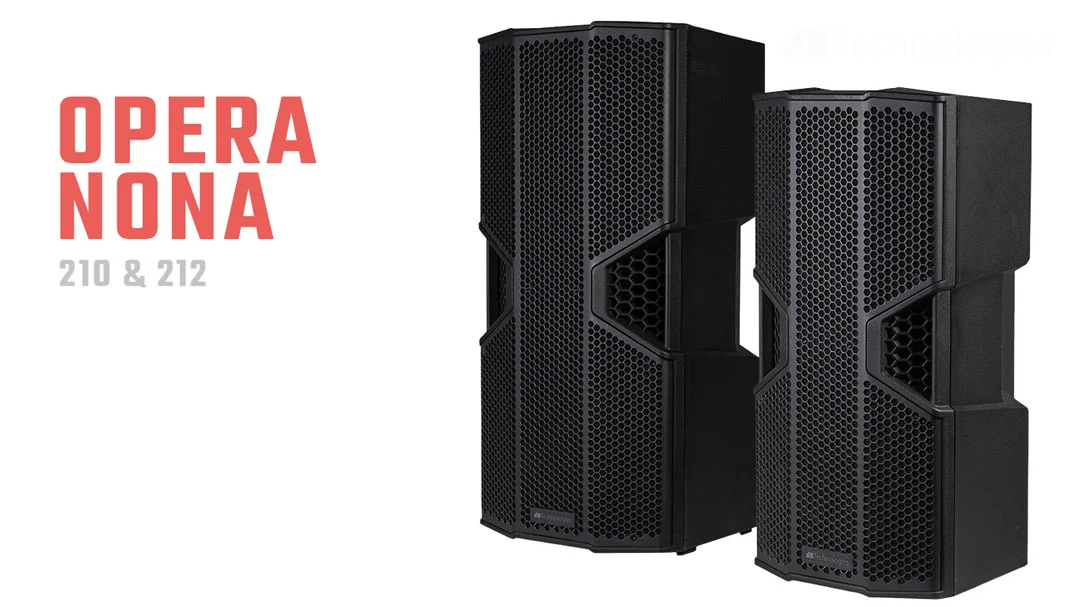
MIAMI BEACH, FL — September 21, 2026 — In a move designed to bridge the gap between high-output professional touring arrays and the agile, portable demands of today’s solo performers and mobile DJs, dBTechnologies has officially announced the launch of the Opera Nona Series. Representing the latest evolution in the company’s storied "Opera" family, the new Nona line introduces a sophisticated, quasi-three-way acoustic design that promises to redefine expectations for self-contained, portable sound reinforcement.
Designed and manufactured in Italy specifically for the rigorous demands of the U.S. market, the series debuts with two primary models: the Opera Nona 210 and the Opera Nona 212. By integrating advanced coaxial mid-high frequency technology with dual-woofer configurations, dBTechnologies is positioning these cabinets as a versatile "middle ground" for users who require more sonic substance than traditional two-way systems, but demand greater portability than large-format line arrays.
The Genesis of the Opera Nona: A New Acoustic Philosophy
The introduction of the Opera Nona series marks a strategic pivot for dBTechnologies. For years, the Opera range has served as a industry standard for reliability. However, as the landscape for live performance has shifted—favoring smaller footprints, faster load-ins, and "mixer-less" setups—the engineering team at dBTechnologies identified a need for a cabinet that could handle the complexity of a quasi-three-way system without the bulk of a traditional mid-high horn stack.
The Nona series utilizes a proprietary coaxial mid-high section coupled with two low-frequency drivers. This arrangement creates a highly coherent sound field that maintains its integrity even at high output levels. By crossing over at 1,900 Hz, the Nona series achieves a 90-degree by 60-degree coverage pattern, ensuring that whether the speaker is used as a front-of-house main or a low-profile floor monitor, the dispersion remains uniform and predictable.
Technical Specifications: Power and Precision
At the heart of the Opera Nona series lies a robust Class-D amplification architecture. The cabinets deliver a formidable 1,000 W RMS (2,000 W peak), distributed via a dual-amplifier layout that sends 500 W RMS to the low-frequency section and 500 W RMS to the coaxial mid-high driver. This balanced power delivery ensures that neither frequency band is starved during high-SPL performances.
Performance Data by Model:
-
Opera Nona 210:
- Drivers: Dual 10-inch woofers with 2.5-inch voice coils.
- Max SPL: 131.5 dB.
- Frequency Response: 55 Hz to 20 kHz (-10 dB) / 60 Hz to 20 kHz (-6 dB).
- Weight: 42.3 lbs.
-
Opera Nona 212:
- Drivers: Dual 12-inch woofers with 2.5-inch voice coils.
- Max SPL: 132.5 dB.
- Frequency Response: 48 Hz to 20 kHz (-10 dB) / 52 Hz to 20 kHz (-6 dB).
- Weight: 49.6 lbs.
Both models incorporate advanced linear-phase FIR (Finite Impulse Response) processing operating at 24-bit/48 kHz, a feature that was once the exclusive domain of high-end touring line arrays. This ensures that the time alignment between the woofer and the coaxial driver remains perfectly phase-coherent, resulting in a "tight" low end and crystal-clear transient response.
User-Centric Connectivity: The "No-Mixer" Workflow
One of the most significant implications of the Opera Nona series is its appeal to the "single-source" performer. In the modern gigging environment, where DJs and acoustic musicians often find themselves in tight spaces with limited setup time, the ability to bypass an external mixing console is invaluable.
The Nona series features a comprehensive onboard I/O panel. Two balanced combo XLR/TRS inputs are provided with independent level controls. Channel 1 is optimized for microphone or line-level signals, while Channel 2 is versatile enough to handle line signals or high-impedance (Hi-Z) instruments, such as an acoustic guitar with a passive pickup. A dedicated balanced XLR output allows for either a direct link of Channel 1 or a mix of both channels, enabling a performer to daisy-chain a second speaker without the need for additional outboard hardware.
DSP Control: Instant Adaptability
Recognizing that users in the field rarely have time to navigate complex sub-menus, dBTechnologies has implemented an intuitive eight-position rotary DSP controller on the rear panel. This control provides instant access to seven specialized application presets:
- Club: Optimized for high-energy playback and dance music.
- Vocal: Enhances clarity and presence for speech or singing.
- Bass Reduction: Ideal for situations where the speaker is placed against a wall or in a corner.
- Playback: A flat, full-range response for music reproduction.
- Bass Boost: Increases low-end impact for smaller setups without subwoofers.
- Wedge Vocal: A specific EQ curve for monitor use.
- Wedge Playback: A balanced monitor curve for full-range instrument monitoring.
Safety is managed by an intelligent suite of limiters, including Peak, RMS, and thermal protection. These systems continuously monitor the health of the drivers, adjusting the gain in real-time to prevent damage during high-intensity usage, ensuring that the Opera Nona remains a reliable investment for rental houses and working musicians alike.
Implications for the Rental and Installation Market
The release of the Nona series arrives at a pivotal time for the U.S. pro audio market. As the demand for high-output, compact loudspeakers continues to grow among corporate AV firms, wedding planners, and small-to-mid-sized venues, the Nona series provides a "workhorse" solution.
Compared to the existing Opera Reevo 210 and 212—which are designed specifically for wide-dispersion, high-output, fixed installation environments—the Nona series offers a more focused, direct-source sound. This makes it an ideal complement for rental inventories. A production company can deploy the Reevo series for broad coverage in a conference room, while utilizing the Nona series for localized sound reinforcement or as high-performance stage monitors for keynote speakers and performers.
Chronology of the Launch
- Early 2026: Engineering phase concludes in Italy; prototypes undergo field testing in diverse environments, ranging from small-club live music to corporate event spaces.
- Late Summer 2026: Final manufacturing protocols are set, with a focus on the specific power requirements of the U.S. voltage grid.
- September 21, 2026: Official press announcement and product unveiling in Miami Beach, FL.
- September 29, 2026: The Opera Nona 210 and 212 are scheduled to begin shipping to U.S. retailers and authorized dealers.
Official Perspective and Future Outlook
While dBTechnologies has not yet released individual pricing tiers, industry analysts suggest that the Nona series is positioned to be highly competitive against other premium Italian and German-manufactured active loudspeakers. By maintaining manufacturing in Italy, dBTechnologies continues to emphasize a standard of build quality that resonates with professional audio engineers who prioritize long-term durability over "disposable" consumer-grade plastic cabinets.
As the industry moves toward more integrated digital ecosystems, the Nona series serves as a testament to the fact that high-quality, analog-inspired connectivity remains a priority for the end-user. By simplifying the input path and providing a robust, quasi-three-way acoustic engine, the Opera Nona series is set to become a permanent fixture on stages across the United States.
For those interested in integrating the new series into their existing inventory, dBTechnologies has confirmed that local demonstrations will be available through authorized U.S. partners beginning in early October 2026. As the product hits the market, the professional audio community will undoubtedly be watching to see how the Nona’s unique coaxial configuration stands up to the rigors of the road.
With the Opera Nona, dBTechnologies has not simply added another speaker to its catalog; they have refined a category, ensuring that the "Opera" name continues to represent the pinnacle of portable, high-performance sound.