In the high-stakes world of semiconductor design, the pace of innovation is relentless. For those who have spent decades in the trenches of Electronic Design Automation (EDA), the current shift toward "Agentic AI" feels less like an incremental update and more like a tectonic shift in the industry’s bedrock. The era of manual gate-level design is long gone, replaced by sophisticated software environments, but we are now entering a new frontier where AI is no longer just a tool—it is becoming a colleague.
The Chronology of EDA: From Pencil to Paradigm Shift
To understand the magnitude of the current AI revolution, one must first appreciate the journey the industry has taken. The history of EDA is a narrative of increasing abstraction.
The Era of "Big Iron" (1980s)
In the early 1980s, the concept of "buying software" was almost alien. If you were a hardware designer, you bought a workstation—a complete, proprietary ecosystem of hardware and software. This was the era of the "DMV" trio: Daisy Systems, Mentor Graphics, and Valid Logic Systems. These companies provided vertically integrated platforms where the hardware, the operating system, and the CAD tools were inseparable. It was a time of proprietary lock-in, where the design methodology was dictated by the machine on your desk.
The Software Revolution (1990s)
The late 1980s and early 1990s marked a pivotal pivot point. The emergence of standardized engineering workstations from vendors like Sun, HP, and Apollo rendered proprietary hardware a business liability. Cadence Design Systems, formed in 1988 through the merger of ECAD and SDA Systems, capitalized on this shift by focusing purely on software. By the time Cadence acquired Valid in 1991, the industry had fundamentally changed: EDA was no longer about selling workstations; it was about selling the intelligence embedded within the code.
The Rise of Modern Synthesis
As the 90s progressed, companies like Synopsys emerged as leaders in logic synthesis, allowing designers to describe hardware at a higher level of abstraction (RTL) and letting software handle the grueling task of turning that logic into physical gates. This shift—initially met with skepticism by "real engineers"—eventually became the industry standard, enabling the massive, complex chips that power our modern digital life.

Introducing Agentic AI Super-Agents
We now find ourselves at the next evolutionary milestone. In a recent discussion with Rob Knoth, Senior Solution Marketing Group Director at Cadence, the conversation centered on the latest "Agentic AI Super-Agents."
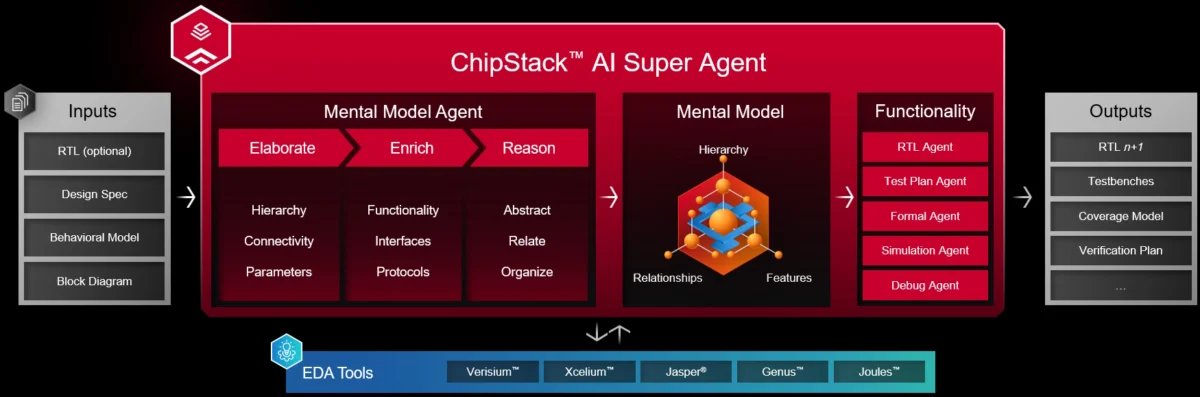
Unlike the early "old school" AI—which utilized machine learning and reinforcement learning for specific optimization tasks like timing closure or power reduction—these new super-agents represent a shift toward orchestration. The flagship of this movement is ChipStack, a super-agent designed to navigate the complexities of digital design and verification. However, ChipStack is merely the tip of the spear. Cadence has architected a family of stacks, including ViraStack for custom analog design, InnoStack for digital implementation, and SystemStack for advanced system-level packaging.
The Architecture of Intelligence: Why "Agentic" Matters
The genius of the agentic approach lies in its pragmatism. As Knoth emphasized, the industry is not trying to force a Large Language Model (LLM) to "hallucinate" a chip design from a prompt. That would be catastrophic in an industry where a single bug can cost millions in fabrication.
Instead, Cadence has adopted a strategy of Tool Orchestration.
The "Dishwasher" Analogy
Knoth uses a compelling analogy to explain the role of these agents: when we eventually see humanoid robots in our homes, we won’t expect them to wash dishes by hand. We will expect them to use the dishwasher. Similarly, an AI agent shouldn’t try to reinvent SPICE simulation or formal verification; it should be trained to operate the existing, proven tools that embody decades of physical and electrical engineering expertise.

The AI agents interact with the tools via standardized interfaces—such as the Model Context Protocol (MCP)—allowing them to:
- Analyze the design requirements.
- Invoke the appropriate engine (e.g., Spectre for simulation, Jasper for formal verification).
- Interpret the results and iterate.
- Decide on the next course of action without human intervention for routine tasks.
Implications: The Engineer as an Architect of Systems
The fear that AI will render engineers obsolete is a recurring theme in the history of technology. We heard it when compilers replaced assembly, and we heard it when synthesis replaced manual gate placement. Yet, the reality has always been the same: technology does not replace the engineer; it expands their sphere of influence.
The "Bigger Hammer" Philosophy
The immediate benefit of Agentic AI is the ability to scale output. If an engineer previously had the capacity to run 100 SPICE simulations, an agentic-assisted workflow allows them to run 1,000. This is not just about raw volume; it is about the quality of the exploration. By automating the "plumbing" of the design process, engineers can spend more time exploring creative architectural alternatives rather than debugging tool configurations or manual constraints.
The Future of Autonomy
The conversation with Cadence highlights a roadmap that extends far beyond today’s capabilities. Currently, these super-agents act as coordinators—highly efficient project managers that supervise workflows. However, the future trajectory points toward:
- Self-Improving Agents: Systems that learn from their own successes and failures in previous design cycles.
- Persistent Memory: Agents that maintain a long-term "understanding" of a company’s design DNA and proprietary methodologies.
- Dynamic Capability Creation: The potential for super-agents to synthesize new sub-agents on the fly when they encounter novel engineering problems.
Conclusion: Teaching AI the Art of EDA
The most profound realization from the current state of EDA is that the industry is not attempting to replace forty years of engineering science with AI. It is doing something far more sophisticated: it is teaching AI how to wield forty years of engineering science.

For the veteran designer, this is a moment of reflection. We have moved from the tactile, pencil-and-paper era to a world where we act as conductors of an AI-orchestrated symphony of tools. The "wow" factor isn’t just that the tools are smarter; it’s that they are finally beginning to speak the language of the designer, understanding intent rather than just executing commands.
As these agentic systems proliferate, the definition of an "engineer" will inevitably evolve again. The engineers of tomorrow will be less concerned with the minutiae of command-line switches and more focused on the high-level strategy, ethics, and architectural integrity of their designs. If the past is any indicator, we won’t be working less; we will simply be working on problems that today seem impossible. And perhaps, that is the most exciting "wow" of all.