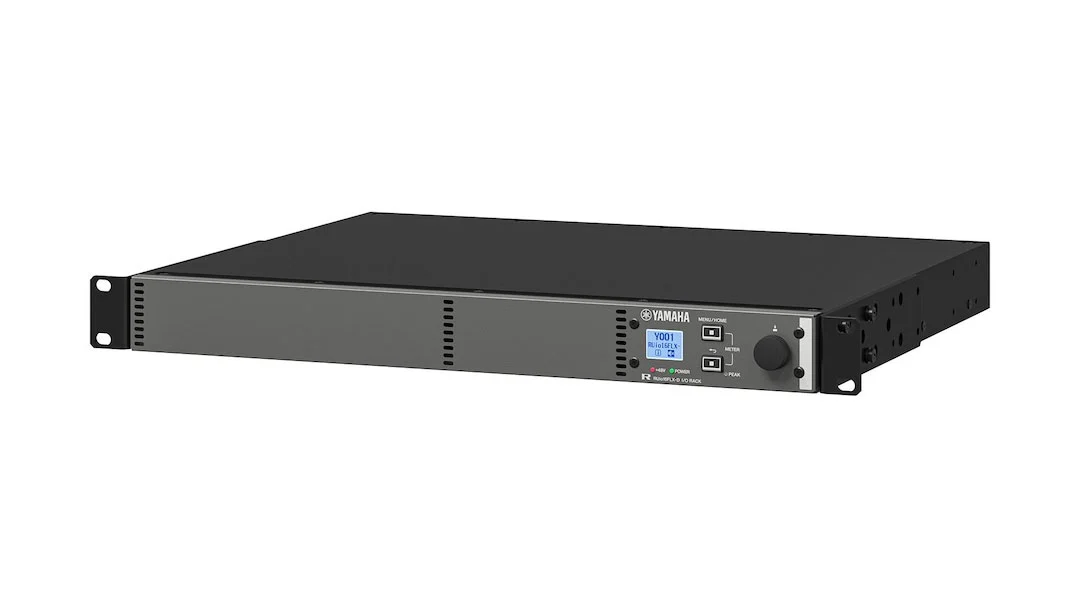
BUENA PARK, CA — September 18, 2026 — In a strategic move to address the growing complexity of modern networked audio, Yamaha has unveiled the RUio16FLX-D, a highly flexible 16-channel rack-mount I/O solution. Designed to bridge the gap between traditional analog hardware and high-performance digital networks, this new interface promises to streamline connectivity for commercial installations, corporate AV environments, and live sound production.
As the industry shifts toward more decentralized audio architectures, the demand for adaptable, high-density I/O has reached an all-time high. With the RUio16FLX-D, Yamaha is positioning itself to provide a "Swiss Army knife" solution for system integrators who require both reliability and modularity in a compact 1RU form factor.
Main Facts: Architecture and Specifications
The RUio16FLX-D is engineered as a core component for Dante-enabled networks, providing 16 channels of I/O within a single rack-space unit. Its defining characteristic is its remarkable physical flexibility, which sets it apart from traditional fixed-configuration interface boxes.
The Power of Phoenix Connectivity
The unit centers its design around professional-grade Phoenix connectors. Unlike standard XLR or TRS inputs, these connectors allow for a significantly smaller footprint, enabling the dense 16-channel configuration to fit into a 1RU chassis. More importantly, the RUio16FLX-D utilizes a unique per-pair channel configuration. Each two-channel block can be independently designated by the user as:
- Analog Input: Ideal for microphone preamplification or line-level source capture.
- Analog Output: Designed for routing signals to amplifiers, powered speakers, or zone controllers.
- AES/EBU Output: Providing digital connectivity for high-end speakers and downstream processing equipment.
Digital Integration and Control
Beyond its physical I/O, the unit features full Dante integration, allowing it to act as a seamless bridge into Yamaha’s broader digital audio ecosystem. The device is fronted by an intuitive LCD display that provides real-time feedback on channel assignment, network status, and signal levels. This local monitoring capability is a significant boon for technicians working in cramped server rooms or backstage racks where remote monitoring software might not be immediately accessible.
Chronology: The Road to the RUio16FLX-D
The development of the RUio16FLX-D is not an isolated event but rather the latest iteration of Yamaha’s long-term strategy to dominate the networked audio space.
Early 2024: Yamaha began soliciting feedback from top-tier system integrators regarding the "missing links" in large-scale commercial installations. The primary complaint centered on the lack of versatile I/O that could adapt to changing room requirements without requiring hardware swaps.
Late 2025: Prototypes of the RUio16FLX-D were tested in selected flagship installations, including high-end conference centers and regional performance venues. Engineers praised the unit’s "configuration-on-the-fly" capability, which allowed them to repurpose a single rack of gear from an input-heavy microphone setup to an output-heavy zone distribution system in minutes.
Q2 2026: Yamaha finalized the software integration for the unit, ensuring it would work natively with the new DME5 and DME3 Digital Signal Processors. This cross-compatibility ensures that the RUio16FLX-D is not merely an endpoint, but a foundational building block for the next generation of Yamaha signal processing.
September 18, 2026: The official public launch, marking the product’s entry into the global commercial AV market.
Supporting Data: Why Flexibility Matters
In the current pro audio landscape, hardware obsolescence is a major pain point. A facility might be built for a corporate town hall (requiring many inputs) but later repurposed for a multi-zone background music system (requiring many outputs).
Reducing SKU Complexity
For distributors and integrators, the RUio16FLX-D simplifies inventory management. Rather than stocking dedicated analog input boxes, analog output boxes, and digital interface boxes, a single SKU now covers three distinct roles.
Synergy with DME5/DME3 Processors
The true potential of the RUio16FLX-D is unlocked when paired with Yamaha’s new DME5 and DME3 processors. In a typical installation, these processors manage the logic and routing of audio signals. When a project demands additional I/O capacity that exceeds the physical ports on the processor, the RUio16FLX-D provides an immediate, plug-and-play expansion. By utilizing Dante, the connection is established over standard Cat6 cabling, drastically reducing labor costs and the weight of copper-heavy cabling looms.
Official Perspectives: The Engineering Philosophy
"We recognized that the modern installation is a living entity," says a spokesperson from Yamaha’s Pro Audio division. "What a client needs today is rarely what they will need three years from now. With the RUio16FLX-D, we wanted to deliver a product that grows with the system. By allowing every channel pair to be redefined, we have essentially turned a piece of hardware into a software-defined asset."
Industry analysts have noted that this move aligns with the "Software-Defined Hardware" trend seen in broadcast and IT. By decoupling the function of the port from its physical design, Yamaha is essentially giving end-users a way to "re-task" their infrastructure without breaking ground or pulling new cables.
Implications for the Industry
The introduction of the RUio16FLX-D has several far-reaching implications for the pro audio sector.
1. The Death of the "Fixed-Function" Interface
As more manufacturers follow the path of programmable I/O, the era of fixed-function interface boxes may be coming to a close. This will force competitors to innovate, potentially leading to more advanced I/O solutions that can perform even more complex conversions (e.g., ADAT or MADI) alongside analog and AES.
2. Streamlining Corporate and Live Sound
In the live sound world, rack space is at a premium. The ability to carry a single spare unit that can fill in as either an input or output stage is a significant logistics advantage for touring production companies. In the corporate world, it simplifies the "Day 2" support model, where a technician can reconfigure a room’s signal flow via the LCD interface rather than needing to replace modules.
3. Strengthening the Dante Ecosystem
By deepening its commitment to Dante, Yamaha is further anchoring the industry to Audinate’s standard. This creates a more unified ecosystem where third-party Dante-enabled products, Yamaha processing, and the RUio16FLX-D can coexist, lowering the barrier to entry for complex, multi-vendor system designs.
Conclusion: A Forward-Looking Solution
The Yamaha RUio16FLX-D represents a shift in how manufacturers view peripheral audio gear. It is no longer just about moving signals from A to B; it is about providing an adaptable architecture that serves as a bridge between the physical and digital worlds.
As system integrators face the challenges of the late 2020s—including tighter budgets, shorter installation timelines, and the need for greater system flexibility—the RUio16FLX-D stands out as a vital tool. Whether it is deployed in a high-tech corporate headquarters, a house of worship, or a professional theater, its combination of Dante connectivity, Phoenix-based flexibility, and robust Yamaha engineering makes it a significant addition to the market.
For those currently planning infrastructure upgrades or looking to refresh their audio signal chain, the RUio16FLX-D provides the necessary modularity to ensure that today’s investment remains relevant well into the future. As the industry moves toward more intelligent, network-centric audio, Yamaha has provided the hardware foundation to make that vision a reality.