By: TONE Staff
Published: March 2026
Category: Hardware Reviews / Digital Audio
Main Facts
The audio landscape has shifted dramatically over the past decade. While high-end audiophile equipment routinely commands five- or six-figure price tags, a parallel revolution is happening at the bottom of the financial spectrum. Enter the SMSL PL100PRO, a compact, feature-rich compact disc player retailing for a modest $159 (up slightly from its pre-tariff price of $99). In an era where a single tank of gas for a full-size SUV or a few weeks of daily lattes can easily eclipse that amount, the PL100PRO offers a shocking level of performance and connectivity that challenges historical notions of what "budget audio" can achieve.
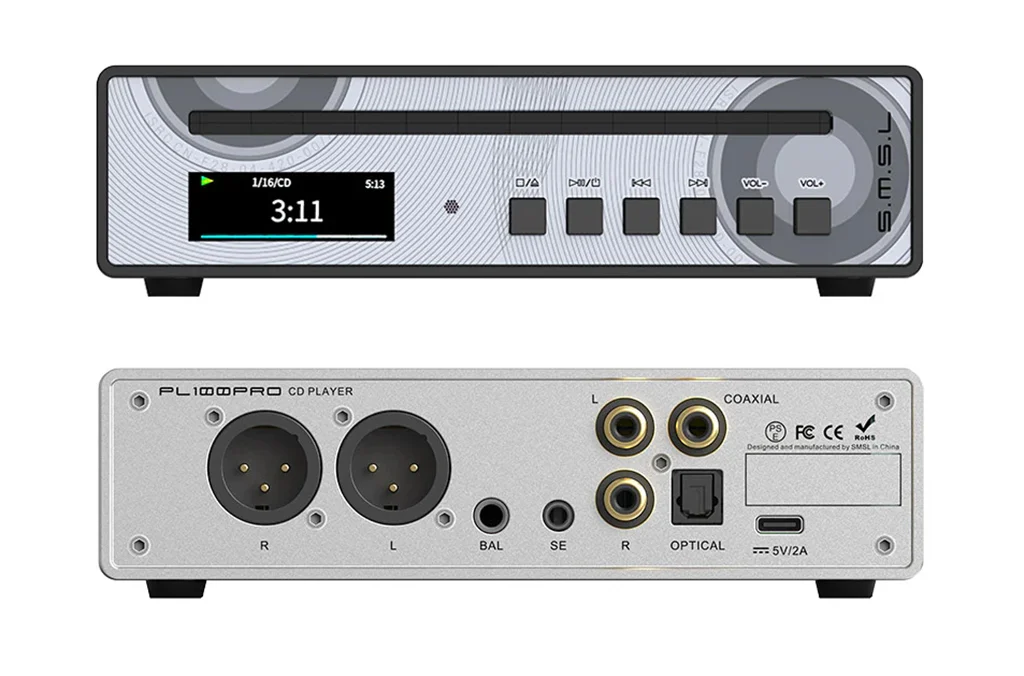
Despite its diminutive footprint and pocket-friendly price, the PL100PRO does not skimp on hardware features. Most notably, it includes both RCA (unbalanced) and XLR (balanced) analog outputs, a rarity in components hovering near the $150 mark. Furthermore, it features optical and coaxial S/PDIF digital outputs, transforming the unit from a standalone player into a high-value digital transport.
Powered via a modern 5V USB-C input, the PL100PRO adapts seamlessly to contemporary power delivery solutions. Whether deployed as a traditional standalone CD player in a vintage rig or paired with an external digital-to-analog converter (DAC) in a dedicated listening space, this tiny machine punches well above its weight class, earning a definitive TONEPublications Exceptional Value Award.
Chronology
To understand how the SMSL PL100PRO fits into the modern audio ecosystem, it is helpful to trace its evolution and the context of its testing:
- Pre-Tariff Era ($99 Baseline): Initially introduced to the market at a sub-$100 price point, the chassis and mechanical assembly captured early attention from budget-conscious audio enthusiasts and desktop system builders looking for physical media playback options.
- Price Adjustment ($159 Retail): Due to shifting trade policies and international tariffs, the retail price settled at $159. Even with this increase, reviewers noted it remained extraordinarily cost-effective.
- Unboxing and Initial Benchmarking: Upon arrival at the testing facilities, the unit was evaluated for build quality. The slot-loading mechanism demonstrated a surprisingly robust tactile feel, dispelling fears of flimsy, unreliable transport mechanisms common in ultra-cheap gear.
- Direct Connectivity Trials: Testers connected the unit directly via standard RCA and 20-foot balanced XLR interconnects to evaluate line-stage driving capabilities. The internal output stages proved more than capable of handling long cable runs without signal degradation.
- Transport and DAC Integration: The review process shifted out of the primary listening room into a garage-based secondary system. Here, the PL100PRO was configured strictly as a transport, feeding an optical signal into a FiiO K17 DAC powered by a basic Apple MacBook USB-C charger.
- Power Supply Experimentation: To gauge the ceiling of the unit’s performance, testers swapped the basic power brick for an audiophile-grade linear power supply from Wyred 4 Sound, noting incremental improvements in low-frequency grip and high-frequency air.
Supporting Data and Technical Specifications
When evaluating hardware at this price point, data analysis helps separate marketing hyperbole from acoustic reality. Below is an overview of the technical parameters and performance observations recorded during evaluation:
| Feature / Parameter | Specification / Observation |
|---|---|
| Retail Price | $159 USD (Up from $99 pre-tariff) |
| Media Compatibility | Standard Audio CDs (CD-DA) via Slot-Loading Mechanism |
| Analog Outputs | Unbalanced RCA, Balanced XLR |
| Digital Outputs | Optical S/PDIF, Coaxial S/PDIF (Transport Mode) |
| Power Input | 5V DC via USB-C |
| Included Accessories | Varies post-tariff (Review sample required independent power brick) |
| Upgradability | Highly responsive to external linear power supplies and external DAC pairing |
Sonic Impressions: Standalone vs. Transport Mode
When evaluated strictly as an all-in-one player using its internal DAC and analog stages, the PL100PRO delivers a remarkably musical, cohesive presentation. It lacks the microscopic layering, holographic soundstage depth, and absolute harmonic refinement found in five-figure digital flagships. However, context is everything.
Placed side-by-side with historical benchmarks—such as the legendary $1,000 Sony CDP-100 from 1983—the PL100PRO is nothing short of a technological marvel. It eclipses vintage digital architecture in signal-to-noise ratio, jitter suppression, and distortion metrics, offering a fatigue-free listen that flatters vintage receivers and modern budget integrated amplifiers alike.
Where the unit truly shines, however, is when its internal DAC is bypassed entirely. Utilizing the optical or coaxial outputs to drive an outboard digital-to-analog converter elevates the performance tier significantly. Running the digital stream into a FiiO K17 DAC yields an expansive, well-balanced sonic signature that rivals dedicated transports costing twice as much.
Official Responses and Industry Context
The release and subsequent reception of the SMSL PL100PRO reflect a broader industry trend: the resurgence of physical media among younger demographics paired with the democratization of high-resolution micro-electronics.
Manufacturers like SMSL (S.M.S.L. – Foshan ShuangMuSanLin Electronics Co., Ltd.) have built their reputations on delivering desktop-sized, high-performance headphone amplifiers, DACs, and small-form-factor amplifiers. The introduction of a dedicated, balanced-output CD player at this price tier represents a direct response to consumer demand for modular, space-saving desktop and secondary-room hi-fi systems.
While major mainstream audio publications often focus on flagship loudspeakers and multi-thousand-dollar monoblocks, niche manufacturers have recognized that the entry-level enthusiast market requires equal attention to detail. Industry commentary surrounding the PL100PRO has generally praised SMSL for avoiding the plastic-heavy, disposable build quality that plagued portable CD players of the late 1990s and 2000s.
Although online video reviewers have occasionally leaned toward hyperbolic praise—proclaiming ultra-budget gear as "giant-killers" that rival reference-grade systems—pragmatic critics emphasize that while the PL100PRO is exceptionally good for the money, its true triumph lies in making physical media accessible to a new generation without requiring financial strain.
Implications for Audiophiles and the Budget Market
The success and performance profile of the SMSL PL100PRO carry several important implications for the future of budget-conscious audiophile audio systems:
1. The Normalization of Balanced Outputs in Entry-Level Gear
Historically, balanced XLR connections were strictly reserved for professional studio gear and high-end consumer components. The inclusion of true balanced outputs on a $159 CD player removes integration barriers, allowing users to run long cable runs to active monitors or balanced preamplifiers without picking up electromagnetic interference (EMI) or ground loop hum.
2. The Power Supply Dilemma: Diminishing Returns
Testing revealed that while the PL100PRO runs happily off a generic USB-C phone charger or laptop brick, upgrading to a high-end linear power supply (such as the Wyred 4 Sound unit) unlocked better bass control and a smoother top-end extension.
- The Catch: Linear power supplies often cost significantly more than the CD player itself. This introduces an interesting philosophical debate within the budget audio community: At what point does upgrading ancillary components defeat the purpose of an ultra-budget piece of hardware? For most users, sticking with a clean, high-quality USB wall wart or power bank strikes the ideal balance between cost and performance.
3. Redundancy as a Strategy
Given the mechanical nature of optical disc drives—which feature moving lasers, motors, and mechanical gears—longevity is always a valid concern for modern CD transport buyers. One of the more pragmatic recommendations emerging from long-term testing is simple: At $159, if you love the sonic footprint and build quality, consider purchasing a second unit to keep sealed in its box on a shelf. In an era where component repair costs often exceed replacement value, having a backup unit guarantees long-term enjoyment of physical media collections without fear of sudden obsolescence.
4. The Resurgence of Silver Discs
Streaming services offer unmatched convenience, but network dropouts, platform subscription fees, and disappearing digital catalogs have driven many music lovers back to physical CDs. Products like the PL100PRO lower the barrier to entry, proving that listeners do not need to drop a month’s rent to enjoy the tactile ritual of pulling a disc from a jewel case, dropping it into a slot-loader, and pressing play.
Conclusion
The SMSL PL100PRO proves that compromise does not have to mean disappointment. By focusing on critical functional elements—robust slot-loading mechanics, versatile output options (including XLR and digital S/PDIF), and flexible USB-C power delivery—SMSL has crafted a digital source component that far exceeds its modest price tag.
Whether it serves as the heart of a garage-bound secondary setup, feeds an outboard DAC as a dedicated transport, or brings a vintage system into the modern era, the PL100PRO delivers performance that warrants serious attention. It is a worthy recipient of TONEPublications’ Exceptional Value Award, reminding us that great sound remains within reach for every budget.