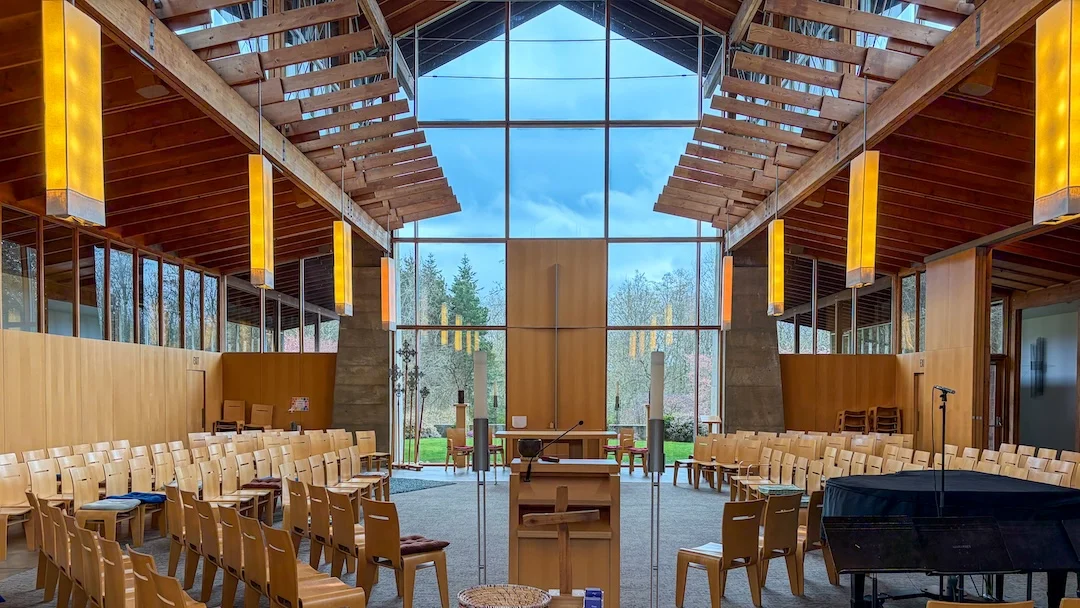
SEATTLE, WA – In the heart of the Pacific Northwest, where architectural innovation often meets the natural landscape, Grace Church has long stood as a testament to aesthetic beauty. However, for years, the very design elements that made the sanctuary a visual marvel—soaring glass walls, extensive wood framing, and a central liturgical aisle—created an acoustic environment that was as challenging as it was beautiful.
In a landmark renovation completed in July 2026, the church successfully bridged the gap between form and function. By partnering with integration firm Viation and premium loudspeaker manufacturer 1 Sound, Grace Church has implemented a cutting-edge, distributed audio system that provides crystal-clear intelligibility while remaining virtually invisible to the naked eye.
Main Facts: The Intersection of Architecture and Acoustics
The recent upgrade at Grace Church represents a shift in House of Worship (HoW) audio design, moving away from bulky, intrusive line arrays toward discreet, high-performance distributed systems. The project centered on solving the "intelligibility crisis" common in modern church designs that favor "airy" aesthetics over acoustic dampening.
Key Project Components:
- Integrator: Viation, led by President John Wilson.
- Manufacturer: 1 Sound.
- Primary Hardware: Cannon C8 point source loudspeakers and Cannon C5 loudspeakers for ancillary spaces.
- Amplification: Powersoft Quattrocanali series.
- Design Philosophy: A distributed system approach utilizing custom-matched wood finishes to blend into the church’s structural beams.
- Primary Challenge: Managing high reflectivity from glass and wood while ensuring feedback-free audio for a mobile pastor.
The result is a system that delivers consistent Sound Pressure Levels (SPL) and high Speech Transmission Index (STI) readings throughout the sanctuary, ensuring that every seat in the house—from the front pews to the rear vestibule—receives the same sonic experience.
Chronology: From Acoustic Struggle to Sonic Clarity
The journey toward Grace Church’s new audio identity began years ago, as the limitations of its original sound reinforcement became increasingly apparent. To understand the timeline of this transformation, one must look at the evolution of the church’s needs.
The Legacy of Echoes
Since its inception, Grace Church was designed to bring the "outdoors in." The architecture features massive banks of windows that look out onto the Seattle greenery, supported by a skeleton of heavy wood timber. While this creates a serene environment for worship, it also creates a "whisper gallery" effect. Sound waves from traditional speakers would bounce off the glass and timber, creating a muddy wash of reverberation that made speech difficult to comprehend.
The problem was exacerbated by the church’s liturgical style. The central aisle serves as a "flexible performance area" used for music, weddings, and processions. The pastor frequently moves throughout this space while speaking. Under the old system, this created a constant battle with microphone feedback and uneven coverage.
The Search for a Solution (Early 2026)
By early 2026, the church leadership determined that the audio system was no longer fit for purpose. They sought an integrator capable of delivering a "high-performance but invisible" system. They turned to Viation, a firm known for its surgical approach to AV integration in sensitive architectural spaces.
Design and Customization (Spring 2026)
Upon assessing the site, Viation’s John Wilson realized that a traditional "point-and-shoot" system from the front of the room would fail. The distance required to throw sound to the back of the room would necessitate high volumes, which would only excite the room’s natural reverberation further.
Viation collaborated with 1 Sound to customize the Cannon Series loudspeakers. The decision was made to use custom-matched wood finishes that would mirror the specific grain and stain of the church’s structural beams.
Installation and Tuning (Summer 2026)
The installation took place in early July. Unlike traditional installs that might take weeks of intrusive scaffolding, the distributed nature of the Cannon C8s allowed for a streamlined deployment. Each unit was mounted with a "minimal reveal" along the exterior of the beams, spaced precisely 15 feet apart.
The final phase involved rigorous time-alignment. By delaying the signal to each speaker by milliseconds based on its distance from the primary "source" (the altar or the pastor), Viation was able to create a natural Haas Effect, where the sound appears to come from the person speaking rather than the nearest speaker.
Supporting Data: The Technical Blueprint
The success of the Grace Church installation is rooted in the technical specifications of the 1 Sound Cannon Series and the strategic layout designed by Viation.
The Cannon C8: Small Footprint, Big Sound
The Cannon C8 is a coaxial point source loudspeaker that features an 8-inch driver and a 1-inch compression driver.
- Frequency Response: It provides a surprisingly deep low-end extension (down to 55 Hz), which allowed the church to forego bulky subwoofers.
- Dispersion: The C8 offers a 90-degree conical coverage pattern, which was essential for keeping sound focused on the congregation and away from the glass ceilings.
- Power Density: Despite its compact size (roughly 10 inches square), the C8 can produce high SPL, ensuring it never sounds "strained" during high-energy musical segments.
Distributed System Geometry
Viation opted for a distributed approach rather than a central cluster.
- Spacing: Speakers were placed at 15-foot intervals. This ensures that no congregant is ever more than a few feet away from a primary sound source, significantly reducing the "room sound" (the ratio of direct to reflected sound).
- Amplification Efficiency: The system is powered by Powersoft Quattrocanali amplifiers. These units are known for their high efficiency and advanced DSP (Digital Signal Processing) capabilities, which were utilized to fine-tune the EQ and limiting for each individual zone in the church.
Ancillary Coverage
The upgrade extended beyond the main sanctuary. Cannon C5 loudspeakers—the smaller sibling to the C8—were installed in adjacent gathering spaces. This ensures a seamless sonic transition for parishioners moving between the sanctuary and the narthex or fellowship halls.
Official Responses: Perspectives from the Field
The project has garnered praise from both the technical team and the end-users, highlighting the emotional impact of clear audio in a spiritual setting.
John Wilson, President of Viation, reflected on the "impossible" mandate given by the church:
"They wanted a high-performance sound system that was invisible. In a room with this much glass and wood, you can’t just hang big black boxes. The 1 Sound Cannon C8s were the only solution that provided the fidelity they needed while allowing us to match the wood finish so perfectly that you truly don’t see them unless you’re looking for them."
Wilson also noted the importance of the distributed design in managing the pastor’s movement:
"Because we have speakers spaced every 15 feet and properly time-aligned, the pastor can walk the entire length of the center aisle without any fear of feedback. The coverage is so consistent that the audio level doesn’t drop or spike as he moves."
Parishioner Feedback:
The true metric of success, however, came from the congregation. Wilson shared an anecdote from the first Sunday service following the installation:
"One of the parishioners came up and said it was the first time he’d been able to hear a sermon the entire time he’d been going there for like 10 years. That is why we do what we do."
Implications: The Future of House of Worship Audio
The Grace Church project serves as a case study for several emerging trends in the AV industry, particularly within the House of Worship sector.
1. The Death of the "Black Box"
For decades, churches have had to choose between high-quality sound and architectural integrity. The trend is now firmly shifting toward "architectural audio." Manufacturers like 1 Sound are leading the way by offering custom finishes—ranging from RAL colors to specific wood stains—allowing technology to disappear into the environment.
2. Intelligibility Over Raw Power
In the 1990s and 2000s, many churches sought "concert-level" sound systems characterized by massive subwoofers and line arrays. Today, the focus has returned to the "Word." Intelligibility (the ability to understand spoken word) is the priority. Distributed systems, while sometimes more complex to wire and tune, offer a superior solution for highly reverberant spaces where line arrays would simply create more noise.
3. The Role of Coaxial Technology
The use of coaxial drivers (where the tweeter is mounted in the center of the woofer) is becoming the standard for point-source applications. This design ensures that all frequencies reach the ear at the same time, preventing the "phase smear" that can occur with traditional two-way speakers. This is critical in a space like Grace Church, where every millisecond of clarity counts.
4. Economic and Practical Longevity
By utilizing high-efficiency amplification from Powersoft and durable, high-performance speakers from 1 Sound, Grace Church has invested in a "ten-year-plus" solution. As the parishioner’s comment suggested, the cost of poor audio is measured in a decade of missed messages. The new system ensures that the church’s mission is no longer hindered by its architecture.
Conclusion
Grace Church in Seattle has proven that you do not have to sacrifice beauty for clarity. Through the strategic application of distributed audio, custom-finished hardware, and expert integration, they have turned a "difficult" room into a model of acoustic excellence. In the quiet corners of the sanctuary, the speakers remain hidden, but the message is now heard loud and clear.