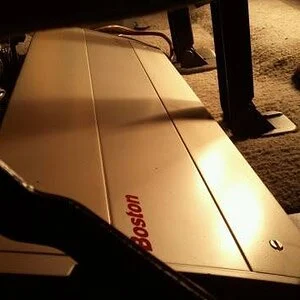
In the ever-evolving world of mobile audio, few components carry the nostalgic weight and raw performance reputation of the mid-2000s "monolith" amplifiers. Recent market discussions have resurfaced interest in the Clarion DPX11500, a powerhouse unit originally debuted in 2006. As enthusiasts continue to hunt for high-current amplification capable of driving demanding subwoofer configurations, the question remains: does a nearly two-decade-old flagship amplifier still hold its own against modern Class-D efficiency, or is it a relic better left in the past?
The Core Facts: A Heavyweight Contender
The Clarion DPX11500 is not a subtle piece of hardware. Measuring an imposing 21 1/4" by 12" by 2 7/8", it was engineered during an era when physical mass and heat sink surface area were the primary indicators of power stability.
Technical Specifications:
- RMS Power Output: 800W x 1 into 4 Ohms; 1500W x 1 into 1 or 2 Ohms.
- Frequency Response: 20Hz – 20kHz.
- Crossover: Adjustable -12dB/Octave Low Pass (50-250Hz).
- Subsonic Filter: Adjustable (10-80Hz).
- Bass Boost: Variable 0-15dB (30-125Hz).
- Build Quality: Gold-plated RCA, speaker, and power terminals with robust input voltage selection.
The unit’s ability to output 1500 watts at both 1 and 2 ohms marks it as a highly versatile monoblock, capable of handling varying impedance loads without the significant power drop-off common in budget-tier amplifiers of the same period.
Chronology: From Showroom Floor to Secondary Market
The Clarion DPX11500 was introduced to the North American market in 2006 as a pinnacle product for the brand’s performance audio lineup. At the time of its release, it carried a manufacturer’s suggested retail price (MSRP) of approximately $700.
For the better part of a decade, the DPX series was favored by enthusiasts who demanded "cheater" power—amplifiers that could reliably output their rated wattage while maintaining a clean signal profile. However, as the industry shifted toward smaller, ultra-efficient Class-D digital platforms, the bulky, power-hungry analog-heavy designs of the mid-2000s began to vanish from retail shelves.
Today, the DPX11500 occupies a unique space in the secondary market. Often found in local audio shops or private sales—occasionally priced between $300 and $400—it attracts "old school" enthusiasts who prefer the reliability of traditional circuitry over the potentially temperamental nature of modern micro-amplifiers. The recent discovery of "new-old-stock" units in local shops has reignited debates regarding whether this vintage hardware is a bargain or a logistical headache.
Supporting Data: Infrastructure and Installation
Integrating a unit like the DPX11500 into a contemporary vehicle requires more than just a mounting surface; it demands a significant upgrade to the vehicle’s electrical infrastructure.
Power Requirements
The DPX11500 is designed to accept large-gauge power cabling—specifically 0 or 2 gauge wire. This is not a suggestion; it is a necessity. Because the amplifier was designed before the widespread adoption of high-efficiency switching power supplies in the consumer car audio sector, it draws a significant amount of current. Failure to provide a high-amperage electrical path will result in voltage drops, leading to clipping, thermal protection engagement, or permanent damage to the amplifier’s internal capacitors.
The Subwoofer Pairing Dilemma
The current discourse involves pairing this unit with dual Alpine Type-R subwoofers. The Type-R line is renowned for its high power handling and excursion capabilities. To effectively drive two such subwoofers, the DPX11500’s 1500W output at 1 or 2 ohms provides an excellent match, provided the box tuning is optimized.
Experts generally recommend a tuned enclosure frequency of 32Hz for these subwoofers to capture the low-end "roll-off" associated with modern bass-heavy music genres. Tuning at 32Hz allows the subwoofers to operate efficiently within their mechanical limits, preventing the "unloading" that can occur at lower frequencies.
Official Perspectives and Industry Implications
While Clarion’s official support for the DPX11500 has effectively sunsetted, the brand’s design philosophy during the 2006 era remains a benchmark for durability. Industry technicians note that while modern amplifiers are smaller, they often lack the robust voltage-regulation circuitry that was standard in the DPX series.
The "New vs. Old" Debate
- Efficiency: Modern Class-D amps are roughly 80-90% efficient. The DPX11500, while powerful, generates more heat and places a higher strain on the vehicle’s alternator.
- Footprint: The DPX11500 requires a dedicated mounting space. Modern "mini-amps" can be hidden under seats or in dash cavities.
- Signal Integrity: Purists argue that the analog-based signal processing of the 2006-era Clarion units provides a "warmer" sound profile compared to the sometimes clinical, analytical output of contemporary digital units.
Implications for the Modern Audio Enthusiast
Choosing to invest in a vintage amplifier like the Clarion DPX11500 is a commitment to a specific type of car audio experience. It is a decision that prioritizes raw, stable output over space-saving convenience.
Key Considerations for Potential Buyers:
- Capacitor Health: Any amplifier from 2006 likely contains electrolytic capacitors that may be nearing the end of their service life. Before installation, a bench test by a qualified technician is highly recommended to check for ripple and signal distortion.
- Weight and Stability: Given the weight of the DPX11500, a reinforced mounting board is essential. Vibrations in a car environment can cause heavy, older components to loosen over time.
- System Synergy: With a 1500W output, the amplifier will easily overpower a stock electrical system. A "Big Three" electrical upgrade—upgrading the alternator-to-battery, engine-to-chassis, and chassis-to-battery cables—is mandatory for any vehicle attempting to run this unit at full capacity.
Final Assessment: Is the Deal Worth It?
For $300 to $400, the Clarion DPX11500 represents a significant amount of power per dollar, provided the user is willing to accommodate its physical and electrical demands. It is a piece of audio history that offers a level of build quality rarely seen in current entry-level or mid-range equipment.
However, the buyer must weigh the cost of the unit against the cost of the necessary supporting infrastructure. If the goal is a "plug-and-play" system, this amplifier is not the right choice. But for the enthusiast looking to build a system with high-excursion subwoofers and a classic aesthetic, the DPX11500 remains a formidable choice that proves, in the world of high-fidelity audio, some designs are simply built to last.
As the car audio hobbyist community continues to look back at the "Golden Age" of the mid-2000s, the Clarion DPX11500 stands as a testament to an era where power was not just measured in watts, but in the sheer durability of the hardware. Whether it is paired with the iconic Alpine Type-Rs or modern equivalents, this amplifier serves as a bridge between the analog soul of the past and the high-output requirements of the future.