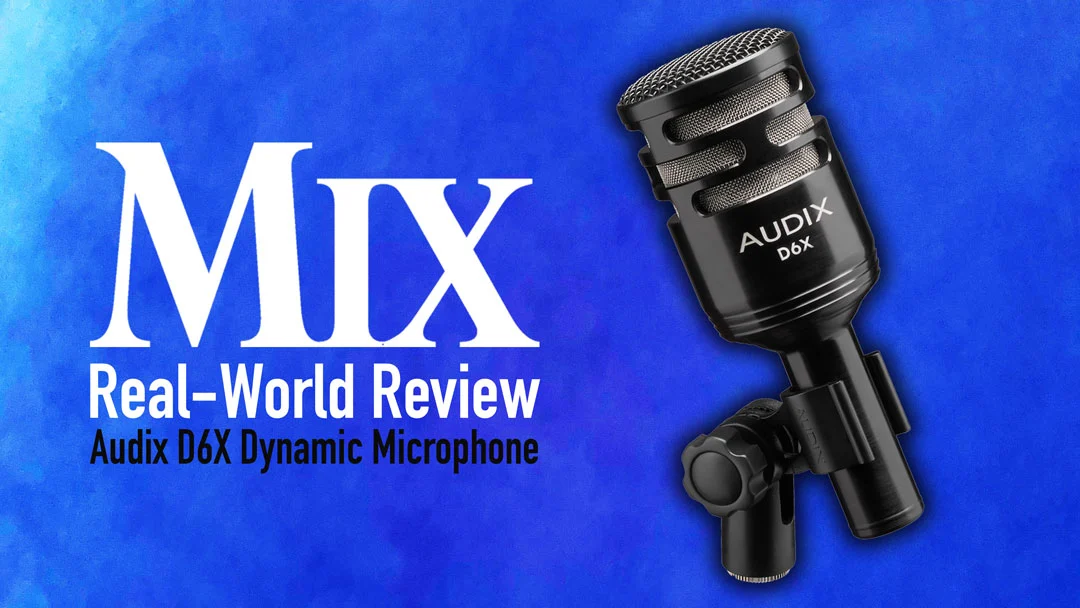
The professional audio landscape is often defined by "standards"—those rare pieces of equipment that become so ubiquitous they define the sound of an era. In the early 2000s, Audix USA achieved this feat with the release of the D6. Designed specifically to capture the power and click of a kick drum with minimal outboard processing, the D6 became the "pre-EQ’d" darling of the hard rock and metal worlds. However, as musical tastes shifted toward more nuanced, organic textures, some engineers began to find the D6’s aggressive "scooped" profile too restrictive for jazz, indie, or classic rock applications.
In response to a quarter-century of user feedback, Audix has unveiled the D6X. This new iteration seeks to preserve the legendary "whump" of the original while introducing a level of versatility previously unseen in a dedicated low-frequency dynamic microphone. By integrating a three-position voicing switch, Audix is attempting to bridge the gap between specialized tool and workhorse utility.
Main Facts: The "X" Factor in Low-Frequency Capture
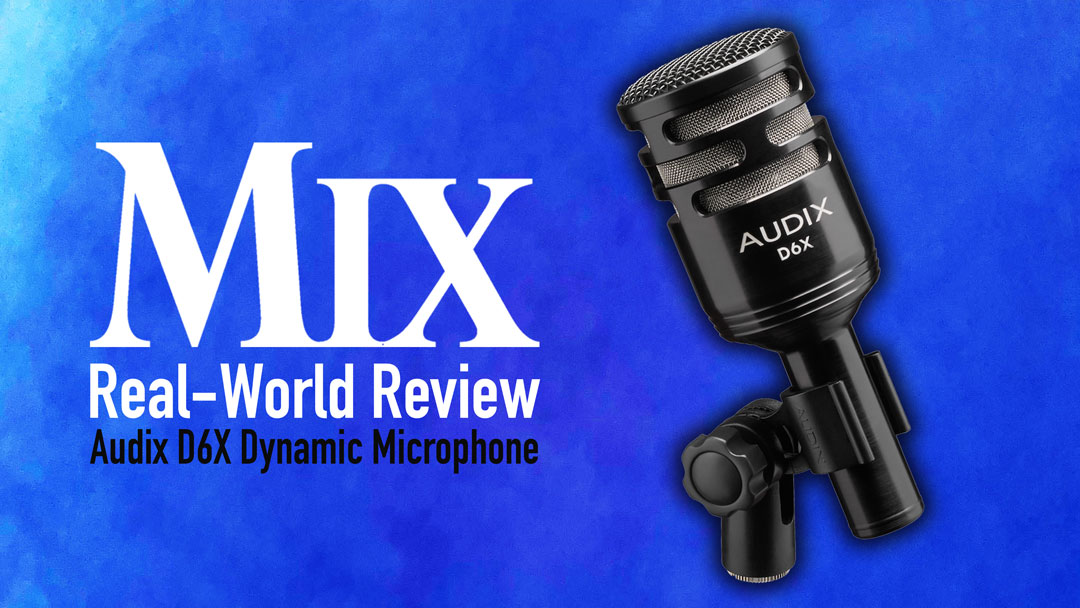
The Audix D6X is a large-diaphragm dynamic microphone that retains the core DNA of its predecessor while expanding its functional range through internal circuitry adjustments. The primary "fact" of the D6X is its versatility; it is effectively three microphones in one, housed within a precision-machined aluminum chassis.
Key Specifications and Features:
- Transducer Type: Dynamic, featuring Audix’s proprietary VLM (Very Low Mass) Type E diaphragm.
- Polar Pattern: Cardioid, providing excellent off-axis rejection (crucial for high-volume stage environments).
- Frequency Response: 25 Hz to 17 kHz (-6 dB).
- Maximum SPL: 144 dB, allowing it to handle the most aggressive drummers without clipping.
- Voicing Switch: A three-position toggle allowing for "Original D6," "Balanced," and "Natural" frequency curves.
- Manufacturing: Precision-machined and assembled in the United States.
- MSRP: $299.00.
While the D6X looks nearly identical to the original D6, it is slightly longer at 5.4 inches (compared to 4.6 inches). This extra length accommodates the complex switching matrix required to offer three distinct EQ profiles without degrading the signal path. The build quality remains tour-grade, featuring a black anodized finish and a heavy-duty steel mesh grille.
Chronology: From the "Scoop" to the "Switch"
To understand the significance of the D6X, one must look at the timeline of Audix’s dominance in the drum microphone market.
- The Late 1990s: Audix establishes itself as a serious competitor to industry giants like Shure and AKG with the D-Series. While the D2 and D4 become favorites for toms, the industry is still searching for a "plug-and-play" kick drum solution that doesn’t require massive 400Hz cuts on the mixing console.
- 2002-2005: The original Audix D6 is released. It immediately gains a reputation for its massive low-end boost (around 40Hz) and its deep midrange scoop. It becomes the "gold standard" for the New Wave of American Heavy Metal, providing a "radio-ready" kick sound instantly.
- 2010s: As the "loudness wars" peak and subside, a movement toward "vintage" and "natural" drum sounds takes hold. Engineers begin using the D6 less frequently in favor of flatter mics like the Electro-Voice RE20 or the AKG D12 VR, citing the D6 as "too processed" for non-metal genres.
- 2024-2026: Audix engineers work on a solution that retains the D6’s high-SPL handling and VLM technology but offers user-selectable voicings.
- July 2026: The D6X is officially released to the public, marking the most significant update to the D-Series kick drum line in over two decades.
Supporting Data: The Science of Three Curves
The true innovation of the D6X lies in the technical calibration of its three switchable settings. Unlike a digital modeling microphone, the D6X uses physical circuit paths to alter the capsule’s interaction with the output, resulting in three distinct "personalities."
1. The Legacy Curve (Bottom Position: "V D6")
This setting is a 1:1 recreation of the classic D6 sound. Data analysis shows:
- Low End: A +5 dB boost centered at 40 Hz, providing the "sub-thump" that fills a room.
- Midrange: A massive -17 dB scoop between 700 Hz and 800 Hz. This removes the "boxy" or "cardboard" frequencies inherent in many kick drums.
- High End: A gentle presence boost starting at 4.5 kHz, peaking near 10 kHz, providing the "click" or "beater attack."
2. The Balanced Curve (Middle Position)
Designed for those who want the D6 flavor but with more "meat" in the mids.
- Low End: The bass boost is slightly attenuated compared to the original.
- Midrange: The scoop is reduced to roughly -8 dB and shifted slightly lower (500-600 Hz). This preserves more of the drum’s fundamental resonance.
- Result: A sound with more "snap" and "punch" rather than just "thud" and "click."
3. The Natural Curve (Top Position)
This is the most radical departure for Audix.
- Low End: The bass boost is removed, resulting in a flat response down to the microphone’s floor.
- Midrange: A minimal -5 dB cut, making it behave more like a traditional broadcast or utility dynamic mic.
- High End: The HF peak is moved down to 3 kHz, rolling off significantly after 7 kHz.
- Result: An organic, "earthy" sound suitable for jazz, folk, or punk rock bass cabs.
Real-World Performance: The Mix Real-World Review
In practical studio testing using an API 3124 four-channel preamp and a 22-inch Pearl Masters Series kick drum, the D6X proved its worth across various genres.
Kick Drum Applications
When set to the "D6" position, the mic was indistinguishable from the original, though some engineers noted a slightly improved transient response—likely due to the brand-new VLM diaphragm compared to older, "tired" D6 units found in most rental lockers.
The "Middle" position was the standout for modern rock. It provided enough low-end to satisfy a subwoofer but kept enough midrange to allow the kick drum to "speak" through a dense mix of guitars. The "Natural" setting, while perhaps too "vanilla" for a standard rock kick, proved excellent for a front-of-head placement where a second, more aggressive mic was used inside the drum.
Floor Toms and Bass Amps
The D6X shines on floor toms, a secret weapon use-case for the original D6. In the "Balanced" setting, the floor tom sounded "more like a drum and less like a sound effect," capturing the resonance of the shell without the overwhelming sub-bass that can sometimes cause feedback in live PA systems.
On bass amplifiers, the "Natural" setting was a revelation. When recording a high-gain "punk rock" bass sound, the Natural curve provided a "throaty" and "lean" capture that sat perfectly in the mix without requiring heavy high-pass filtering.
Official Responses and Industry Positioning
While Audix USA maintains a philosophy of "letting the gear speak for itself," the company’s release of the D6X signals a strategic pivot. By keeping production in the United States, Audix continues to target the premium professional market rather than the budget home-studio segment.
Industry analysts suggest that the D6X is a direct response to the "modeling" microphone trend. Rather than using software to emulate different mics, Audix is betting that engineers still prefer a physical switch and a dedicated analog circuit. This "all-in-one" approach is intended to reduce the number of microphones an engineer needs to carry to a gig, effectively offering the utility of a Shure Beta 52A, an AKG D112, and an Audix D6 in a single chassis.
Implications: The Future of Drum Miking
The release of the Audix D6X carries several implications for the pro-audio industry:
- The Death of the "One-Trick Pony": The D6X proves that even the most specialized microphones must now offer versatility to justify their place in a modern mic locker. At a street price of $299—roughly $110 more than the standard D6—the D6X offers three times the utility for a fraction of the cost of three separate mics.
- Live Sound Efficiency: For front-of-house (FOH) engineers, the ability to change the "vibe" of a kick drum with a physical switch—without having to re-gain the preamp or drastically alter the desk EQ—is a major workflow improvement.
- A New Standard for Bass Recording: By offering a "Natural" setting that tames the D6’s aggressive low-end, Audix has created a formidable competitor for the bass cabinet market, potentially challenging the dominance of the Sennheiser MD421 or the EV RE20.
In conclusion, the Audix D6X is a masterclass in evolution. It respects the legacy of a legendary product while acknowledging that the needs of the modern recording engineer have changed. It is a robust, American-made tool that provides the "D6 sound" everyone loves, while finally offering a way to turn that sound off when the music calls for something more subtle. For any studio or touring professional, the D6X is not just an upgrade; it is a new benchmark.