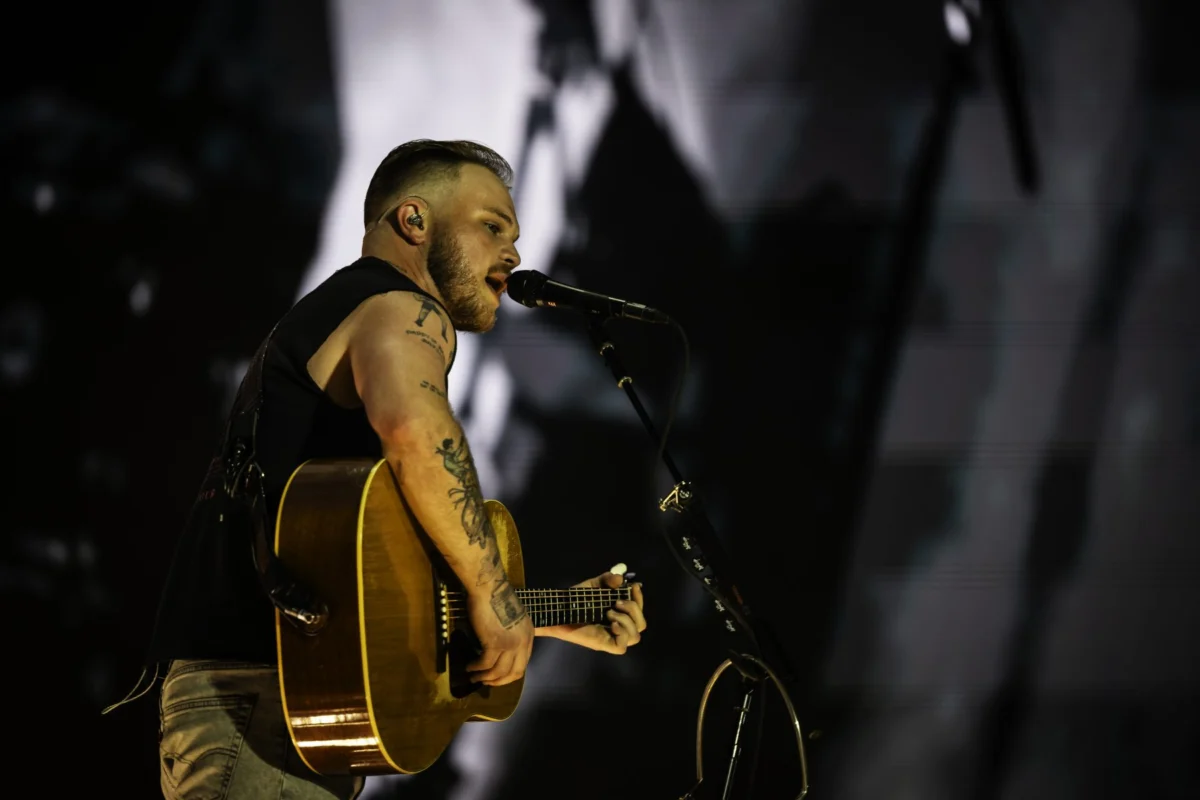
In a move that has sent shockwaves through the intersection of American music, sports ownership, and geopolitical discourse, Grammy-winning country star Zach Bryan made a bold, non-verbal protest during his recent performances at Gillette Stadium in Foxborough, Massachusetts. On the evening of October 2, during the first of two nights on his With Heaven On Tour, Bryan took the stage wearing a black T-shirt emblazoned with the words “Free Palestine.”
The choice of venue, coupled with the timing of the statement, has drawn significant media scrutiny. Gillette Stadium is the home of the New England Patriots, an organization led by billionaire Robert Kraft. The protest occurred just weeks after Kraft played a pivotal role in the professional fallout surrounding rapper Macklemore, who was removed from the remaining U.S. dates of Ed Sheeran’s Loop Tour following his own public pro-Palestinian advocacy.
The Chronology of a Growing Divide
The tension surrounding musical artists and their political expression began to crystallize earlier this year as the conflict in the Middle East intensified.
On September 4 and 5, at MetLife Stadium in East Rutherford, New Jersey, Macklemore used his platform as an opening act for Ed Sheeran to voice his political stance. During his set, he performed his protest anthem, “Hind’s Hall,” a track explicitly written to address the humanitarian crisis in Gaza. During these performances, Macklemore explicitly declared “Free Palestine” to the stadium crowds. On the second night, he attempted to nuance his message, speaking directly to Jewish members of the audience to clarify that his criticism of the Israeli government’s policies was not an indictment of the Jewish people.
The backlash was immediate. The Israeli-American Council (IAC) spearheaded a campaign calling for the artist’s removal from the tour. By September 14, the situation had reached a breaking point. Messina Touring Group, the promoter for the tour, confirmed that Macklemore would no longer appear at the remaining U.S. dates. Reports emerged that multiple NFL stadium owners, including those with ties to the league’s power brokers, had signaled that they would not host the tour if Macklemore remained on the lineup.
Robert Kraft, a vocal supporter of Israel, confirmed his involvement in the decision-making process shortly thereafter. In a statement, Kraft articulated his belief that he had a "responsibility to speak up" when he felt a line regarding antisemitism had been crossed. While he acknowledged that the suffering of Palestinians was a real and tragic reality, he maintained that the rhetoric used during the tour was unacceptable.
Supporting Data and Industry Fallout
The removal of Macklemore triggered a cascade of professional consequences that rippled through the touring industry. The move was met with immediate resistance from other artists associated with the Loop Tour.
In an act of solidarity, notable openers including Finneas, Aaron Rowe, and Lukas Graham exited the tour. The Irish folk band Beoga, a long-time collaborator of Sheeran’s, also withdrew. The financial and reputational implications for Macklemore were substantial; in a lengthy Instagram post, the rapper detailed the loss of brand deals, festival bookings, and private event opportunities.
However, the artist doubled down on his convictions. Macklemore pledged $1 million of his touring earnings toward Palestinian aid organizations and announced a dedicated "Free Palestine Tour." The European run, scheduled for late October, reportedly sold out almost immediately, suggesting that while the artist faced significant institutional pressure, his core fanbase remained deeply engaged.

The irony of the situation was not lost on industry observers. Despite the efforts to sanitize the Loop Tour of political controversy, Ed Sheeran’s planned shows at Gillette Stadium—the very venue where the pressure to remove Macklemore was exerted—were ultimately canceled due to severe weather. The compromise, it seemed, had been made in vain.
Official Responses and Political Friction
The incident at Gillette Stadium involving Zach Bryan marks a distinct escalation in how artists are navigating the "political minefield" of major stadiums. Unlike Macklemore, who addressed the crowd directly with spoken word and performance, Bryan remained silent on the matter during his set. He let the shirt, and the visual of his band members wearing matching apparel, serve as his statement.
The decision is being viewed by many as a direct challenge to the power dynamics of stadium touring. Representatives for Robert Kraft have not yet issued a formal statement regarding Bryan’s choice of attire. However, the lack of a public response from the Kraft camp stands in stark contrast to the swift, decisive action taken in the Macklemore case.
Bryan is no stranger to political friction. In October 2025, he faced intense public criticism from the Department of Homeland Security and the White House after teasing a song titled “Bad News,” which featured lyrics referencing ICE raids. Kristi Noem, the Homeland Security Secretary at the time, publicly expressed her disappointment, labeling the imagery as harmful. Bryan navigated that controversy by urging his fans to avoid partisan traps, framing his music as a reflection of the struggles faced by everyday Americans on both sides of the political aisle.
The Implications for Live Music
The implications of these events are profound for the live entertainment industry. For years, the stadium circuit has operated as a largely apolitical space, driven by corporate sponsors and venue owners who prefer to avoid controversy.
- The Power of the Venue Owner: The Macklemore incident established a precedent where venue owners, particularly those with deep ties to political or social causes, feel empowered to dictate the content of the performances hosted on their property.
- The "Solidarity" Movement: The swift exit of artists like Finneas and Beoga highlights a growing trend of artist-to-artist solidarity. Musicians are increasingly willing to sacrifice high-profile touring opportunities to support the political agency of their peers.
- The Financial Risk of Advocacy: As Macklemore’s experience demonstrated, speaking out can lead to significant financial loss. However, as the rapid sell-out of his European tour suggests, there is a burgeoning market for artists who define their brands through strong, transparent political convictions.
- The "Silent" Protest: Zach Bryan’s choice to use his clothing rather than his microphone suggests a new strategy—one that communicates a message to an audience of tens of thousands without providing a direct "soundbite" that can be easily weaponized by opponents.
As Bryan returned to the stage at Gillette Stadium on October 3, the atmosphere was thick with anticipation. The question remained: would he continue the protest, and if so, what would be the reaction from the venue’s ownership?
For now, the standoff represents a shift in the landscape of American pop culture. The traditional guardrails—corporate sponsorship, stadium contracts, and media management—are being tested by a new generation of artists who view their platforms as tools for social and political commentary.
The industry is watching closely. Whether this leads to a "chilling effect" where artists are forced to sign morality clauses, or whether it marks the beginning of a new era of artistic autonomy, remains to be seen. What is clear is that the days of the stadium tour as a neutral, "safe" space for entertainment are rapidly fading, replaced by a more volatile, engaged, and uncompromising reality.
As fans continue to file into stadiums, they are no longer just buying a ticket to hear music; they are entering a space where the battle for public opinion is being fought in real-time, one song—and one T-shirt—at a time.