The professional audio landscape is defined by the seamless integration of hardware and software. As modern production workflows become increasingly complex—shifting rapidly between tracking, overdubbing, and intricate immersive mixing—the demand for intuitive, centralized control has never been higher. Focusrite’s answer to this challenge is Focusrite Control 2, the sophisticated desktop software engine powering the flagship ISA C8X audio interface.
By bridging the physical tactile nature of high-end analog preamplification with the flexibility of digital routing, Focusrite Control 2 has transformed how engineers interact with their hardware. This article explores the capabilities of this software ecosystem, its impact on studio architecture, and how it is redefining the "control center" concept in professional recording environments.
Main Facts: The Software Engine of the ISA C8X
Focusrite Control 2 acts as the digital nervous system for the ISA C8X. While the ISA series is legendary for its heritage and sonic signature, the C8X brings that pedigree into the 21st century by offloading the management of its sophisticated circuitry to a robust desktop application.
The Desktop Command Center
The core philosophy behind Focusrite Control 2 is transparency and accessibility. By extending nearly every major front-panel function of the ISA C8X to the computer screen, the software eliminates the need for engineers to physically reach for rack units during a session. This is particularly vital in studios where the interface might be housed in a machine room or a rack inaccessible from the primary mixing position.
Remote Accessibility
Focusrite has acknowledged the mobile-first nature of modern production. The companion iOS and Android application allows for remote control of the interface. It is important to note the architecture here: the mobile device communicates with the computer running Focusrite Control 2 via a shared network. This bridge allows performers or engineers to adjust their own monitor mixes or trigger phantom power from the comfort of the vocal booth or the tracking floor, provided they are connected to the same local area network (LAN).
Chronology: The Evolution of Focusrite’s Software Ecosystem
To understand the significance of Focusrite Control 2, one must look at the evolution of Focusrite’s interface management software over the past decade.
- The Early Days (The Scarlett/Clarett Era): Focusrite initially introduced "Focusrite Control" to manage the routing of their mid-tier interfaces. It was a functional, albeit basic, matrix-style mixer that allowed users to balance DAW outputs with hardware inputs.
- The Transition to 64-bit Architecture: As OS updates from Apple and Microsoft grew more restrictive regarding kernel extensions, Focusrite pivoted toward a more stable, hardware-agnostic communication protocol. This allowed for lower latency and better stability in high-track-count sessions.
- The ISA C8X Launch: With the arrival of the ISA C8X, the need for a more granular control surface became apparent. The "2" in Focusrite Control 2 signifies a complete rewrite of the software’s codebase, optimized for high-density audio interfaces and the complex routing required for immersive sound formats.
- Present Day: Today, Focusrite Control 2 is not just a routing utility but a complete studio management platform, supporting everything from simple stereo tracking to complex 7.1.4 Dolby Atmos monitor calibration.
Supporting Data: Feature Breakdown
Focusrite Control 2 is divided into two primary workspaces: the Mixer Tab and the Routing Tab. Each serves a distinct function in the recording and monitoring chain.
The Mixer Tab: Precision Monitoring
The Mixer tab is where the "creative" work happens. It allows users to combine analog and digital inputs with DAW playback channels. Key features include:
- Independent Monitor Mixes: Engineers can construct multiple cue mixes for performers while maintaining a separate, high-fidelity mix for the control room.
- Channel Management: Each channel features standard pan, mute, solo, and mono/stereo toggles.
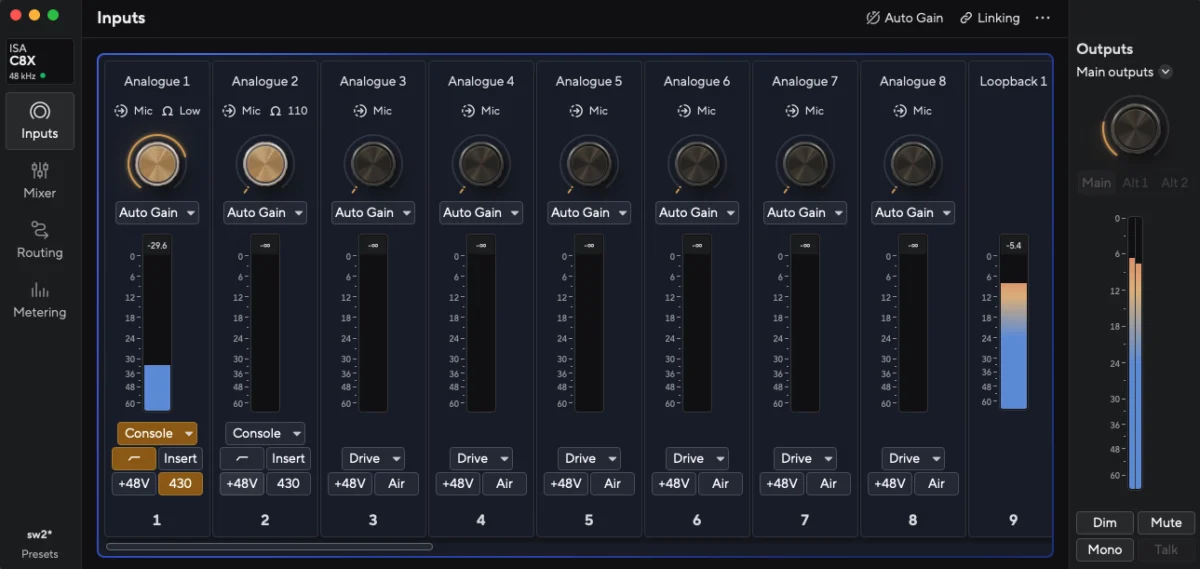
- Preamp Mastery: The software provides full digital control over gain staging, input selection (Mic/Line/Inst), 48V phantom power, and impedance settings. More importantly, it allows for the remote toggling of modern ISA features like Air, Drive, and Console Mode, as well as high-pass filtering and Auto Gain.
The Routing Tab: The Matrix of Power
If the Mixer tab is for the artist, the Routing tab is for the systems engineer. This section manages the complex task of signal flow:
- Output Assignment: Users can map hardware inputs, DAW channels, or custom software mixes to any analog or digital output.
- Monitor Groups: The software supports the configuration of Main, Alt 1, and Alt 2 monitor groups.
- Immersive Sound Support: One of the most significant features is the ability to configure surround and immersive monitoring systems up to 7.1.4. This makes the ISA C8X a future-proof centerpiece for studios transitioning to spatial audio.
- Loopback Functionality: Essential for podcasters and streamers, the built-in loopback routing allows for the seamless capture of computer audio alongside live inputs.
Official Responses and Industry Reception
In recent technical briefings, Focusrite representatives emphasized that the goal of Focusrite Control 2 was to "remove the friction between the musician and the music."
"We didn’t just want to build a software remote," noted a lead developer during the interface’s launch. "We wanted to build a preset-management system that respects the workflow of a modern professional. If you spend an hour dialing in the perfect gain staging and monitoring setup for a session, you should be able to save that state and recall it instantly."
Industry testers have lauded the software’s Preset Management system. In commercial studios where multiple engineers may cycle through the same room, the ability to save "Studio Configurations"—recalling input settings, mixer levels, and routing matrices—has been described as a "time-saver that pays for itself within the first month of operation."
Implications: The Future of Hybrid Studio Workflow
The integration of software like Focusrite Control 2 into a high-end analog preamp chain like the ISA C8X carries significant implications for the future of studio design.
1. The Death of the Patchbay?
While the physical patchbay will always have a place in vintage-focused studios, software-defined routing is clearly the future for modern facilities. By allowing for digital reconfiguration of outputs and inputs, Focusrite Control 2 reduces the need for complex, manual cable routing, thereby reducing noise floors and human error.
2. Democratization of Immersive Audio
By simplifying the configuration of a 7.1.4 monitoring array within the software, Focusrite is lowering the barrier to entry for spatial audio. Studios no longer need an external monitor controller or complex matrix hardware to manage immersive setups; the interface does the heavy lifting.
3. The Hybrid Equilibrium
The "Hybrid" studio—defined as a mix of high-end analog hardware and digital control—has reached a point of maturity. Focusrite Control 2 proves that you do not need to sacrifice the sound of a transformer-coupled preamp to gain the benefits of digital automation. By keeping the audio signal path pure while offloading the "admin" tasks to a software interface, Focusrite has achieved a delicate balance that serves both the purist and the tech-forward producer.
4. Scalability and Longevity
The modular nature of the software ensures that as new standards emerge, Focusrite can push updates to the interface without requiring the user to replace their physical hardware. This creates a sustainable model for studio equipment, protecting the user’s investment over the long term.
Conclusion
Focusrite Control 2 is much more than a companion application; it is the cornerstone of the ISA C8X experience. By providing an intuitive, powerful, and deeply customizable interface for managing complex signal flows, Focusrite has successfully bridged the gap between legacy analog warmth and modern digital efficiency.
Whether you are managing a simple vocal session or calibrating an immersive monitoring system, the software provides the clarity and control necessary to keep the focus where it belongs: on the music. As the industry continues to move toward more flexible, software-centric workflows, tools like Focusrite Control 2 serve as the blueprint for how hardware manufacturers can adapt, evolve, and empower the next generation of audio engineers.
For those looking to expand their knowledge, Focusrite offers a suite of support tools and documentation via their official website, ensuring that users can master their ISA C8X environment regardless of their experience level.