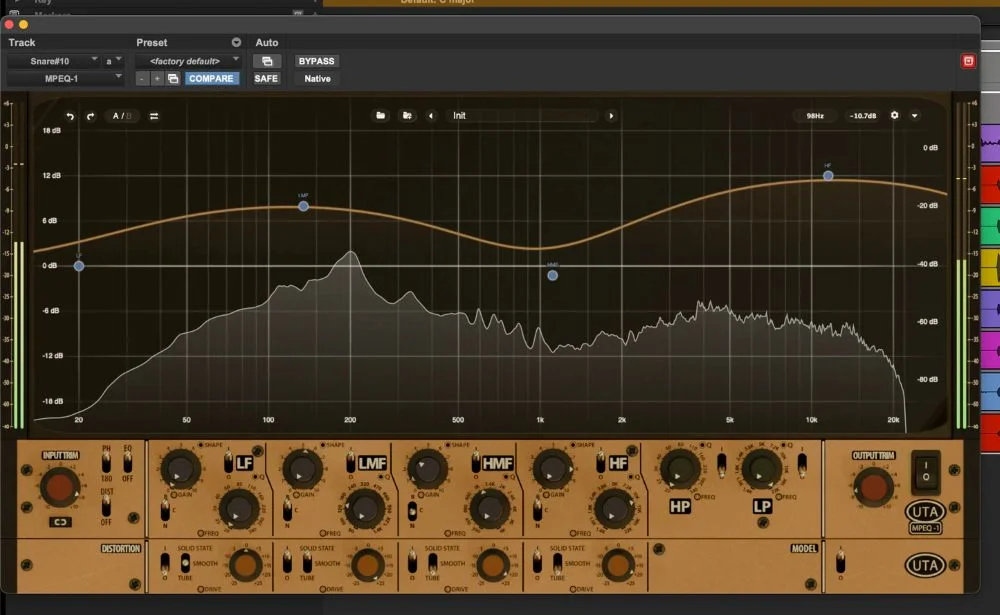
In the evolving landscape of professional audio production, the bridge between analog character and digital convenience has often been a point of contention. For years, engineers have sought the sonic "magic" of high-end hardware, only to be limited by the constraints of physical units—lack of total recall, static signal paths, and the inability to process multiple instances without heavy investment. Today, Undertone Audio is changing that narrative with the release of the MPEQ-1 super-parametric saturation equalizer plugin, a digital recreation that promises not just to emulate, but to expand upon, the capabilities of its renowned analog predecessor.
The Genesis of the MPEQ-1: Bridging Analog and Digital
Undertone Audio, founded by producer and engineer Eric Valentine, has built a reputation on hardware that pushes the boundaries of traditional circuit design. The MPEQ-1 hardware unit has long been a staple in high-end studios for its surgical precision and musical warmth. However, the move to software was not a decision made lightly.
The development team, led by the same minds behind the original UTEQ, approached this project with a specific philosophy: digital replication should not be a static copy. Instead, the plugin was developed to be a "genuinely new" tool. By leveraging the power of modern DSP (Digital Signal Processing), the team has managed to encapsulate the hardware’s intricate curves, specialized filters, and its unique "Vari-Phase" mode into a plugin environment that addresses the modern workflow’s demand for speed, recall, and precision.
Chronology of Development: From Hardware to Code
The journey to the MPEQ-1 plugin began long before its July 2026 release. Following the success of the original analog MPEQ-1, user feedback consistently pointed to a demand for a digital variant.
- Early Conceptualization (2024): Undertone Audio begins exploring the potential of a software version. The primary hurdle was not just replicating the EQ curves—which is a well-understood process—but capturing the dynamic, non-linear saturation characteristics that give the hardware its "breath."
- The Prototyping Phase (2025): The team decides to integrate independent band-by-band saturation, a feature that was physically impossible on the original unit. This period focused on modeling the harmonic distortion profiles of the hardware at various gain stages.
- Beta Testing and Refinement (Early 2026): A select group of mix and mastering engineers are given access to the prototype. Their feedback emphasizes the need for a UI that honors the original hardware aesthetic while providing the efficiency of modern plugin GUIs.
- Final Release (July 9, 2026): The MPEQ-1 plugin is officially launched, marking Undertone Audio’s most significant foray into the digital domain to date.
Technical Specifications and Workflow Integration
At the heart of the MPEQ-1 plugin are four "super-parametric" bands. Unlike standard parametric EQs that offer basic frequency, gain, and Q adjustments, the MPEQ-1 offers a more nuanced approach. The "super-parametric" design allows for a deeper level of interaction between these parameters, mirroring the behavior of the original hardware’s complex filters.
Independent Band-by-Band Saturation
The standout feature of the plugin is undoubtedly the independent saturation control for each of the four bands. In traditional analog EQ, saturation is often a global byproduct of the entire circuit. In the MPEQ-1 plugin, an engineer can apply grit, warmth, or harmonic excitement to the low-mids without affecting the clarity of the high-end air, or vice-versa. This allows for surgical frequency shaping combined with creative tonal coloration—a workflow that was previously only achievable through complex serial routing of multiple outboard processors.

The Digital Advantage: UI and Functionality
While the sound engine is rooted in the analog domain, the interface is designed for the modern "in-the-box" engineer. The plugin offers two distinct ways to interact with the EQ:
- Direct Parameter Control: For engineers who prefer precision and speed, the direct parameter interface provides clean, high-resolution knobs and numerical entry.
- Graphic Recreation: For those who rely on muscle memory or the visual cues of the original hardware, the UI features a faithful visual representation of the physical MPEQ-1, complete with its characteristic layout and knob configurations.
Beyond the sound, the plugin introduces essential modern workflow features:
- Full Recall: Every setting is saved within the DAW project file.
- Automation: Every parameter can be automated, allowing for creative, evolving EQ shifts throughout a mix.
- Integrated Spectrum Analysis: Real-time visual feedback allows engineers to see exactly how their adjustments are affecting the frequency response, bridging the gap between ears and eyes.
- Instant A/B Comparison: A critical feature for mastering, allowing for immediate assessment of changes without the need for manual resetting.
Perspectives from the Source: A Conversation with Eric Valentine
When asked about the philosophy behind the plugin, Eric Valentine was candid about the challenges of the transition. "Engineers have been asking us when we would release a plugin version of the MPEQ-1 and our answer was always: only when we could do something genuinely new," he stated.
Valentine emphasizes that the value of the plugin lies in its ability to do things that the hardware cannot. "The MPEQ-1 has always been about expanding what an equalizer can do. By combining the EQ’s flexible architecture with independent saturation, the plugin gives engineers and producers a level of tonal control that simply wasn’t possible before." This statement highlights a shift in the industry: hardware is no longer the "gold standard" to be mimicked; it is a starting point for innovation.
Implications for the Professional Audio Market
The release of the MPEQ-1 plugin carries several implications for the future of studio hardware and software development.
The Shift Toward "Hybrid" Innovation
We are seeing a move away from "emulation-only" plugins. As CPU power increases, developers are finding that they don’t have to just simulate the limitations of the past. The MPEQ-1 proves that customers are eager for products that take the character of classic gear and marry it with the possibilities of modern computing.

The Democratization of High-End Tones
By pricing the MPEQ-1 at $149, Undertone Audio is providing access to a sound profile that would typically cost thousands of dollars in rack-mount hardware. This allows home studio owners and independent producers to achieve a professional, finished sound with greater ease. It lowers the barrier to entry for high-fidelity audio production without compromising on the quality of the signal processing.
The Future of Mastering and Mixing
The inclusion of granular saturation controls suggests a new trend in EQ design. As mixes become more dense and complex, the ability to control harmonic content at a frequency-specific level will become increasingly vital. The MPEQ-1 is likely to influence other manufacturers to explore similar "multi-dimensional" processing in their upcoming plugin releases.
Conclusion
The Undertone Audio MPEQ-1 plugin represents a successful marriage of engineering heritage and forward-thinking design. By refusing to simply replicate the past, the team at Undertone has created a tool that feels both familiar and revolutionary.
For the professional engineer, the MPEQ-1 offers a versatile, high-fidelity solution that fits seamlessly into a modern workflow while retaining the soul of the hardware that inspired it. As the industry continues to balance the demands of the analog aesthetic with the efficiency of the digital world, plugins like the MPEQ-1 serve as a blueprint for how to bridge that gap effectively. With its combination of precise surgical EQ and creative, band-specific saturation, the MPEQ-1 is poised to become a permanent fixture in thousands of digital signal chains worldwide.
For those interested in exploring the plugin, it is currently available via the Undertone Audio digital portal, with the purchase price including the license, a robust factory preset library, and a commitment to ongoing free updates—ensuring that this tool remains as relevant in five years as it is today.