On the final day of the 2026 Tribeca Festival, the cultural epicenter of lower Manhattan became a stage for a profound dialogue on the state of American democracy. Amidst a backdrop of nationwide political tension, the festival’s organizers bestowed the prestigious Harry Belafonte Voices for Social Justice Award upon Bruce Springsteen. The event, which featured a candid, wide-ranging conversation between the "Boss" and U2 frontman Bono, served as both a tribute to a legendary career and a clarion call for civic responsibility in an era of profound institutional strain.
The Ceremony and the Honoree
The Harry Belafonte Voices for Social Justice Award is designed to recognize artists who utilize their platforms to effect change, embodying the spirit of the late activist and performer for whom it is named. For Tribeca co-founders Robert De Niro and Jane Rosenthal, Springsteen was the natural choice for this year’s honor.
“This is a man who knows how to use his voice,” De Niro remarked during his introduction. “He uses it to give voice to the powerless and he uses it to lead the resistance. He is fearless and direct. He knows what the problem is and he names it: Donald Trump. Donald J. Trump and his feckless enablers. That’s so important because this isn’t about reasonable disputes on policy: this is about the corruption and megalomania of one person. Bruce Springsteen puts a face on it, and he does it with the words of a poet.”
Accepting the award with characteristic humility, Springsteen seemed visibly moved, yet quick to deflect the focus from himself. “I’m a little embarrassed to get this award,” he admitted. “I’m just a concerned citizen.” He immediately redirected the spotlight, dedicating the honor to the residents of Minneapolis, Portland, and Los Angeles, praising their resilience in standing “against the federal invasion of their cities this year.”
A Chronology of the Conversation: From Art to Activism
The afternoon was anchored by a "Tribeca Storytellers" session moderated by Bono. The discussion was marked by a rare, raw vulnerability as the two rock icons navigated the complexities of maintaining a connection with a working-class audience while simultaneously engaging in high-level political advocacy.
The Erosion of Democratic Norms
The conversation quickly pivoted to the primary concern of the day: the perceived erosion of democratic institutions in the United States. Springsteen’s recent Land of Hopes & Dreams Tour has been described as the most explicitly political project of his career, a fact he addressed directly. He noted that he made his intentions clear from the outset, warning audiences of the tour’s thematic content so that concertgoers would not be blindsided by his political stances.
“I warned everybody what the tour was gonna be like so they didn’t waste their money before they came,” Springsteen said with a wry chuckle. “I figured I did my job and it was every man for himself after that.”
The Struggle of the Celebrity Advocate
Bono, acting as both peer and interrogator, pressed Springsteen on the potential professional costs of his activism. Referencing the growing chasm in American discourse, Bono noted, “I fear sometimes we on the left lost a little bit of it and that the accusations of elitism that are out there for people like me are not inaccurate.”
He asked his friend, “Has it cost you? Do you feel torn at all thinking there’s people in this town that used to come see my shows who don’t now? Or have you made peace with that?”
Springsteen’s response was reflective of his long-standing commitment to the "sacred argument" of American democracy. “You have to make your stand and follow your beliefs and you have to have the faith in them that they will be explicable and understandable by your fellow citizens,” he explained. “You have to believe that America is a sacred argument and a compromise.”
Lessons in Advocacy: The "Gap" Regret
One of the most humanizing moments of the event occurred when the conversation shifted toward the strategic limitations of activism. Bono recounted a past attempt to recruit Springsteen for a charitable cause—specifically, a request to license the song "Girls In Their Summer Clothes" for a Gap commercial to support the (PRODUCT) RED campaign, which aimed to fight HIV/AIDS in Africa.
At the time, Springsteen had declined. In a moment of unexpected transparency, the Boss admitted that his refusal was a mistake. “That was a big mistake, too,” he said, surprising even Bono. “I should have said yes. I should have f—king done it. I have to apologize.” This moment of candor underscored the idea that even the most committed activists are navigating an imperfect process of weighing principles against practical impact.
Musical Interlude: A Call to Peace
The event concluded with a surprise performance that had been conspicuously absent from the festival’s official program. Patti Smith joined Springsteen and keyboardist Tony Shanahan on stage for a poignant performance of "Peaceable Kingdom." The song, written in memory of Rachel Corrie—an activist killed by an Israeli military bulldozer in 2003—served as a sobering reminder of the global scope of human rights struggles.
The trio followed this with a stirring rendition of Smith’s anthem, "People Have the Power." Bono, who had briefly left the stage, was called back by Springsteen to provide backing vocals, creating a powerful tableau of musical legends united by a common call for grassroots engagement. Finally, Springsteen treated the audience to a solo, acoustic version of "Land of Hope and Dreams," delivering an intimate performance that resonated deeply within the confines of the BMCC Tribeca Performing Arts Center.
Implications for the Current Political Climate
The event at the Tribeca Festival serves as a microcosm of the broader cultural debate regarding the role of artists in politics. In an era where the divide between political factions is increasingly hostile, the participation of icons like Springsteen and Smith signals a shift toward more overt, unabashed activism in the arts.
The "No Kings" Movement
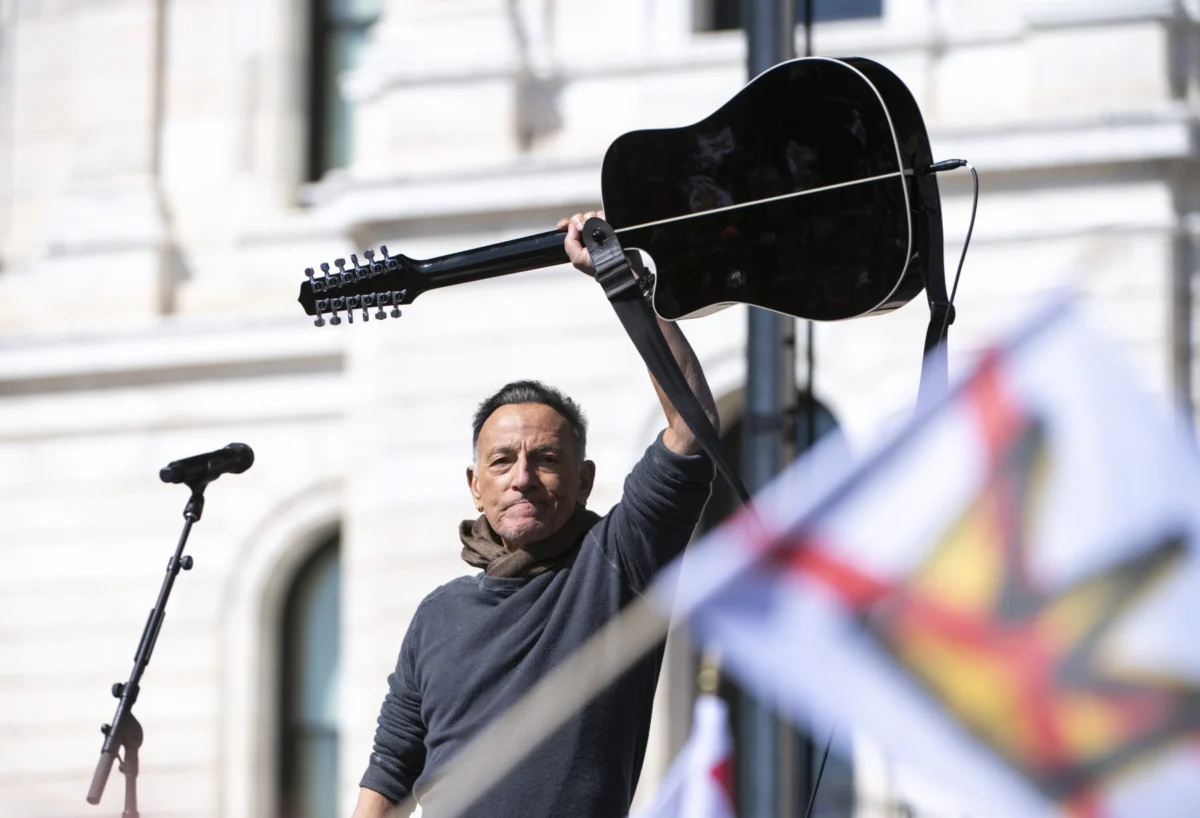
The timing of the award—occurring on the same day as the third nationwide "No Kings" protest—underscores the urgency with which these artists view the current administration. By aligning the Harry Belafonte award with these protests, the Tribeca Festival has firmly positioned itself as a platform for dissent. The imagery of Springsteen performing during the "No Kings" protest in St. Paul, Minnesota, earlier that year provided a visual anchor for the sentiment expressed at the festival: that the "Boss" is not merely an entertainer, but a participant in the ongoing American political struggle.
The Burden of Representation
The dialogue between Bono and Springsteen also highlights a significant challenge for modern public figures: the "elitism" trap. As Bono noted, there is a legitimate fear that the artist-activist class has become disconnected from the very working-class citizens whose struggles they champion in their music. Springsteen’s response—that one must simply have faith that one’s beliefs are "explicable and understandable"—suggests that he views his role not as a leader of a movement, but as a bridge-builder who must remain committed to the dialogue, even when that dialogue is fractured.
Conclusion: A Legacy of Engagement
As Bruce Springsteen exited the stage, leaving the audience with the lighthearted, albeit regionally specific, parting shot, "Go Knicks," the atmosphere was one of solemn resolve mixed with hope. The Harry Belafonte Voices for Social Justice Award, in this context, was more than just a trophy; it was a validation of the role that art plays in maintaining the health of a democracy.
Whether one agrees with his political assessments or not, Springsteen’s career remains a testament to the idea that an artist’s primary responsibility is to the truth as they perceive it. By leaning into the discomfort of being a "concerned citizen," the Boss has cemented his legacy not just as a titan of rock and roll, but as a persistent, and sometimes polarizing, voice for the values he believes define the American promise. In the words of De Niro, he is a man who uses his voice for the powerless, and in the current climate, that voice remains as resonant and necessary as ever.