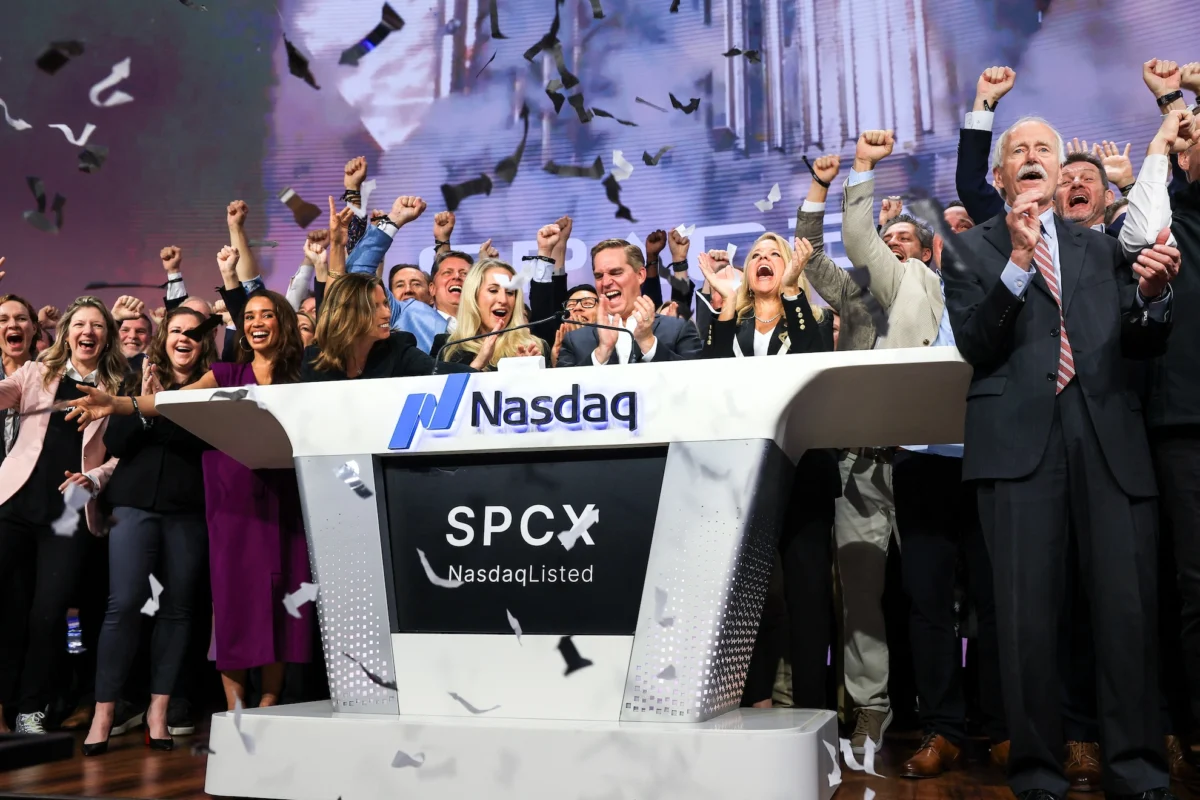
The financial world witnessed a seismic transformation this week as SpaceX, the aerospace giant led by Elon Musk, successfully debuted on the public markets. With shares priced at $135, the IPO marks the largest in history, a monumental milestone that has officially catapulted Elon Musk into the stratosphere of wealth as the world’s first trillionaire.
However, the implications of this event extend far beyond the personal fortune of a single entrepreneur. As the dust settles on the trading floor, the market is signaling a broader, structural pivot: the era of FAANG (Facebook, Amazon, Apple, Netflix, Google) is effectively over, replaced by a new market paradigm that analysts are calling "MANGOS"—a grouping that includes Meta, Anthropic, NVIDIA, Google, OpenAI, and SpaceX. This shift represents a decisive migration of capital away from consumer-facing social networks and toward the high-stakes, capital-intensive world of deeptech and artificial intelligence.
Chronology of a Financial Revolution
The path to this historic IPO was paved with years of speculation and internal maneuvering. For nearly a decade, SpaceX operated as a private entity, allowing it to take massive, often risky, leaps in technology—from reusable rockets to the global Starlink satellite network—without the scrutiny of quarterly earnings calls.
- The Build-Up (2024–2025): Throughout last year, SpaceX signaled a strategic pivot, framing its massive satellite infrastructure not just as an aerospace project, but as the foundational architecture for a global, low-latency AI and data processing business.
- The Confidential Filings (Early 2026): As SpaceX finalized its IPO plans, rivals Anthropic and OpenAI initiated their own confidential filings with the SEC. The "AI Arms Race" effectively moved from the lab to the public exchange.
- The IPO Week (June 2026): SpaceX officially went public on June 11, 2026, setting a record for valuation and capital absorption. By June 12, market analysts confirmed that Musk’s stake in the newly public company had pushed his net worth past the $1 trillion mark.
The "MANGOS" Era: A New Market Logic
The nomenclature "MANGOS" is more than a catchy acronym; it reflects a fundamental change in investor sentiment. For years, the market favored platforms that dominated the attention economy. Today, investors are pouring capital into "AI Labs" and infrastructure-heavy deeptech firms.
"We’ve got a bunch of AI labs in there, and that’s very different," says Kirsten Korosec, a veteran tech journalist. "Netflix gets booted out—a giant streaming service—and in its place, we see a shift toward innovative deeptech. The vast amount of money and capital available in the public markets is shifting away from consumer social networks and toward companies that are building the physical and digital infrastructure of the future."
This transition poses a unique challenge to the public markets. While tech giants of the past were often criticized for their influence, SpaceX is testing the limits of what a public company can be. With a single individual wielding significant control, SpaceX represents a new type of corporate governance that other AI-focused firms are likely to emulate.
Stress-Testing the Public Markets
One of the most pressing questions for financial regulators and retail investors alike is how these AI-focused, cash-intensive companies will behave under the pressures of public scrutiny.
Sean O’Kane, a close observer of the sector, notes that SpaceX is effectively merging the most extreme elements of early Google and Meta—namely, high-control corporate structures—with the "lose money forever" growth-at-all-costs philosophy popularized by Amazon in its early days.
"SpaceX is sucking up a huge chunk of the money available in public markets, but it’s also stress-testing the limits of what a public company can be," O’Kane explains. "The question now is whether companies like Anthropic and OpenAI will follow suit. Will they try to remake themselves in the image of SpaceX, or will they attempt to offer a more traditional model to potential investors?"
The race to go public is partly driven by the finite nature of capital. As the IPO market "opens back up" after a period of stagnation, these companies are scrambling to be the first to capture the attention of institutional investors. There is a palpable anxiety that if these companies wait too long, valuations may be forced to "come back to Earth" as the initial fervor for AI cools.
The Ripple Effect: Beyond the Headline
While the "trillionaire" narrative dominates the front pages, the more profound impact is being felt in the startup ecosystem. The "SpaceX wave" has created a ripple effect that is currently changing how venture capital and private equity interact with deeptech.
Smaller firms, such as Quantum Space, have already moved to launch Special Purpose Acquisition Companies (SPACs) specifically designed to capitalize on the excitement surrounding space-based infrastructure. These companies are betting on concepts popularized by SpaceX, such as orbital data centers—a notion that seemed like science fiction only a few years ago.
Furthermore, traditional industries are scrambling to adapt. Ford and General Motors have pivoted their unused battery manufacturing capacity to serve as energy storage solutions for the massive data centers required by AI labs. This pivot has already seen positive reactions from the stock market, proving that the influence of the "AI/Deeptech" sector is already remaking the broader economy.
Official Perspectives and Market Caution
Despite the current excitement, there is a distinct undercurrent of skepticism among industry analysts. The attempt by legacy companies to "chase" the strategies of Musk-led businesses has historically been fraught with failure.
"Five or six years ago, we had a wave of ‘Tesla killer’ headlines," Korosec notes. "Automakers and other legacy companies spent years chasing these strategies, and they haven’t learned their lesson. They see unused batteries and think they can just pivot to space data centers or massive energy storage. It doesn’t always work."
The primary risk for investors is the assumption that the AI boom is a uniform tide that will lift all boats. As OpenAI and Anthropic prepare to enter the public fray, the market will likely become more discerning. The current "hot IPO summer" will serve as a definitive test of whether these companies can sustain their growth projections once they are forced to answer to a diverse base of public shareholders.
Conclusion: A Turning Point for Tech
As we look toward the remainder of the summer, the IPO calendar remains packed. The success of SpaceX has set a high bar, but it has also created a high-pressure environment. Whether this transition to the "MANGOS" era is a sign of a sustainable, innovation-led future or a bubble waiting to burst remains the defining question of the year.
For now, the message from the markets is clear: the economy is being rewritten by the companies that control the infrastructure of the future. Whether it is space-based computing, artificial intelligence, or energy storage for massive data centers, the focus has shifted from the screen to the stack. Investors, regulators, and the public alike are watching closely, waiting to see if these companies can justify their historic valuations and prove that they are truly building the future, rather than just riding the hype of the present.