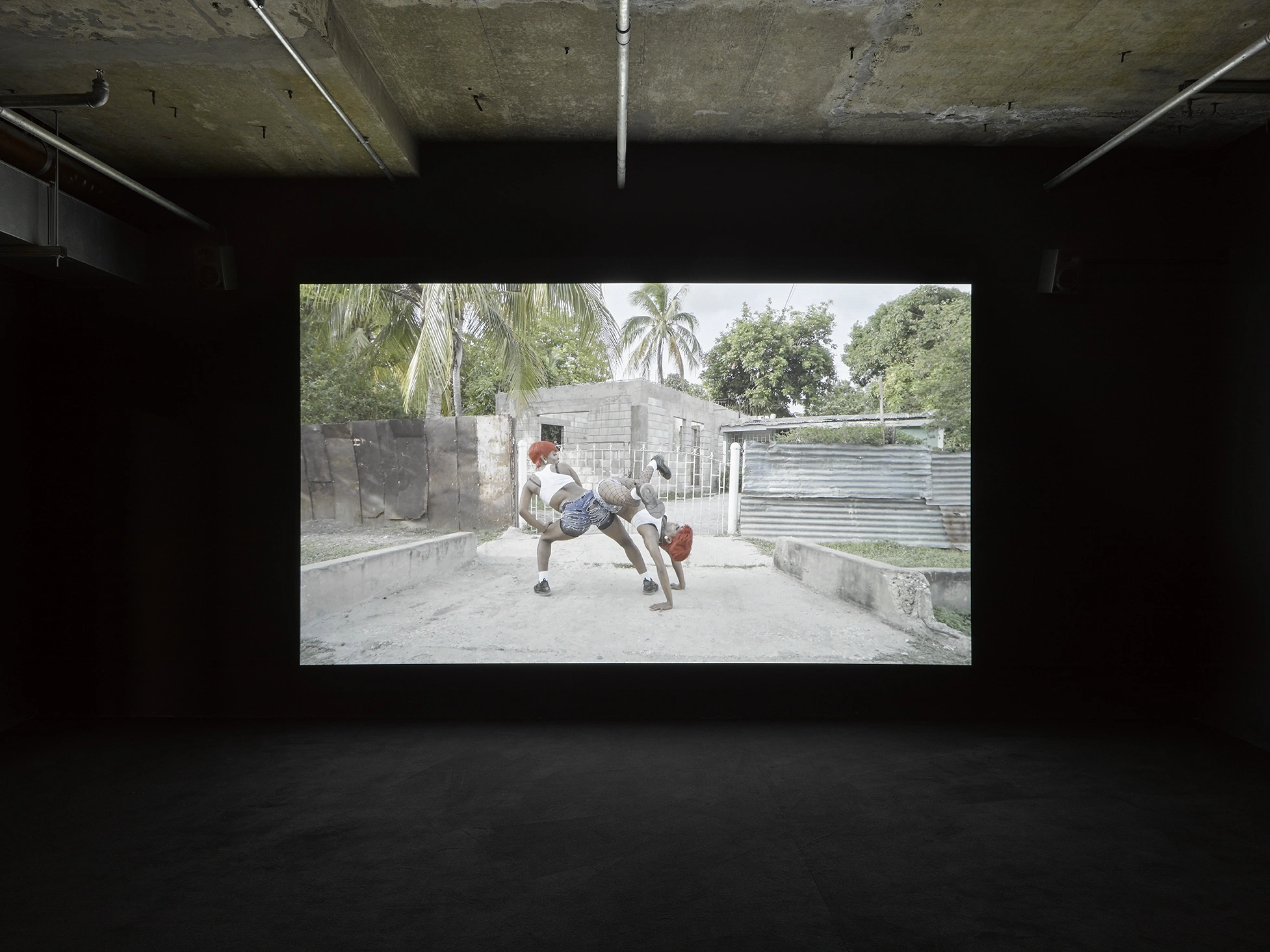
In the cavernous, industrial expanse of 180 Studios, a heartbeat emanates from the walls—a rhythmic, bass-heavy vibration that feels as much like a cultural manifesto as it does a soundtrack. This is Shelly Belly Inna Real Life, a mesmerizing video installation by the Argentinian artist, choreographer, and dancer Cecilia Bengolea. Currently a cornerstone of The Vinyl Factory: Reverb exhibition, the work offers an immersive, uncompromising look at the vibrant, often misunderstood world of Jamaican dancehall.
Captured on location between 2015 and 2019, the piece is more than a mere documentary; it is an ethnographic study of movement, community, and the friction between artistic expression and systemic authority. Through an intimate lens, Bengolea invites viewers to step into the kinetic landscape of Kingston, guided by one of its most charismatic figures: the legendary dancer Shelly Belly.
The Genesis of an Artistic Obsession
To understand Shelly Belly Inna Real Life, one must first understand the artistic trajectory of its creator. Bengolea, whose work often interrogates the intersection of sculpture, performance, and sociology, has long been drawn to the visceral nature of street dance. Her fascination with dancehall—a genre that emerged from the socio-political crucible of post-independence Jamaica—is rooted in the genre’s ability to act as both a mirror and a catalyst for its community.
The project represents a maturation of a long-standing creative relationship between the artist and her subject. This is not the first time Bengolea has turned her camera toward the dancehall scene. In 2016, she collaborated with the British artist Jeremy Deller to produce Bom Bom’s Dream for The Infinite Mix exhibition, also commissioned by The Vinyl Factory. That work traced the surreal, transnational journey of a Japanese dancer known as "Bom Bom," whose devotion to Jamaican dancehall underscored the global reach of the genre. Shelly Belly, the charismatic icon of the scene, played a pivotal role in that project, and his presence in the new work serves as a narrative bridge between the two pieces.
A Chronology of the Streets (2015–2019)
The production of Shelly Belly Inna Real Life was not a sprint, but a sustained, multi-year immersion. Between 2015 and 2019, Bengolea traveled repeatedly to Jamaica, embedding herself within the social fabric of the dancehall scene.
- 2015: The initial research phase. Bengolea begins building trust within the community, moving away from the role of a detached observer to that of an active participant.
- 2016: A turning point. While working on Bom Bom’s Dream, the collaboration with Shelly Belly deepened. Bengolea realizes that the story of dancehall cannot be told in a single film; it requires a deep dive into the everyday reality of those who live it.
- 2017–2018: The core filming period. Bengolea spends months navigating the local dance circuits, documenting the specific choreographic languages—the "steps"—that are invented, popularized, and discarded in a cycle of constant innovation.
- 2019: Final documentation. The artist captures the changing social landscape of Kingston, noting the evolving relationship between the dancehall practitioners and the local authorities.
- 2024: The exhibition premiere. Shelly Belly Inna Real Life is unveiled as a cornerstone of The Vinyl Factory: Reverb at 180 Studios, providing a permanent, high-definition home for ephemeral street culture.
The Choreography of Social Context
At the heart of the installation is a fundamental question: what does it mean to dance in a space where your body is seen as a political object? In her recent interviews, Bengolea discusses the inherent tension in dancehall. It is a form of expression that is fiercely independent, yet constantly policed.

"Dancehall is a language of survival," Bengolea explains. The movements are not merely aesthetic; they are responses to the environment. The "steps" often mimic everyday activities or act as satirical commentary on social status, police presence, and economic precarity. By framing these movements within an art gallery setting, Bengolea forces a dialogue between the "high art" of the institution and the "street art" of the ghetto.
The relationship between the Jamaican police and the dancehall scene is a recurring theme in the work. Historically, public gatherings and street parties were often viewed with suspicion by the state. Bengolea’s lens captures the constant, low-level friction—the way the music must sometimes be lowered, the way dancers must navigate the presence of law enforcement, and the resilience required to keep the culture alive despite these constraints.
Supporting Data: The Global Dancehall Economy
While the installation focuses on the human element, the implications of dancehall extend far beyond the streets of Kingston.
- Cultural Export: Dancehall has influenced global pop music, from the production styles of international artists to the fashion and vernacular of youth cultures in London, New York, and Tokyo.
- The Role of the "Icon": Figures like Shelly Belly function as both choreographers and local influencers. Their ability to "create" a dance step that goes viral—long before the digital era—is a testament to the power of the Jamaican creative class.
- Institutional Recognition: The inclusion of this work in a major exhibition like Reverb signals a shift in how museums are engaging with subcultural history. By treating dancehall as an art form worthy of archival preservation, institutions are acknowledging that the "canon" of modern dance is incomplete without the influence of the Caribbean.
Official Responses and Curatorial Intent
The Vinyl Factory, which has consistently pushed the boundaries of where music and visual art meet, views Shelly Belly Inna Real Life as a vital component of the Reverb exhibition. Curators have noted that the piece acts as a "sonic and visual anchor," grounding the more experimental aspects of the exhibition in a raw, human reality.
"Cecilia doesn’t just film the dance," a spokesperson for the exhibition noted. "She films the atmosphere, the humidity, the sound of the speakers, and the intense gaze of the onlookers. It’s a sensory experience that challenges the viewer to look at the power dynamics of who gets to be a ‘performer’ and who gets to be a ‘citizen.’"
The Implications of Representation
The work raises significant questions about representation. As an Argentinian artist documenting Jamaican culture, Bengolea is conscious of the potential for appropriation. However, her approach—which emphasizes collaboration, long-term commitment, and deep respect for the community—positions the film as a testament to the universal nature of the dancehall experience.

By bringing the "real life" of these dancers to 180 Studios, the exhibition does more than provide entertainment; it provides a platform for voices that are often marginalized in mainstream discourse. It highlights the ingenuity of creators who have developed a complex, sophisticated, and highly physical culture with few resources, proving that art is not about the materials one possesses, but the intensity with which one expresses their reality.
Visiting Information
For those looking to experience the exhibition firsthand, The Vinyl Factory: Reverb is currently on display at 180 Studios in London. It serves as a rare opportunity to witness the convergence of music, film, and social commentary.
Exhibition Details:
- Location: 180 The Strand, London, WC2R 1EA
- Dates: 22 May 2024 – 2 March 2025
- Closure Note: Please be advised the exhibition will be closed for the winter break between December 23, 2024, and January 8, 2025.
- Hours:
- Wednesday – Saturday: 12pm to 7pm
- Sunday: 12pm to 6pm
As the world continues to move and evolve, works like Shelly Belly Inna Real Life remind us that there is profound power in the simple, defiant act of dancing. Whether in a Kingston street or a London gallery, the heartbeat of the dancehall remains a pulse that refuses to be ignored.