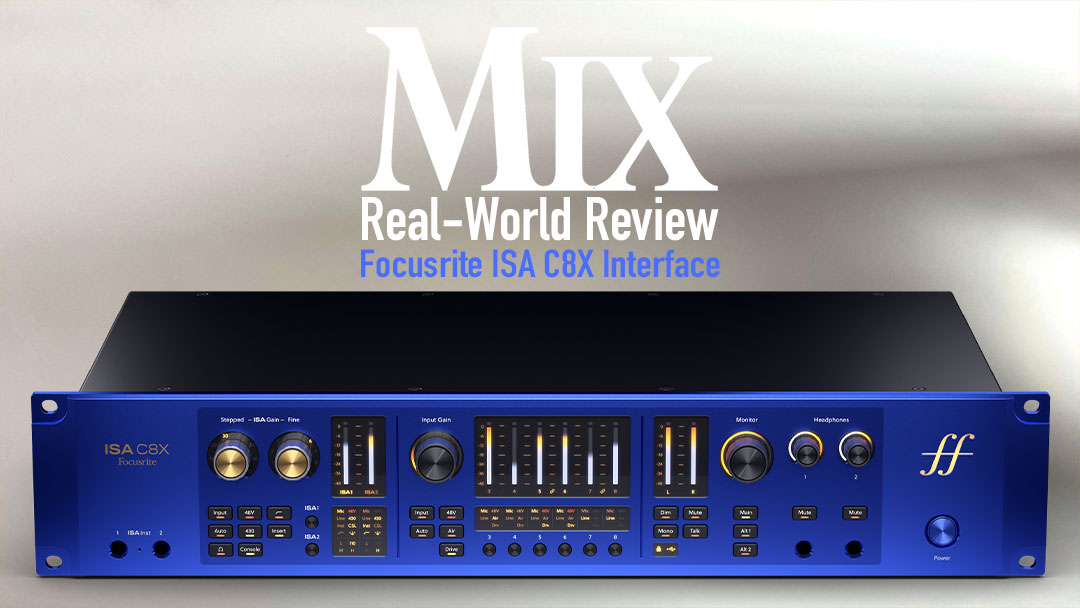
In the professional audio landscape, the eight-channel rackmount interface has long been the unsung workhorse—a utility device that engineers rely on until the moment a clocking issue or a signal-path bottleneck forces a rethink. It is rare for a product in this category to generate the kind of industry-wide fervor usually reserved for boutique microphones or vintage console restorations. However, with the October 1, 2026, release of the Focusrite ISA C8X, the market has been presented with a compelling exception.
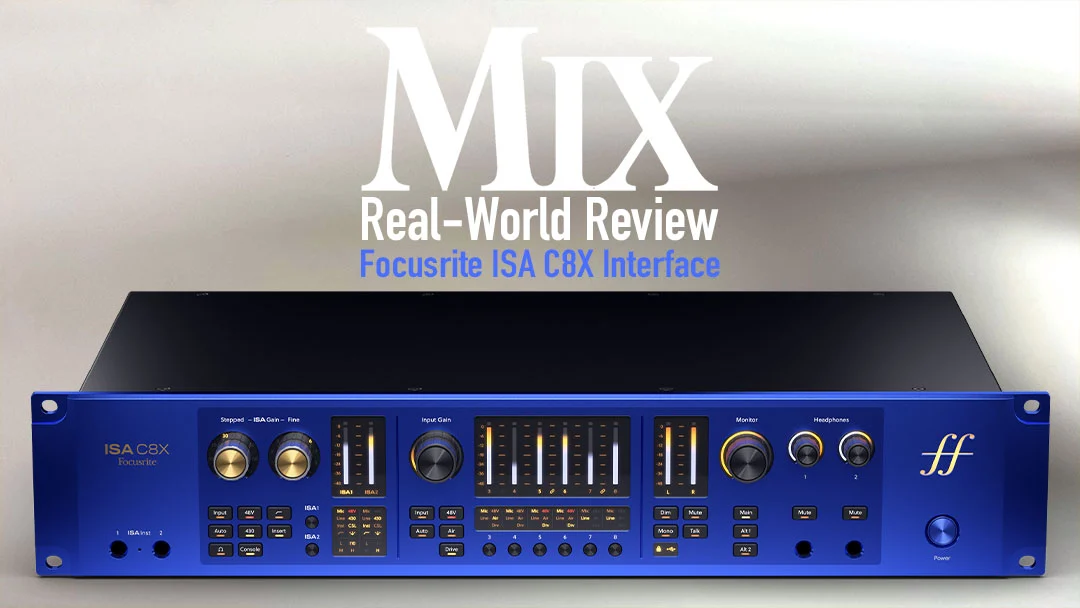
Positioned strategically between the consumer-friendly Clarett+ series and the enterprise-grade, Dante-integrated RedNet systems, the ISA C8X is a 26-input, 28-output, 2U USB-C powerhouse. By marrying the legendary transformer-coupled circuitry of the original 1985 ISA 110 with modern, high-fidelity conversion, Focusrite has signaled a shift: the era of the "utilitarian" interface is being replaced by the era of the "studio centerpiece."
The Technical Foundation: Legacy Meets Modernity
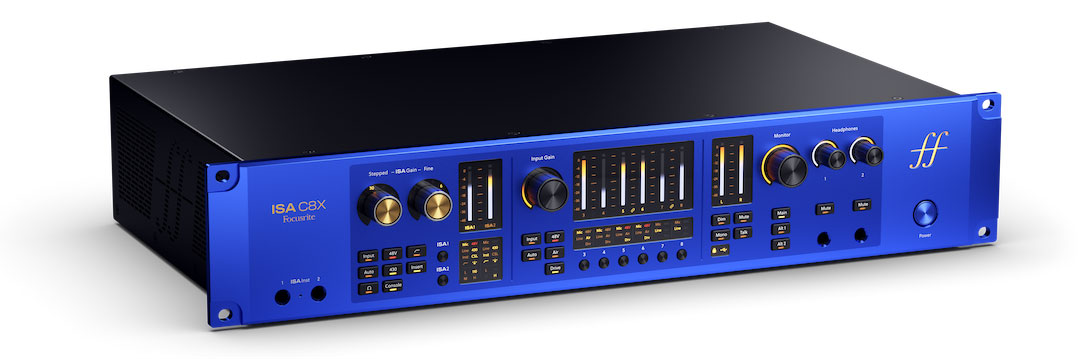
At the heart of the ISA C8X lies a direct lineage to the golden age of recording. The unit’s defining feature is its pair of flagship ISA microphone preamps. These are not merely digital emulations; they are hardware-based circuits built upon the legendary Lundahl LL1538 input transformer. This is the same architecture that Rupert Neve famously engineered for Sir George Martin, a design that eventually became the sonic backbone of the iconic Focusrite Forte and Studio consoles.
Precision and Coloration
Each of these primary channels offers a staggering 79 dB of gain. To maintain sonic integrity, engineers are provided with both stepped and fine gain adjustments, allowing for surgical precision when capturing delicate sources. The signal path is further enhanced by:
- Switchable Impedance: Tailoring the mic load to the specific characteristics of the microphone.
- Balanced Inserts: Allowing for seamless integration of external analog processors, such as compressors or EQs, directly into the signal chain before A/D conversion.
- Console Mode: An analog-circuitry addition that introduces variable saturation and a weighted low-end response, mimicking the behavior of vintage large-format consoles.
- 430 Air Mode: A sophisticated circuit that provides high-frequency lift, lending a "sheen" to vocals and overheads without the harshness often associated with digital EQ.
Beyond these two "hero" channels, the C8X boasts six additional ultra-low-noise microphone preamps offering 69 dB of gain. These secondary channels feature analog Air mode and variable Drive DSP, offering a flexible middle ground between clinical transparency and colored, harmonically rich textures.
Chronology of Development and Real-World Integration
The journey to the ISA C8X began with a recognized gap in the project studio market. Engineers were finding themselves forced to choose between the high-channel-count, "transparent" interfaces that offered little in the way of character, or expensive, outboard-heavy setups that made patch-bay management a nightmare.
The Setup Phase
In our real-world testing, the C8X proved that its design philosophy prioritizes workflow speed. Upon connecting the device via USB-C, the integration with Focusrite Control 2 software was seamless. Within five minutes of unboxing, the system had successfully performed a firmware update and initialized.
It is worth noting for prospective users that the hardware is robust; the unit produces mechanical relay clicks during initialization and sample-rate changes—a tactile reminder of the physical analog components being engaged under the hood. Once established, the device functioned with the stability expected of a professional hub, appearing immediately in both macOS and Windows environments without the need for complex routing gymnastics.
Supporting Data: Specifications and Connectivity
The ISA C8X is designed to handle the complexities of a modern professional studio, where multiple instrument types and monitoring requirements converge.
Conversion and I/O
Focusrite has opted to implement the same 24-bit/192 kHz AD/DA converters found in their high-end RedNet systems. The result is a dynamic range of 125 dB and a noise floor that effectively vanishes in most recording environments.
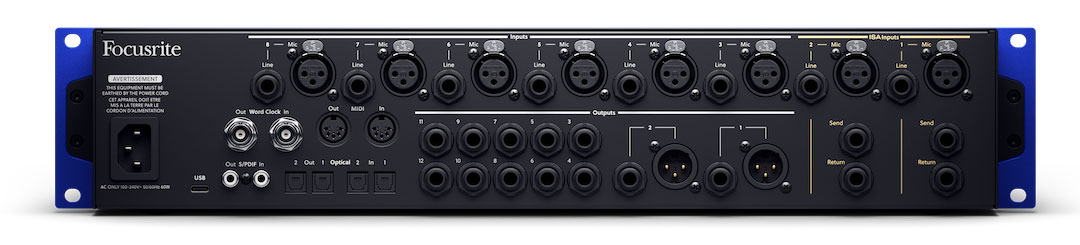
- Line-Level Management: The interface includes eight dedicated, fixed-gain balanced line inputs. This is a critical feature for the contemporary studio, as it allows for permanent connections to synths, outboard preamps, and compressors, effectively ending the cycle of repatching.
- Monitoring Flexibility: The 12 balanced line outputs are highly versatile, supporting everything from standard stereo arrays to complex 7.1.4 immersive audio configurations. Users can toggle between three discrete monitor groups directly from the front panel.
- Digital Expansion: To ensure future-proofing, the unit provides 16 channels of ADAT I/O (at 44.1/48 kHz), S/PDIF connectivity, and MIDI/Word Clock for synchronization in complex digital environments.
Official Perspective: The Focusrite Control 2 Ecosystem
A hardware interface is only as effective as its software control layer. Focusrite has acknowledged this by centralizing the C8X’s management into the Focusrite Control 2 application.
This software is not merely a virtual mixer; it is an extension of the hardware’s capabilities. From the desktop app, or the companion mobile app, users can trigger the Auto Gain feature, which calibrates levels across all eight preamps simultaneously. This is a game-changer for solo engineers who are both the operator and the performer. The ability to save and recall complete studio snapshots ensures that the session state—including routing, preamp impedance, and monitor levels—is preserved exactly as left, eliminating the "recall anxiety" that often plagues project studios.
Implications for the Future of Studio Recording
The release of the ISA C8X marks a pivot point in the industry. For years, the "transparent vs. colored" debate has driven engineers toward massive, expensive rack systems. By distilling the essence of the ISA 110 circuit into an interface that also serves as a high-end converter and router, Focusrite has essentially lowered the barrier to entry for professional-grade "console" sound.
The "Dollars-to-Features" Math
At a list price of $2,299.99, the ISA C8X presents a formidable value proposition. When one calculates the cost of purchasing two high-end boutique preamps, a 26-channel interface, a high-quality monitor controller, and a digital patch bay separately, the total significantly exceeds the price of the C8X.
The implication is clear: the market is moving toward integration. Producers no longer want to troubleshoot compatibility between disparate manufacturers; they want a unified, high-fidelity ecosystem. The ISA C8X provides that by offering a sound that is decidedly "analog" in its warmth and saturation, while maintaining the digital flexibility required for modern DAW-based workflows.
Conclusion: A New Standard
The Focusrite ISA C8X is not just an interface; it is a declaration of intent. It challenges the notion that an interface should be a "silent partner" in the signal chain. Instead, it invites the engineer to lean into the hardware, using the Console and 430 Air modes to shape the sound at the point of entry.
For the studio owner looking to elevate their production value without moving to a full analog desk, the C8X is arguably the most significant piece of hardware to hit the market this year. It balances the nostalgia of the 1985 ISA lineage with the high-speed, low-latency requirements of 2026, creating a platform that is as reliable as it is musical. If you are building a studio meant for serious, high-fidelity production, the C8X is no longer a peripheral consideration—it is the logical foundation upon which to build.