For decades, the gigging musician’s worst nightmare has remained constant: the spinning beach ball of death on a laptop mid-performance. Whether it’s a sudden OS update, a stray notification, or a faulty USB hub, relying on a computer for backing tracks in a live environment is an exercise in high-stakes anxiety.
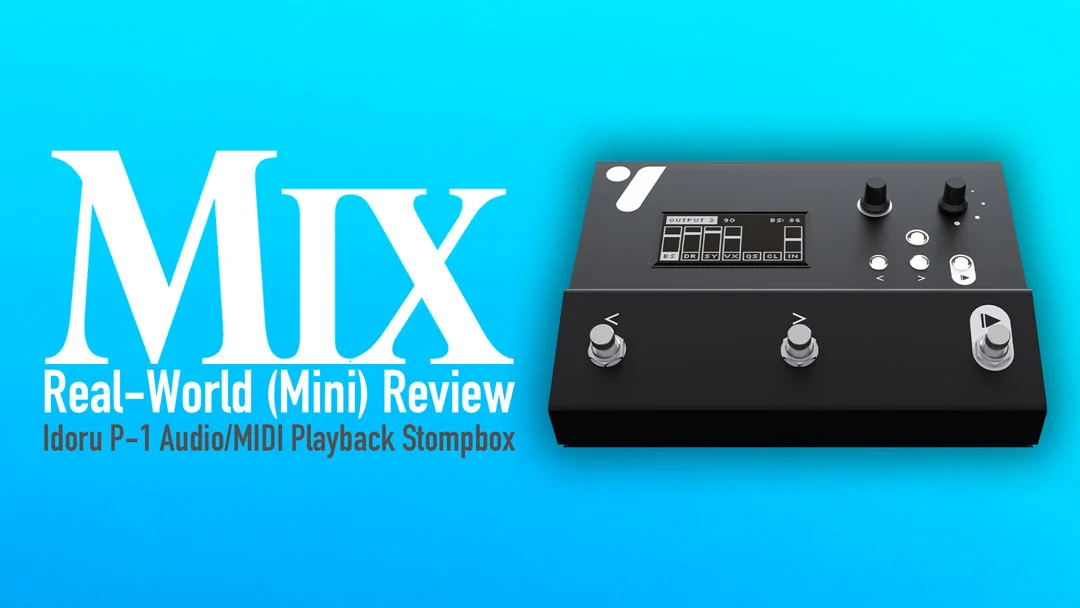
Enter the Idoru P-1, a device that promises to liberate performers from the fragility of the laptop-on-stage paradigm. Reviewer Rob Tavaglione recently put this unique stompbox-style playback device through its paces, and the verdict suggests that the era of the "unreliable laptop rig" may finally be drawing to a close. Priced at $529, the P-1 offers a robust, dedicated hardware solution that prioritizes stability, audio quality, and ergonomic control.
Main Facts: The Anatomy of the P-1
At its core, the Idoru P-1 is designed to be the "set-and-forget" brain of a live performance rig. Packaged in a rugged, all-steel chassis that looks right at home on a pedalboard, the P-1 is built to withstand the rigors of the road.
Key Specifications:
- Form Factor: Stompbox-style, pedalboard-friendly.
- Storage: MicroSD card-based playback (ensuring no hard drive spinning-platter failures).
- Connectivity: Six discrete audio outputs.
- File Support: 16-bit WAV, MP3, and MIDI.
- Build: All-steel construction with high-visibility display and industrial-grade footswitches.
The device functions as a multi-channel playback engine, allowing musicians to load up to six simultaneous tracks per song. These can be configured in any combination of stereo or mono, giving sound engineers and band leaders granular control over how their backing tracks—be it synth layers, vocal harmonies, or percussion loops—are routed to the front-of-house (FOH) console.
Chronology: The Evolution of Live Backing Tracks
To understand why the Idoru P-1 is such a significant development, one must look at the evolution of live performance technology.
The Early Days: Tape and CD
In the 1980s and 90s, artists relied on cassette multitracks or MiniDiscs. While these were inherently stable, they lacked the flexibility of modern digital systems. If a setlist changed on the fly, the musician was stuck with the pre-recorded order of the tape.
The Laptop Era (2000s–Present)
The arrival of DAWs like Ableton Live, Logic Pro, and MainStage revolutionized the industry. Suddenly, performers could trigger infinite clips, map MIDI controllers to effects, and sync lighting cues. However, this came at the cost of "compute-dependency." The laptop became a single point of failure. A single driver conflict could bring a show to a screeching halt.
The Dedicated Hardware Shift (2025–2026)
With the introduction of devices like the Idoru P-1, we are seeing a pivot back toward dedicated hardware. The philosophy is simple: Do one thing, and do it perfectly. By moving the processing away from a general-purpose computer and into a specialized embedded system, the P-1 eliminates the background processes and software bloat that plague traditional laptop setups.
Supporting Data: Why Reliability Matters
In the world of professional touring, "downtime" is not just a nuisance; it is a financial and reputational liability.
Audio Fidelity
One of the primary concerns for professional audio engineers when moving away from a high-end audio interface (like those from RME or Universal Audio) is the quality of the Digital-to-Analog (D/A) converters. Tavaglione notes that the P-1’s converters sound excellent. In a live setting, where the signal path is often long and noisy, having a clean, high-headroom output stage is crucial for ensuring that backing tracks sit well in the mix without sounding "digital" or thin.
Operational Workflow
The Idoru workflow is built on a hierarchy: Songs > Sets > Sessions.
- Songs: The individual files (WAV/MP3/MIDI).
- Sets: A collection of songs arranged for a specific performance.
- Sessions: A grouping of sets, ideal for tours with varying setlists.
By using the Idoru software on a computer to manage the files and then transferring them to the MicroSD card, the artist removes the computer from the performance stage entirely. The P-1 handles the decoding and playback internally, ensuring that the latency between the physical press of a switch and the audio trigger is near-instantaneous.
Official Responses and User Experience
While Idoru is a relatively newer entrant to the market, the feedback from early adopters—including industry professionals like Tavaglione—has been overwhelmingly positive. The emphasis on "survivability" is the recurring theme in all user reports.
"A bright screen, all-steel construction and proper switches convince me that the P-1 should survive the hard-knocks world of live music," Tavaglione reports. This sentiment is echoed by many in the touring community who have grown tired of the "clamshell" laptop aesthetic, which often feels out of place among tube amplifiers and analog pedalboards.
The ability to use both hands and feet to navigate the device allows for a level of improvisation that was previously difficult. "Crafty jammers," as Tavaglione puts it, can load song sections as distinct files, allowing them to loop, skip, or advance to next sections in real-time. This transforms the P-1 from a simple "backing track player" into a dynamic instrument that can respond to the energy of the room.
Implications: The Death of the Laptop-on-Stage?
The success of the Idoru P-1 carries several implications for the future of live sound.
1. The Rise of the "Hybrid" Pedalboard
We are seeing a trend where pedalboards are becoming the central hub for a musician’s entire rig. By incorporating the P-1 into a board that already contains guitar processors, MIDI controllers, and expression pedals, artists can centralize their control. This reduces the "footprint" of gear on stage and simplifies the setup and teardown process.
2. Democratization of Pro-Level Playback
Previously, high-reliability playback systems were reserved for major stadium tours, often involving complex rack-mounted servers and redundant failover systems (like the Radial SW8). The P-1 brings a similar level of reliability to the club and theater-level artist for a fraction of the cost. This democratizes the use of backing tracks, allowing smaller bands to achieve a "wall of sound" production without needing a massive technical crew.
3. Focus on Artistic Intent
Perhaps the most profound implication is the psychological one. When a musician stops looking at a screen to monitor their CPU usage or their track status, they begin to look at their bandmates and their audience. The P-1 facilitates this by handling the heavy lifting, allowing the performer to focus on the emotional delivery of the music.
4. A New Standard for Hardware Stability
As more companies follow Idoru’s lead, we expect to see a surge in specialized hardware that emphasizes offline reliability. In an age of cloud-based everything, there is a renewed appreciation for "local, offline, and indestructible."
Final Thoughts
The Idoru P-1 is not trying to be a computer. It is not trying to run plugins, stream audio, or check emails. It is a dedicated, single-purpose engine for delivering audio reliably, night after night. For the working musician, the $529 investment is arguably an insurance policy against the biggest fear in live performance: the sound cutting out.
As Rob Tavaglione concluded, the P-1’s combination of high-quality converters, intuitive software, and "tank-like" construction makes it a standout piece of gear. Whether you are a solo artist performing with backing tracks or a full band looking to integrate complex sequences without the stress of a laptop, the Idoru P-1 offers a professional, modern, and—most importantly—stable path forward. In the high-pressure world of live sound, reliability is the ultimate feature, and in that regard, the P-1 hits all the right notes.