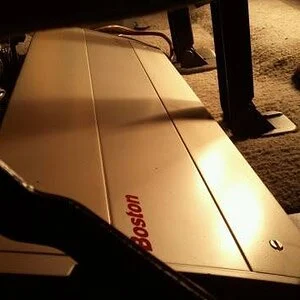
For automotive enthusiasts, the 2025 Ford Mustang GT Premium represents the pinnacle of the internal combustion era—a raw, visceral experience paired with modern digital creature comforts. However, for the discerning audiophile, the factory sound system often falls short of the performance expected from a vehicle with such a commanding road presence. As owners look to push the boundaries of their sonic landscape, a new trend has emerged: custom-integrated high-output bass systems designed to complement, rather than clash with, the Mustang’s sophisticated electrical architecture.
This article explores the technical landscape of upgrading a 2025 Mustang GT, the challenges of electrical load management, and the debate between woofer designs for the modern performance coupe.
Main Facts: Building a Sonic Foundation
The quest for a high-fidelity audio system in the 2025 Mustang is fraught with technical hurdles. The owner of the project at the center of this investigation has set a clear objective: a dual-subwoofer setup optimized for ported enclosures, powered by a 1,200-watt RMS Kicker amplifier.
Project Specifications at a Glance:
- Target Vehicle: 2025 Ford Mustang GT Premium.
- Primary Objective: High-output, ported bass system.
- Amplification: Kicker 46CXA1200.1T (1,200W RMS at 2-ohms).
- Subwoofer Configuration: Dual 10-inch subwoofers (Kicker CVX or L7S series).
- Total Budget: Approximately $2,000, covering hardware, integration modules, and ancillaries.
- Integration Strategy: Active Noise Cancellation (ANC) bypass and PAC integration modules to retain factory steering wheel controls and infotainment functionality.
The core challenge involves maintaining the integrity of the vehicle’s electrical system. With limited information available regarding the stock alternator’s precise amperage—a common frustration even among dealership service departments—the integration relies on predictive modeling and historical data from the 2023 model year.
Chronology: Navigating the Modern Integration Process
The installation process for a 2025 Mustang is not as straightforward as it was for the muscle cars of yesteryear. The process follows a precise sequence to ensure the vehicle’s sensitive CAN-bus systems are not compromised.
Phase 1: Research and Data Aggregation
The planning phase began with AI-assisted research to determine the available trunk space and electrical capacity. Using measurements of 46"W x 35"D x 15-18"H, the design allows for a custom-built ported enclosure. Concurrent research into the electrical system suggested a baseline draw of 50-80 amps, placing the 1,200W Kicker amplifier within a theoretically safe operating range, provided that a capacitor is utilized to mitigate voltage dips during high-transient bass hits.
Phase 2: Integration Hardware
The selection of the PAC module is critical. In the 2025 Mustang, the factory head unit is tightly integrated with the vehicle’s digital infrastructure. Replacing the radio is rarely an option; therefore, signal integration—extracting a clean, full-range audio signal—must be handled by a sophisticated interface.
Phase 3: The Forscan Dilemma
A critical juncture in the installation is addressing the Active Noise Cancellation (ANC) and Electronic Sound Enhancement (ESE). ESE, which pipes synthesized engine noise into the cabin, can cause significant distortion when amplified. Current plans involve using a physical bypass module, though experts suggest that manual intervention via the Forscan software platform may be required to fully disable the ESE system to prevent "feedback loops" or unwanted drone.
Supporting Data: The Subwoofer Debate
A significant portion of this project revolves around the choice of subwoofers. The owner is torn between the Kicker CVX50102 (a traditional round 10-inch driver) and the Kicker 44L7S102 (the iconic square Solo-Baric driver).
Technical Comparison
| Feature | Kicker CVX50102 | Kicker L7S102 |
|---|---|---|
| Shape | Round | Square |
| Surface Area | Standard | Increased (More air displacement) |
| Frequency Response | Up to 500Hz | Up to 100Hz |
| Design Philosophy | Traditional SQ/SPL balance | Maximum SPL/Air movement |
The dilemma centers on the frequency response. While the round CVX series offers a broader range, the L7S series provides greater surface area, which is highly desirable for the ported enclosure the owner prefers. The question arises: in a ported setup, does the 100Hz roll-off of the L7S truly diminish Sound Quality (SQ)?
In a ported system, the enclosure is tuned to a specific frequency, usually designed to boost the low-end response. Because the enclosure—not the driver alone—handles the heavy lifting of the low-frequency reproduction, the higher frequency roll-off of the L7S may be mitigated by the crossover settings on the Kicker 46CXA1200.1T.
Official Responses and Expert Insights
Industry professionals and specialized audio shops emphasize that the "Big 3" upgrade—upgrading the alternator-to-battery ground, engine-to-chassis ground, and battery-to-chassis ground—is a mandatory first step for any high-wattage install in a modern Ford.
"While we don’t have the exact factory alternator spec for the 2025," notes a lead technician at a regional custom audio facility, "we treat the Mustang’s electrical system with extreme caution. The use of a capacitor is a start, but for a 1,200-watt RMS load, owners should also consider an AGM battery upgrade to ensure consistent voltage under heavy, sustained load."
Regarding the ANC and ESE systems, the consensus among installers is clear: bypass modules are the preferred path for most consumers, but deep-level software adjustments via Forscan are the only way to ensure the factory "artificial engine noise" does not attempt to "correct" the sound of the subwoofer system, which could lead to phasing issues and a muddy, inconsistent bass response.
Implications: The Future of Mustang Audio
The implications of this project extend beyond one owner’s trunk. As Ford continues to tighten the integration of its infotainment and engine management systems, the "plug-and-play" era of car audio is effectively dead.
Electrical Sensitivity
The 2025 Mustang’s electrical system is a finely tuned instrument. By drawing an additional 1,200 watts, the owner is effectively taxing the alternator’s overhead. Should the alternator prove insufficient, the system risks "brownouts" that could trigger error codes in the Mustang’s PCM (Powertrain Control Module). This necessitates a conservative approach to power distribution.
Retaining the "Muscle" Experience
The goal is "loud bass" that complements a history of rock and hip-hop, spanning from the 1950s to the 2000s. The preference for ported enclosures indicates a desire for the physical impact of the music—the "feel" of the bass—over clinical accuracy. However, in a performance vehicle like the Mustang GT, the weight of a custom enclosure and the draw of high-power electronics must be balanced against the car’s intended purpose: driving performance.
Final Considerations
The project budget of $2,000 is aggressive but achievable. By allocating funds toward the PAC integration module and a high-quality wiring kit, the owner is prioritizing the longevity of the install over superficial upgrades. The final hurdle remains the choice between the round and square Kicker drivers.
For the listener who values the nuances of classic rock and the punch of modern hip-hop, the ported L7S configuration may offer the best of both worlds. While the square geometry might technically roll off sooner in an open-air test, the gain in cone area provides the "air movement" necessary to fill the cabin of the Mustang, ensuring that the bass is felt as much as it is heard.
As the industry shifts toward more complex digital signal processing (DSP), the DIY approach—coupled with professional installation—remains the best way to extract the full potential of a 2025 Mustang GT. Whether this project ultimately requires a high-output alternator upgrade or proves stable with the stock setup remains to be seen, but it serves as a masterclass in modern automotive audio planning.
For those looking to follow in these footsteps, the advice is consistent: document your electrical draw, prioritize your signal integration, and never underestimate the impact of a well-designed, ported enclosure on the overall soundstage. The road to the perfect sound system is long, but for the Mustang owner, it is a journey well worth taking.