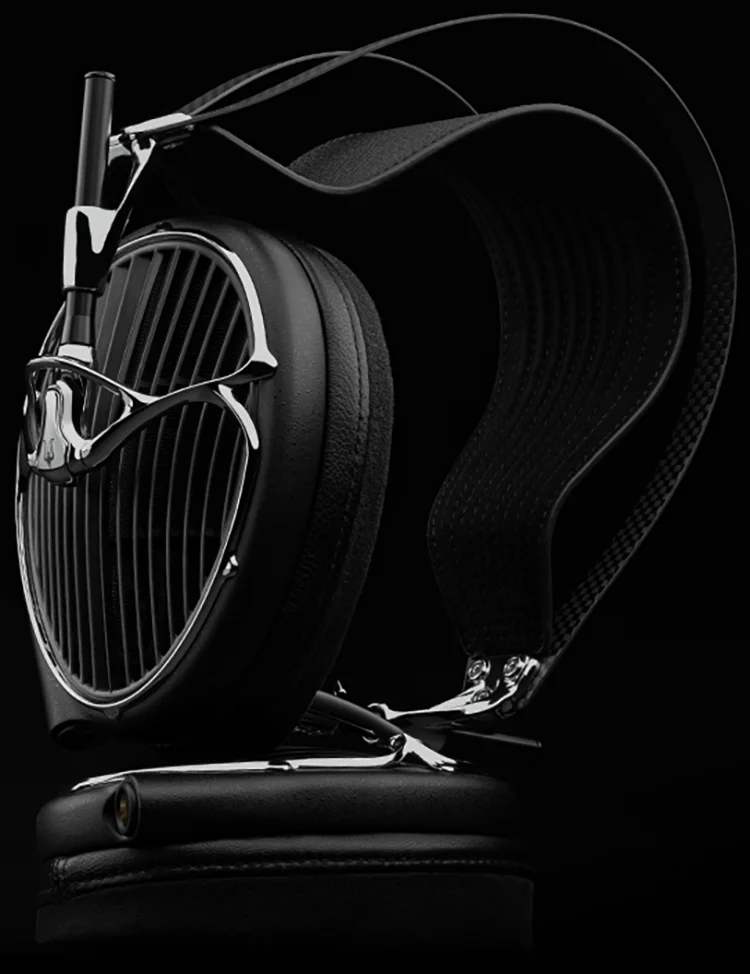
In the rarified air of high-end audio, where the pursuit of perfection is often measured in microscopic adjustments and material science, Romanian manufacturer Meze Audio has long stood as a titan of both aesthetics and engineering. This week, the company confirmed the upcoming release of its latest flagship: the ARTA. Representing a multi-year odyssey in acoustic research and sculptural design, the ARTA is not merely a new product; it is a declaration of intent to bridge the final gap between recorded sound and the lived experience of music.
Unveiled in anticipation of its public debut at the High-End Vienna show (June 4–7), the ARTA promises to redefine the boundaries of planar magnetic technology. With a retail price point set at $6,000/€6,000, it positions itself firmly in the ultra-luxury tier, competing with the world’s most prestigious audio equipment.
Main Facts: The Anatomy of a Masterpiece
At the heart of the ARTA lies the proprietary MZ5 H𝛿 (Delta) driver, developed in close collaboration with the long-term partner Rinaro Isodynamics. This driver represents the most significant departure from conventional headphone design seen in recent years. By engineering the highest-impedance planar magnetic driver to date, Meze Audio has achieved a level of signal purity and electrical stability previously thought impossible in a headphone format.
The ARTA operates on a high-voltage, low-current principle, which allows for exceptional linearity across the entire frequency spectrum—a range spanning an astonishing 3 Hz to 115 kHz. This ultra-wide bandwidth ensures that the listener is not just hearing music, but perceiving the complex harmonics and spatial cues that constitute a truly "live" performance.

The physical architecture of the ARTA is equally ambitious. Eschewing the utilitarian, industrial aesthetic common in high-end audio, Meze has employed a "bionic fluidity" design language. The chassis is a marriage of precision-milled metals, structural carbon fiber, and premium leather, intended to function as a piece of "art in motion." Every component, from the angled acoustic blades in the grille—designed specifically to eliminate internal soundwave reflections—to the fully replaceable headband and earpads, is built with an eye toward multi-generational longevity.
Chronology of Development: A Multi-Year Odyssey
The genesis of the ARTA is rooted in a fundamental philosophical question posed by the Meze Audio engineering team: What remains between the listener and the music?
2020–2021: Conceptualization and R&D
Following the critical success of the Empyrean and Elite series, the Meze design team sought to push the limits of their partnership with Rinaro. The initial phase focused on overcoming the limitations of current planar magnetic drivers. The decision to pursue a high-impedance, high-voltage driver was made during this period, requiring a complete reimagining of the electrical architecture of the headphones.
2022: Sculptural Integration
With the core driver technology in development, the project shifted toward the "sculptural" phase. Antonio Meze, the company’s founder, insisted that the design must move away from the traditional, rigid headphone shape. The team spent months iterating on a form that would mimic natural curves while maintaining the structural integrity required to house the massive MZ5 H𝛿 array.

2023: The Prototype Phase
Throughout 2023, the team at their Baia Mare, Romania headquarters began hand-assembling prototypes. This period was characterized by rigorous stress testing and acoustic tuning, ensuring that the "warm-neutral" sound signature—a hallmark of Meze’s target frequency response—was achieved without sacrificing detail or transient speed.
June 2024: Public Preview
The announcement precedes the official showcase at High-End Vienna, serving as the first public unveiling of the final production units. The company has stated that consumer availability will follow shortly after the event, marking the culmination of a four-year development cycle.
Supporting Data: Technical Excellence
The specifications of the ARTA confirm its place in the upper echelon of audio hardware.
| Feature | Specification |
|---|---|
| Driver Type | Rinaro High Impedance Isodynamic® Hybrid Array MZ5 H𝛿 |
| Frequency Range | 3 Hz – 115 kHz |
| Total Harmonic Distortion | 0.05% |
| Philosophy | Warm-neutral with expansive soundstage |
| Origin | Hand-assembled in Baia Mare, Romania |
The low Total Harmonic Distortion (THD) of 0.05% is particularly noteworthy. In the context of audio equipment, this indicates that the signal being reproduced is nearly identical to the source recording, with virtually no coloration or distortion introduced by the headphone itself. This purity allows for the "organic spaciousness" that Meze describes, where instruments are projected into a three-dimensional space that mirrors the acoustics of a well-treated listening room.

Official Responses: The Engineering Perspective
Alex Grigoras, Lead Acoustic Engineer at Meze Audio, has been the driving force behind the "music as space" philosophy that defines the ARTA.
"ARTA came into existence from asking the same question over and over: what is there still between the listener and the music?" Grigoras stated during the press briefing. "Through our collaboration with Rinaro Isodynamics, we’ve arrived at something that doesn’t quite sound like headphones anymore, but simply music occupying real space. We have removed the veil. When you put these on, you are not listening to a driver; you are listening to the performance."
This sentiment is echoed by the broader Meze team, who emphasize that the ARTA is a "passion project." By creating a product that is fully serviceable—where every screw, pad, and driver can be replaced or repaired—they are fighting against the "disposable consumer electronics" trend. "An artistic headphone made to this standard should never become waste," the company noted in its official press release, "but rather appreciated with the passing of time."
Implications for the High-End Audio Market
The release of the ARTA carries significant implications for the audiophile landscape. First, it reinforces the trend of "boutique-luxury" integration, where technical performance is no longer sufficient; the product must also be a tactile and visual masterpiece.

Second, the move toward a high-impedance design suggests a shift in the high-end headphone market. While many modern headphones are designed to be "easy to drive" (low impedance/high sensitivity) for use with portable devices, the ARTA signals a return to the "home-base" audiophile experience. By requiring high-voltage, low-current operation, it encourages users to pair the ARTA with high-end, dedicated amplification, thereby elevating the entire audio chain.
Finally, the commitment to modularity and serviceability is a bold move. In a market where flagship products are often superseded by "Mark II" versions every few years, Meze is positioning the ARTA as a "heirloom-quality" investment. This strategy targets the serious enthusiast who values sustainability alongside sonic performance.
As the industry turns its gaze toward Vienna this June, the question remains: Can a pair of headphones truly replicate the experience of an acoustically treated listening room? If the technical specifications and the heritage of Meze Audio are any indication, the ARTA is poised to be the most compelling answer to that question to date. For those who seek the pinnacle of acoustic immersion, the wait for the ARTA is more than just a pre-order cycle; it is the anticipation of a new standard in the art of listening.