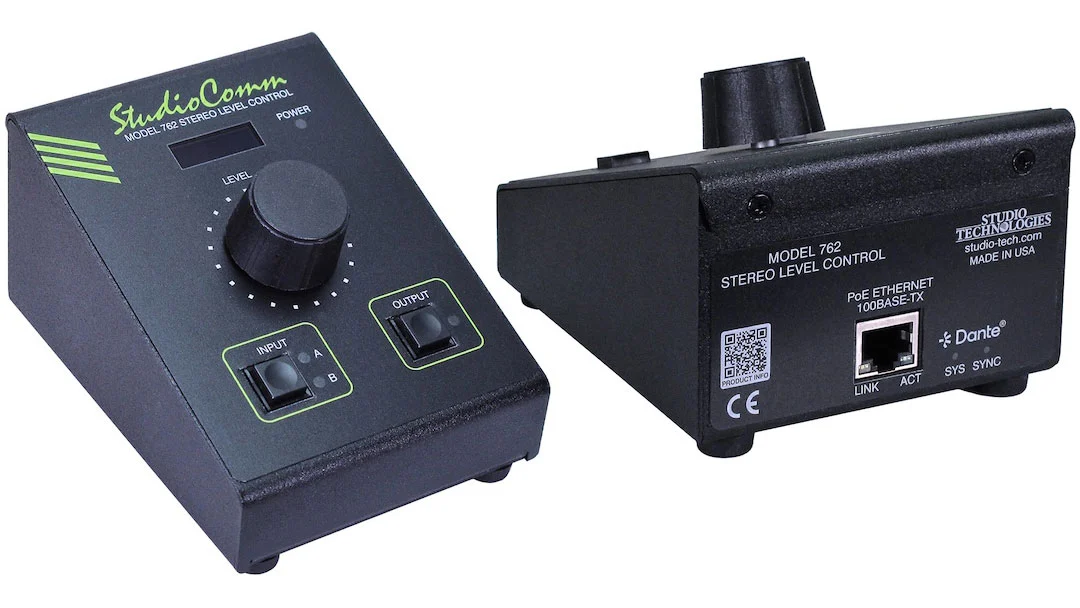
AMSTERDAM, Netherlands — As the professional audio industry prepares for the prestigious IBC2026 exhibition this September, Studio Technologies, a long-standing leader in specialized audio, video, and fiber-optic solutions, has announced the upcoming launch of its latest innovation: the StudioComm Model 762 Stereo Level Control.
The Model 762 arrives at a pivotal moment for the broadcast and recording sectors, where the transition from traditional analog infrastructure to fully networked Audio-over-Ethernet (AoIP) environments is reaching its maturity. Designed as a compact, self-contained solution, the Model 762 is engineered specifically for Dante-based ecosystems, offering a streamlined approach to stereo monitoring that prioritizes signal integrity and network flexibility.
Main Facts: A New Benchmark in Networked Audio Control
The StudioComm Model 762 is more than just a volume knob; it is a sophisticated digital bridge designed to handle the complexities of modern professional audio workflows. At its core, the device is a stereo monitor controller that operates entirely within the digital domain, utilizing the Dante audio-over-Ethernet protocol.
Key Features at a Glance:
- Pure Digital Path: The unit eschews analog inputs and outputs entirely, ensuring that the audio signal remains bit-perfect from the network source to the output destination.
- Dual-Source Monitoring: Users can toggle between two stereo (2-channel) Dante audio sources.
- Flexible Output Routing: The device supports one or two stereo Dante-based loudspeaker systems or a dedicated headphone cue system.
- Network Interoperability: Full support for AES67 and Dante Domain Manager (DDM), ensuring compatibility with enterprise-level networks.
- Power over Ethernet (PoE): A single Ethernet connection provides both data and power, simplifying installation in cramped racks or desktop setups.
- High-Resolution Processing: 32-bit internal architecture with support for 48 kHz sampling rates.
By focusing on a 100% digital signal path, Studio Technologies is targeting professionals in recording, broadcast, and post-production who require precise control without the noise floor or distortion concerns often associated with analog-to-digital conversions.
Chronology: From Concept to IBC2026 Debut
The development of the Model 762 follows a multi-year trajectory in which Studio Technologies has aggressively expanded its Dante-enabled portfolio.
The Evolution of the StudioComm Line
For decades, the "StudioComm" brand has been synonymous with reliable monitor control. In the early 2000s, this meant analog consoles and rack-mount units. However, as the industry shifted toward Dante in the mid-2010s, Studio Technologies began reimagining these tools for the IP age.
- July 16, 2026: Studio Technologies officially breaks the news of the Model 762, providing the first look at the unit’s specifications and design.
- August 2026: Beta testing in high-stakes broadcast environments and elite recording studios concludes, finalizing the firmware for the 32-bit processing engine.
- September 2026: The Model 762 will make its public debut at the International Broadcasting Convention (IBC) in Amsterdam. This event serves as the primary launchpad for the device, allowing global distributors and end-users to experience the hardware firsthand.
- Q4 2026: General availability is expected, following the production ramp-up post-IBC.
The timing of this launch is strategic. With many facilities undergoing "mid-decade" technology refreshes in 2026, the Model 762 positions itself as an essential upgrade for rooms moving away from legacy hardware.
Supporting Data: The Technical Architecture of the Model 762
To understand why the Model 762 is significant, one must look at the technical specifications that differentiate it from consumer-grade or entry-level networked controllers.
All-Digital Signal Integrity
The decision to remove analog I/O is a bold move that reflects the current state of professional studios. In a traditional setup, a signal might go through several D/A and A/D conversion stages before reaching the listener’s ears. Each stage introduces a margin of error. The Model 762 maintains a 32-bit digital signal path. By supporting bit depths of up to 32 and a 48 kHz sampling rate, the unit ensures that what the engineer hears is exactly what is on the network.
Dante and AES67 Compatibility
The Model 762 is built on the Audinate Dante platform, the industry standard for AoIP. However, recognizing the need for cross-platform communication, Studio Technologies has included AES67 support. This allows the Model 762 to receive audio from non-Dante devices, such as those operating on Ravenna or Livewire+ networks, provided they are configured for interoperability.
Power and Efficiency
The device identifies as a Class 2 low-power device under the IEEE 802.3af PoE standard. This means it consumes minimal energy, which is a critical consideration for massive broadcast centers or OB (Outside Broadcast) vans where power management and heat dissipation are constant challenges. A single RJ45 cable provides everything the unit needs to function, eliminating the need for external "wall-wart" power supplies.
Input/Output Configuration
The internal matrix of the Model 762 supports:
- Four Dante Receiver (Input) Channels: These are typically mapped as two stereo pairs.
- Four Dante Transmitter (Output) Channels: These can be used to feed two sets of stereo monitors, or one set of monitors and a headphone amplifier.
Official Responses: Meeting the Needs of Modern Engineers
While official quotes from the IBC floor are yet to come, the design philosophy behind the Model 762 speaks to the feedback Studio Technologies has received from the field.
According to technical briefs released by the company, the Model 762 was developed in response to a growing demand for "distributed monitoring." In the past, monitor control was centralized in a large console. Today, an editor might be working in a small suite, or a producer might need to monitor a feed from a remote location.
"The Model 762 represents our commitment to the Dante ecosystem," a spokesperson for Studio Technologies noted during the preliminary announcement. "We recognized that as studios move to a ‘glass-to-glass’ digital workflow, the monitor controller was often the last piece of analog equipment left on the desk. The Model 762 removes that bottleneck."
Industry analysts suggest that the inclusion of Dante Domain Manager (DDM) support is a key selling point. DDM allows IT managers to secure audio networks, manage user permissions, and route audio across different subnets. By including DDM compatibility, Studio Technologies ensures the Model 762 can be deployed in the world’s most complex corporate and broadcast networks.
Implications: The Future of the Control Room
The launch of the Model 762 has several long-term implications for the professional audio industry.
1. The Decline of the Analog Patch Bay
As devices like the Model 762 become the norm, the need for physical analog patch bays continues to dwindle. Routing is now handled via software (Dante Controller), and the "wiring" is done through standard Cat6 cables. This significantly reduces the cost of studio construction and the time required for installation.
2. High-Fidelity in Compact Form Factors
Traditionally, high-end monitor control required a rack-mounted unit with a heavy power supply. The Model 762 proves that professional-grade 32-bit audio processing can exist in a compact, PoE-powered desktop device. This enables "mobile" professional setups—such as a high-end mixing environment set up in a hotel room or a temporary broadcast booth at a sporting event—without sacrificing audio quality.
3. Integration of Headphone Cue Systems
By offering a dedicated configuration for headphone cue systems, Studio Technologies is acknowledging the shift toward hybrid monitoring. Many modern producers switch between high-end monitors and reference headphones. The Model 762 makes this transition seamless within a Dante environment, allowing a secondary stereo output to feed a Dante-enabled headphone amp (like the Studio Technologies Model 207) without extra routing hurdles.
4. Sustainability and Longevity
By utilizing an all-digital architecture and supporting firmware updates, the Model 762 is designed for a long lifecycle. Unlike analog equipment, which suffers from component aging (such as drying capacitors or scratchy potentiometers), the Model 762’s performance will remain consistent over decades of use. Furthermore, its low power consumption aligns with the "Green Broadcast" initiatives being adopted by major networks worldwide.
Conclusion: Looking Ahead to IBC2026
When the doors open at the RAI Amsterdam for IBC2026, the Studio Technologies booth is expected to be a destination for engineers looking to modernize their signal chains. The StudioComm Model 762 stands as a testament to the fact that in the world of professional audio, "less is often more." By removing analog complexity and embracing the full potential of Dante AoIP, Studio Technologies has created a tool that is both a throwback to the tactile reliability of the past and a bold step into the networked future.
For professionals attending IBC, the Model 762 will be available for hands-on demonstrations, showcasing its ease of configuration and the transparency of its 32-bit signal path. As the industry continues to move toward a software-defined, network-heavy reality, the Model 762 provides the physical touchpoint that engineers still crave: a reliable, high-quality control for the most important part of the process—listening.