Main Facts: The SIVGA Lyrebird Takes Flight
The personal audio landscape has long been crowded with formidable contenders in the sub-$150 bracket, but few releases manage to capture the attention of audiophiles quite like a truly unique driver configuration paired with striking artisanal aesthetics. Enter the SIVGA Lyrebird, a quadbrid In-Ear Monitor (IEM) priced competitively at $149.00.
Developed by a manufacturer celebrated for blending organic materials with precise acoustic engineering, the Lyrebird represents an ambitious push downmarket for complex driver architectures. Eschewing the conventional single-driver or simple dual-driver setups typical of this price point, SIVGA has packed four distinct driver technologies into a compact, aircraft-grade aluminum and stabilized wood chassis.

The core specifications of the SIVGA Lyrebird immediately highlight its accessibility and ambition:
- Driver Configuration: Quad-driver hybrid system featuring 1x Dynamic Driver (bass), 1x Balanced Armature (mids), 1x Micro-Planar driver (treble), and 1x Multilayer Piezoelectric Ceramic driver (ultra-highs).
- Impedance: 14 Ohms.
- Sensitivity: 108 dB.
- Cable: 1.2-meter round, interlaced hybrid cable comprising 50 total cores (30-core Furukawa OFC, 10-core silver-plated copper, and 10-core enamel gold-plated silver-copper), terminating in a 4.4mm balanced jack with 0.78mm 2-pin connectors.
- Retail Price: $149.00.
Chronology: From Concept to Global Launch
SIVGA’s journey to the Lyrebird has been marked by a steady escalation of design maturity and market penetration. To understand where the Lyrebird sits, one must look at the brand’s trajectory over recent years.

- The Breakthrough: SIVGA initially disrupted the budget audiophile scene with the SV021 Robin, a headphone that proved high-end artisanal styling and solid tuning could coexist at an accessible price.
- Expanding the Flock: Building on headphone success, the brand pivoted toward IEMs. Models like the Nightingale (priced around $229) and the ultra-popular Que (retailing near $69) cemented SIVGA’s reputation for natural timber aesthetics and engaging musicality. The subsequent release of "PRO" iterations kept their catalog fresh.
- The Debut: The SIVGA Lyrebird made its formal public debut at CanJam London, drawing curious crowds eager to hear how a quadbrid setup at $149 would perform in the wild.
- Official Release: Following the positive reception in London, SIVGA officially launched the Lyrebird globally, positioning it directly against established heavyweights in the mid-tier IEM market.
Supporting Data: Engineering, Design, and Acoustic Architecture
Acoustic Architecture: The Quadbrid Approach
Hybrid configurations are increasingly common, but SIVGA’s choice of a quadbrid array in the Lyrebird is remarkably ambitious for a $149 product. The acoustic burden is intelligently distributed:
- Dynamic Driver: Handles the low-end frequencies, yielding an elevated, physically impactful bass response with a clear delineation between sub-bass sustain and mid-bass punch.
- Balanced Armature: Manages the midrange. It delivers dense, warm vocal presentations that avoid sounding clinical or hollow.
- Micro-Planar & Piezoelectric Drivers: Share the load in the treble regions. Together, they extend high-frequency information well beyond fundamental vocal ranges while maintaining a smooth, non-fatiguing character.
With a low impedance of 14 Ohms and a high sensitivity of 108 dB, the Lyrebird is remarkably easy to drive. On paper and in practice, it demands very little raw amplification power, making it an ideal companion for portable digital audio players (DAPs) and portable dongle DACs alike.

Industrial Design and Aesthetics
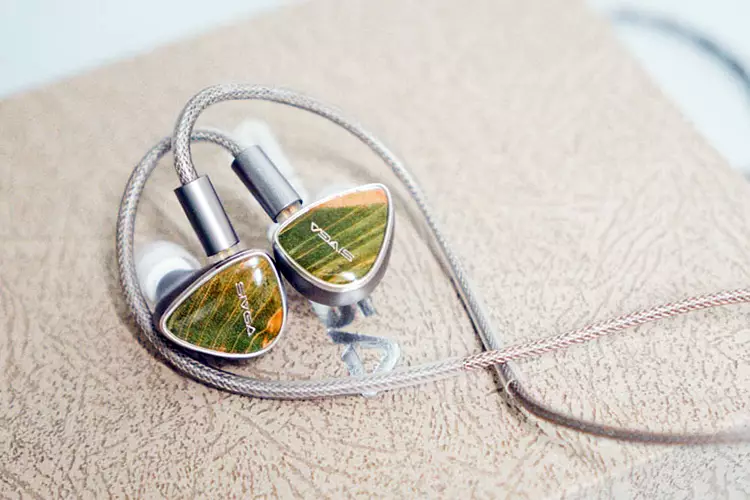
True to SIVGA’s design ethos, the Lyrebird relies on stabilized wooden faceplates rather than generic plastic or plain metal. Each unit boasts a unique wood grain pattern. The review unit features a striking greenish hue that evokes a tranquil "birch-in-the-forest" aesthetic.
Underneath a protective layer of resin, a subtle metallic SIVGA logo rests upon the stabilized wood. The main housing is carved from aircraft-grade aluminum, featuring strategic venting near the nozzles and sides to manage internal air pressure. Despite the robust metal construction, the shell remains remarkably compact and lightweight, avoiding the cumbersome sizing issues plaguing many planar or multi-driver rivals.

Accessories and Unboxing Experience
Unboxing the Lyrebird is designed to be a multi-sensory experience. The outer paper sleeve carries a natural woody scent alongside minimalist Chinese characters meaning "lyrebird" and an elegant line drawing of the bird itself. Inside, buyers find a blind-box-style presentation where the exact wood grain and colorway remain hidden until the box is opened.
SIVGA bundles the IEMs with a premium Crazy Horse leather storage case. Furthermore, the accessory kit includes two distinct styles of ear tips:

- Liquid Silicone Tips: Feature a tacky, grippy surface designed to enhance passive isolation and security in the ear canal.
- Wide-Bore Tips: Feature a conventional matte finish that opens up the soundstage slightly.
The stock cable is another highlight. Designed aesthetically to mimic a lyrebird’s tail, it utilizes an intricate 50-core tri-material blend (Furukawa OFC, silver-plated copper, and gold-plated silver-copper) housed in a flexible jacket with custom metal hardware and a spring strain relief system.
Official Responses and Expert Impressions
Critical consensus classifies the SIVGA Lyrebird as a neutral-bright IEM defined by exceptional technicalities, stellar spatial imaging, and high coherence.

Sound Analysis by Frequency Range
- Bass: The single dynamic driver delivers authoritative low-end weight. Sub-bass notes carry a visceral, sustained warmth, whereas the mid-bass remains agile, providing swift, clean attacks on heavy thumps without bleeding into the midrange.
- Mids: Handled by the balanced armature, the midrange leans slightly warm and dense. Both male and female vocals enjoy strong body and forward positioning. While density begins to taper slightly in the upper female vocal range, instrument separation remains pristine even on complex arrangements.
- Treble: The tandem micro-planar and piezoelectric ceramic drivers yield extended, airy highs without crossing into harshness or sibilance—provided the user pairs the IEM with an appropriate source and achieves a proper seal. Cymbals ring out with realistic texture and appropriate brilliance.
- Staging and Imaging: Perhaps the Lyrebird’s crowning achievement is its soundstage. It offers an expansive, holographic 3D presentation with precise instrument localization. Listeners can easily track micro-details that often get obscured in similarly priced rivals.
Source Synergy
Because of its revealing nature in the upper frequencies, source matching is a vital consideration.
- Favorable Pairings: Tube-mode amplifiers like the iBasso PB6 MACAW or warm-neutral sources like the FangSound NEREUS Mini and FiiO M21 smooth out upper-frequency peaks, making for a velvety, non-fatiguing listen.
- Unfavorable Pairings: Brighter analytical sources (such as the SMSL DS20) can push the Lyrebird’s treble dangerously close to the fatigue threshold for treble-sensitive listeners.
Implications: Market Position and Competitive Landscape
Priced at $149, the SIVGA Lyrebird does not operate in a vacuum. It steps directly into the Thunderdome of the mid-tier IEM market, trading blows with established giants:

- Juzear Fiesta: Utilizing a 1D + 3BA configuration, the Fiesta offers a more compressed, bass-heavy, V-shaped presentation with a more recessed midrange. The Lyrebird outclasses it in spatial staging, imaging precision, and high-frequency extension.
- Hidizs MP145 PRO: Based around a large 14.5mm planar driver, the MP145 PRO leans toward a leaner, highly textured bass response and a brighter, sparkling treble. However, its massive whale-tail aluminum shell is considerably bulkier and less ergonomic for smaller ears compared to the Lyrebird’s compact silhouette.
- EarAcoustic SPA Hi-End: Featuring a single titanium dynamic driver, the SPA delivers fun, energetic V-shaped slam, but lacks the intricate air, micro-detail retrieval, and wide soundstage achieved by SIVGA’s quadbrid design.
Final Verdict
The SIVGA Lyrebird proves that budget-conscious audiophiles no longer need to sacrifice technical performance for natural aesthetics. Despite minor caveats—such as sensitivity to bright source gear and a fixed 4.4mm balanced cable that may alienate users wedded to 3.5mm outputs—its stellar imaging, holographic staging, and rich, detailed musicality make it a formidable benchmark at $149. True to its namesake, the Lyrebird doesn’t just mimic music; it unearths the quietest, most intricate details hidden deep within your favorite tracks.