In the high-stakes world of live event production, the "silent" architecture of wireless audio is increasingly under siege. As the RF (radio frequency) spectrum becomes a battlefield of competing signals, professional integrators are finding that traditional frequency coordination is no longer enough to guarantee a flawless performance. Performance Audio, a leading integration firm based in Salt Lake City, Utah, has emerged as a bellwether for the industry by standardizing its wireless designs around a specific, high-efficacy solution: the RF Venue Band-pass Filter.
By integrating these filters alongside RF Venue’s signature Diversity Fin antennas, the firm is effectively creating a "shield" against the rising tide of 5G interference and the unpredictable RF noise floor generated by thousands of mobile devices in a packed auditorium.
The Invisible Threat: A New Landscape of Interference
To understand the necessity of this shift, one must first look at the changing geography of the wireless spectrum. In recent years, the deployment of 5G infrastructure has radically altered the RF environment. While these technological advancements benefit cellular users, they have created significant headaches for audio engineers and system integrators.
The phenomenon that Performance Audio encountered—and subsequently solved—is one that has plagued venues nationwide: the "Opening Night Phenomenon." Systems would be meticulously commissioned, tested, and verified during soundcheck while the room was empty. The noise floor would appear clean, and signal-to-noise ratios would be well within optimal ranges. However, as soon as the doors opened and the audience filed in, each attendee effectively became a mobile RF transmitter. With hundreds, or even thousands, of cell phones hunting for 5G signals, the ambient RF noise floor rises dramatically.
This out-of-band energy can overwhelm sensitive wireless microphone receivers, leading to intermittent dropouts, signal artifacts, and, in the worst cases, complete system failure. When standard frequency coordination fails to account for this dynamic, "in-the-moment" interference, the result is a catastrophic loss of reliability that can ruin a theatrical performance, a religious service, or a corporate keynote.
Chronology of a Solution: From Trial to Standardization
The journey for Performance Audio began when the firm started noticing a recurring pattern in their installations. Despite high-end hardware and professional-grade antennas, theaters and schools across Utah were reporting mysterious audio dropouts.
"One of the biggest challenges we faced was that every system looked perfect during commissioning," explains Harley Anderson, integration manager at Performance Audio. "Then opening night would arrive, the auditorium would fill with hundreds of people carrying mobile devices, and suddenly we’d begin seeing wireless dropouts."

The chronology of their response was methodical:
- Initial Assessment: Recognizing that frequency coordination alone was not the culprit, the team identified that unwanted out-of-band energy was likely bleeding into the receivers.
- The Pilot Phase: The firm began testing RF Venue Band-pass Filters in the most problematic environments. The goal was to filter out everything except the specific frequency ranges assigned to the wireless microphones.
- The Validation: The results were immediate. By rejecting unwanted RF energy before it reached the receiver distribution system, the systems gained a new level of robustness.
- Full Adoption: Seeing the clear return on investment and the dramatic improvement in uptime, Performance Audio transitioned to a company-wide policy: no wireless system leaves their shop without a corresponding Band-pass Filter.
The Technical Edge: How Band-Pass Filters Function
At the heart of this success is the fundamental principle of band-pass filtering. In a typical wireless microphone setup, antennas capture everything in the air—both the desired signal from the transmitter and the "junk" noise from cellular towers, Wi-Fi, and ambient digital interference. Without a filter, this wide-spectrum noise is sent directly into the distribution system, where it can cause intermodulation distortion or simply swamp the receiver’s front end.
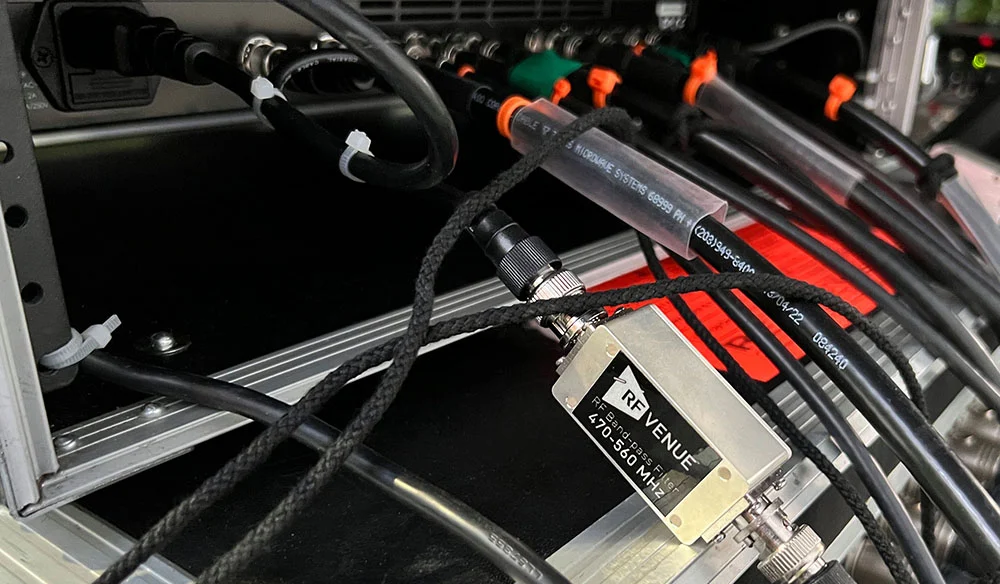
The RF Venue Band-pass Filter acts as a precision gatekeeper. It is designed to pass only the specific frequency range (or "band") where the microphones operate, while aggressively attenuating frequencies above and below that range.
By placing the filter inline—between the antenna and the distribution system—Performance Audio ensures that only clean, relevant RF energy enters the signal chain. This simple mechanical addition acts as a force multiplier for the existing wireless gear, ensuring that the receiver doesn’t have to work as hard to distinguish the target signal from the background chaos of a modern 5G-enabled world.
Implications for System Integrators and Venue Owners
The move by Performance Audio carries significant implications for the wider AV industry. It signals a shift away from a "frequency-first" mindset toward an "environment-first" design philosophy.
1. Cost-Benefit Analysis
As Harley Anderson points out, the financial barrier to entry is remarkably low. "The cost of adding Band-pass Filters is insignificant compared to the investment clients are already making in professional wireless microphone systems," he notes. When the cost of a single dropout can involve a ruined show or lost reputation, the ROI of a filter becomes nearly instantaneous.
2. The Necessity of Future-Proofing
Integrators can no longer assume that a quiet spectrum today will remain quiet tomorrow. With the continued rollout of cellular infrastructure and the proliferation of IoT (Internet of Things) devices, the RF environment is becoming more, not less, crowded. Incorporating physical filtering is a form of insurance that protects the long-term utility of an audio system.

3. Integration Synergy
The synergy between the filters and the RF Venue Diversity Fin antenna is worth noting. While the antenna captures a stable signal, the filter ensures the quality of that signal. This "dual-layer" approach is becoming the standard for high-performance venues.
Official Perspective: The View from RF Venue
Chris Regan, chief innovation officer at RF Venue, views the success of Performance Audio as a testament to the company’s core mission. "As wireless spectrum becomes increasingly crowded, compounded by a hall filling with an audience carrying cell phones adding dramatically to the RF noise floor, integrators need practical tools that address real-world RF challenges before they impact a performance," Regan explains.
For RF Venue, the objective is to demystify RF management. By providing tools that are "plug-and-play" but technically sophisticated, they empower integrators like those at Performance Audio to focus on the art of sound rather than the science of interference. The collaboration between the two firms highlights a growing trend: the recognition that RF management is now an essential, non-negotiable component of audio engineering.
Beyond the Hardware: A New Standard for Quality
The decision by Performance Audio to standardize on these filters is more than just a procurement strategy; it is a commitment to performance reliability. In an era where audiences are increasingly sensitive to production quality, the "invisible" work of the integrator is what truly defines a successful venue.
When a wireless microphone cuts out, the audience’s attention is immediately pulled away from the performance and toward the technology—the ultimate failure for any AV professional. By proactively eliminating the source of that failure through band-pass filtering, Performance Audio has managed to elevate the baseline of expectation for their clients.
Conclusion: The Future of Wireless Design
As the industry moves forward, the "Performance Audio model" is likely to become the standard for professional integration. The days of relying on antenna placement and frequency software as the sole means of defense against interference are drawing to a close.
The future belongs to a layered approach: utilizing high-performance antennas to capture the signal, and using precise band-pass filtering to protect the receiver’s integrity. For schools, theaters, and houses of worship, this means a future where the wireless mic always works, regardless of how many smartphones are in the crowd. Through their foresight and commitment to this technology, Performance Audio has provided a roadmap for the rest of the industry to follow, ensuring that the show, quite literally, goes on—without interruption.