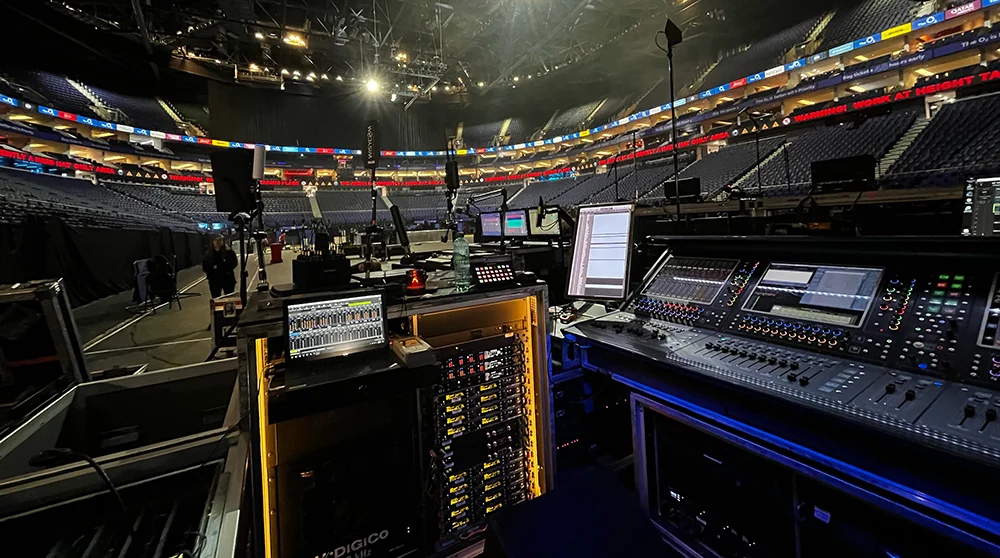
For a globally touring act like OneRepublic, the stage is never static. As the band traverses continents—moving from the sprawling, spectrum-crowded arenas of the United States to the varied RF landscapes of Europe, Asia, and Australia—the technical requirements for their live performance remain constant: absolute sonic fidelity and flawless, drop-out-free wireless connectivity.
At the center of this complex logistical and technical operation is monitor engineer Chris Marinaccio. Tasked with ensuring that every member of the band receives a pristine, studio-quality mix regardless of their geographical location, Marinaccio has turned to Wisycom’s advanced wireless in-ear monitoring (IEM) ecosystem. By deploying a rig built around MTK952 dual transmitters, MPR50 IEM receivers, and ADB3 omnidirectional antennas, Marinaccio has not only solved the recurring headaches of international frequency management but has elevated the auditory experience for the artists on stage.
The Technical Foundation: A Global Wireless Strategy
The core of OneRepublic’s current touring rig is designed for agility. In an era where RF (Radio Frequency) spectrum is becoming increasingly scarce and heavily regulated, the ability to operate across diverse regions without needing to swap out equipment racks is a massive logistical advantage.
The Wisycom system utilized by the team centers on:
- MTK952 Dual Transmitters: Providing high-power, wideband transmission that ensures signal integrity even in the most challenging RF environments.
- MPR50 IEM Receivers: Offering exceptional sensitivity and selectivity, allowing for cleaner signals even in proximity to high-power intermodulation interference.
- ADB3 Omnidirectional Antennas: Providing robust coverage across both main and B-stages, simplifying antenna placement and reducing the amount of cabling required on stage.
"Our production manager, Dave McMullen, made the decision to switch to Wisycom before I even joined the team," Marinaccio explains. "When I came on board, I was immediately struck by the performance. In my 13 years as a monitor engineer, this is quite simply the cleanest, clearest monitoring I have ever worked with."
Chronology of a World Tour: Navigating RF Chaos
The band’s current touring schedule has been nothing short of relentless. Following their "Escape to Europe" leg, the production team performed a rapid-fire transition to California, followed immediately by dates in Australia and Asia, with a return to Europe already on the horizon.
This rapid movement creates a significant challenge for any sound department. In the past, touring engineers were often forced to maintain region-specific wireless gear to comply with local frequency laws and to avoid interference in crowded broadcast bands. However, Wisycom’s wideband technology has essentially rendered this limitation obsolete for the OneRepublic team.
"The ability to put frequencies anywhere is a game-changer," says Marinaccio. "It allows me to work around RF chaos, which is particularly prevalent in the United States. In the U.S., the spectrum is incredibly congested. Being able to choose whatever part of the spectrum is actually available at a given venue, rather than being trapped in fixed frequency blocks, is invaluable. It’s the difference between a smooth show and a constant stream of RF-related stress."
While Europe offers a more open, regulated spectrum, the U.S. landscape requires constant, real-time coordination. Marinaccio notes that the team frequently leverages the "gaps" in the U.S. spectrum to deploy their secondary systems, including crew communications and intercom packs. By using the Wisycom gear as the anchor, the team can effectively "park" their wireless gear in cleaner areas of the spectrum, allowing them to focus on a smaller subset of channels rather than managing a massive, cluttered frequency list.
Fidelity and the "Studio-in-the-Ear" Experience
Beyond the technical hurdles of RF management, the primary goal of any monitor engineer is the sound quality delivered to the artist’s ears. For Marinaccio, who transitioned into live sound after years of working in high-end recording studios, the "transparency" of the signal chain is paramount.
"With Wisycom, you aren’t fighting the noise floor," he explains. "You turn it on, and you don’t even know it’s on. It’s that transparent. This is absolutely essential for our band members, particularly those who rely on bone conduction technology due to eardrum sensitivity. If the noise floor were any higher, it would make it nearly impossible for them to hear the nuance in their mixes."
A common complaint among touring engineers regarding traditional wireless systems is the "flattening" effect of aggressive companding—a process used to compress the dynamic range of a signal for transmission. Often, this results in a lifeless, clinical sound that forces the engineer to over-process the mix to make it sound "musical" again.
"Other brands tend to flatten the mix as soon as you apply compression," Marinaccio notes. "It forces you to work around the gear rather than with it. Because the Wisycom system is so transparent, I can apply as much compression as I need without the signal collapsing. It responds exactly like a wired studio headphone. I can provide the natural EQ and dynamics the band expects without losing the musicality of the mix."
Official Perspectives: A Shift in Philosophy
Dave McMullen, the production manager who initiated the transition to the Wisycom platform, echoes Marinaccio’s sentiments. Having spent years mixing monitors for the band himself, McMullen understands the struggle of fighting against signal degradation.
"When we moved to this platform, the difference was immediate," McMullen states. "It was much less compression, much more open, and much more musical. We really needed that extra headroom in the amplifier, and the Wisycom system delivered that in spades. It allowed us to move away from the ‘live sound’ compromise and closer to a studio-quality listening environment."
Implications for the Future of Live Touring
The success of OneRepublic’s implementation of Wisycom highlights a broader shift in the live music industry. As concert production values continue to skyrocket and the amount of wireless technology required on stage—from instrument packs to crew intercoms and high-fidelity IEMs—grows, the burden on RF coordination has reached a breaking point.
The implications of this transition are clear:
- Efficiency Through Flexibility: Wideband technology is no longer a luxury; it is a necessity for international touring acts. The ability to deploy gear globally without re-purchasing or re-configuring racks based on regional spectrum constraints saves production teams both time and significant capital.
- The Rise of "Transparent" Wireless: As artists become more accustomed to the high fidelity of studio recording, they are less willing to accept the artifacts of traditional wireless transmission. The demand for systems that offer "wire-like" performance is driving manufacturers to push the boundaries of signal-to-noise ratios and dynamic headroom.
- Simplified Coordination: By choosing systems that allow for clean, reliable operation in dense environments, engineers can spend less time troubleshooting RF interference and more time on the creative aspects of their mix.
Conclusion
For Chris Marinaccio and the rest of the OneRepublic production team, the transition to Wisycom has been about more than just buying new hardware—it has been about reclaiming control over the sonic landscape. In a business where every millisecond and every decibel matters, the reliability of their IEM system acts as a silent partner in the show’s success.
As they continue their non-stop global run, moving between the disparate RF environments of Asia, Europe, and North America, the team is armed with a system that is as resilient as it is clear. By prioritizing spectral agility and sonic transparency, OneRepublic is setting a new benchmark for what is possible in live monitoring, proving that even in the most crowded RF environments, high-fidelity sound is not just an aspiration—it is an achievable standard.