Main Facts
Released over four decades ago, Van Halen’s Diver Down remains one of the most polarizing, eccentric, and fascinating releases in the legendary American hard rock band’s catalog. Hitting store shelves in mid-May 1982, the album arrived at the absolute peak of the original lineup’s commercial dominance. Yet, it broke nearly every convention of traditional hard rock album sequencing by leaning heavily on cover songs, unorthodox instrumentation, and rushed studio sessions.
Despite its slapdash genesis—or perhaps precisely because of it—Diver Down occupies a unique space in rock history. It is a snapshot of a band caught in a whirlwind of relentless touring, internal friction, and unbridled creative bravado. For decades, music critics viewed the record as a contractual obligation or a placeholder between major statements. However, modern reassessments, fueled by advanced audiophile reissues from master tapes, have forced a critical re-evaluation.
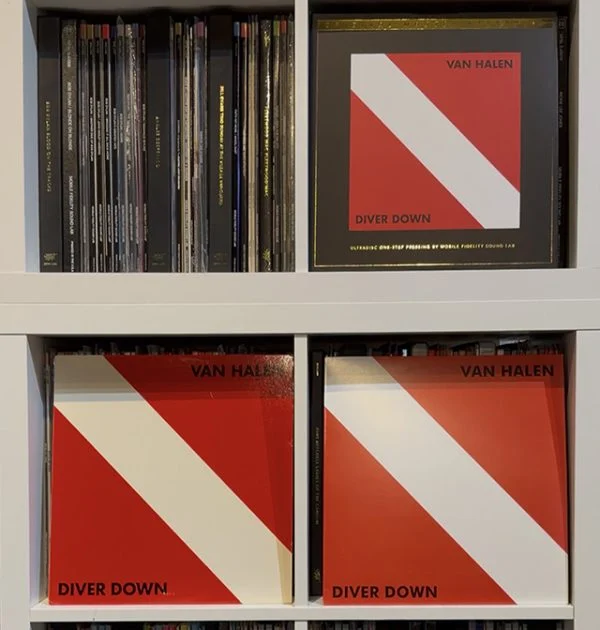
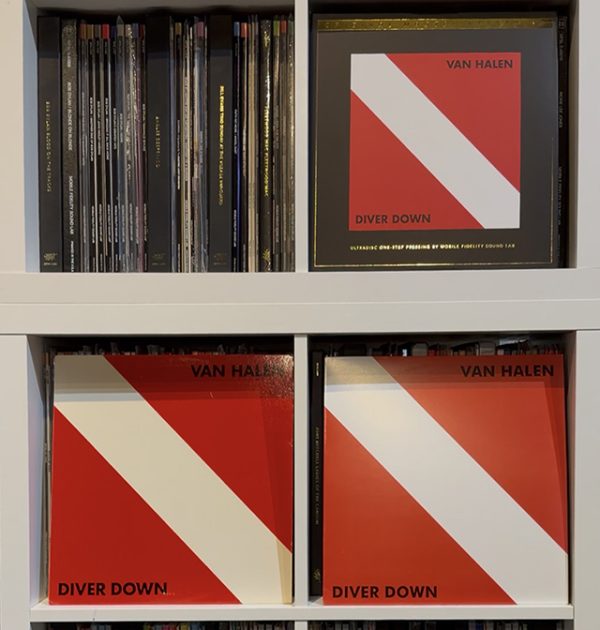
The conversation around Diver Down has shifted from a dismissal of its heavy reliance on covers to an appreciation of its sonic daring. Modern comparisons between the 1982 original vinyl pressings, the critically acclaimed Chris Bellman remasters, and Mobile Fidelity Sound Lab’s (MoFi) ultra-premium One-Step vinyl releases reveal hidden dimensions in the mix. Far from being a mere throwaway record, Diver Down is a masterclass in dynamic performance, showcasing the band’s ability to bend diverse musical genres—from big band swing to blues-infused pop—to their inimitable hard rock aesthetic.
Chronology: The Road to ‘Diver Down’
The Early 1980s Whirlwind
To understand Diver Down, one must examine the frantic timeline of Van Halen in the early 1980s. Following the massive success of their self-titled 1978 debut, Van Halen II (1979), Women and Children First (1980), and Fair Warning (1981), the band was trapped on a perpetual treadmill of writing, recording, and touring.
By late 1981, Van Halen was exhausted. Their management and record label, Warner Bros., demanded a new album to capitalize on their soaring momentum and to support another massive upcoming arena tour. However, the band simply did not have a full album’s worth of fresh original material ready. Guitar virtuoso Eddie Van Halen had been experimenting with synthesizers and unconventional song structures, but the band needed a quick solution to satisfy the label’s aggressive release schedule.
The Emergency Studio Pivot
Faced with a tight deadline, the band decided to lean into their bar-band roots. Before signing their record deal, Van Halen had spent years cutting their teeth on the Southern California backyard party circuit and club scene, playing a diverse mix of covers ranging from blues and R&B to pop and classic rock.
The formula that launched them into international stardom had been built on a brilliant cover: their explosive rendition of The Kinks’ "You Really Got Me" on their debut album. Hoping to capture that lightning in a bottle once again, the band entered Sunset Sound Recorders in early 1982 with producer Ted Templeman. They quickly pulled together a collection of covers alongside a handful of originals and instrumentals. The resulting album, christened Diver Down—a nautical term signaling that a diver is down and warning boats to keep clear—was rushed to the pressing plants and released on May 14, 1982.
Supporting Data: The Tracklist, The Covers, and The Audiophile Evolution
Anatomy of a Controversial Tracklist
Diver Down broke traditional hard rock protocol by featuring five cover songs out of its ten total tracks. This heavily tilted balance sparked immediate debate among purists upon its release:
- "Where Have All the Good Times Gone!" (The Kinks cover)
- "Hang ‘Em High" (Original)
- "Cathedral" (Instrumental original)
- "Secrets" (Original)
- "Intruder" (Instrumental original)
- "(Oh) Pretty Woman" (Roy Orbison cover)
- "Dancing in the Street" (Martha and the Vandellas cover)
- "Little Guitars (Intro)" / "Little Guitars" (Original)
- "Big Bad Bill (Is Sweet William Now)" (Milton Ager and Jack Yellen cover, featuring Jan Van Halen on clarinet)
- "Happy Trails" (Dale Evans cover)
The inclusion of Roy Orbison’s "(Oh) Pretty Woman" served as the album’s lead single, accompanied by a groundbreaking and slightly controversial music video that MTV briefly restricted. Meanwhile, tracks like "Big Bad Bill (Is Sweet William Now)" stunned fans by featuring Eddie and Alex Van Halen’s father, Jan Van Halen, playing a soulful clarinet solo.
The Vinyl Evolution: From 1982 Pressings to MoFi One-Step
For decades, the sonic evaluation of Diver Down was hampered by the limitations of early 1980s vinyl mastering.
- The 1982 Original Pressing: Like many mainstream rock records of its era, the original Warner Bros. LP was heavily compressed to ensure compatibility with standard phonograph cartridges and AM/FM radio broadcast limitations. Listening to an original pressing reveals a notable truncation in the lower frequencies. Bass guitar and kick drum presence were reined in, leading to conspiracy theories among audiophiles regarding the treatment of bassist Michael Anthony’s contributions in the mix. Whether this was intentional shelving or simply a byproduct of optimizing the master for high-rotation radio play, the original lacks the tactile weight found in the band’s earlier work.
- The Chris Bellman Remaster: Years later, acclaimed mastering engineer Chris Bellman tackled the Van Halen catalog, breathing new life into the mixes. Bellman’s work successfully unlocked much of the high-end air and mid-range clarity that had been buried in the original vinyl runs. It marked a massive step forward, proving that the original multi-track tapes contained significantly more depth than the 1982 commercial releases suggested.
- The MoFi One-Step Treatment: The definitive chapter in the Diver Down listening experience arrived via Mobile Fidelity Sound Lab’s ultra-high-end UltraDisc One-Step (UD1S) vinyl pressing process. Listening to a track like "Big Bad Bill" on the MoFi edition exposes the staggering genius of the production. Not only is the long-lost bottom-end restored with astonishing articulation and slam, but the natural timber and warmth of Jan Van Halen’s clarinet achieve a three-dimensional realism that transforms the track. While MoFi’s subsequent SACD releases offer crystalline digital clarity, this remains a rare instance where the analog warmth and tactile magic of the vinyl format decisively rule the day.
Official Responses and Industry Reception
At the time of its release, the music industry and press met Diver Down with mixed, highly polarized reviews. Mainstream critics pointed to the high volume of cover tracks as evidence of writer’s block or artistic exhaustion. Renowned rock critics questioned whether America’s premier hard rock band was running out of steam just as they were reaching the summit of global fame.
However, the record-buying public completely ignored the critical hand-wringing. Diver Down was a commercial juggernaut. It peaked at #3 on the US Billboard 200 chart and eventually achieved multi-platinum status, selling over four million copies in the United States alone. "(Oh) Pretty Woman" dominated rock radio and became a staple of MTV’s heavy rotation, cementing the band’s status as undeniable pop-metal royalty.
Band members themselves offered candid reflections on the record in subsequent years. Eddie Van Halen often spoke of Diver Down as a fun, low-pressure experiment born out of necessity. In various retrospective interviews, the guitarist noted that while the album was hastily assembled, it captured the spontaneous, party-oriented atmosphere that defined their early years before endless arena touring turned the music industry into a grueling corporate machine. Producer Ted Templeman frequently defended the eclecticism of the project, emphasizing that Van Halen’s ability to interpret classic standards with ferocious technical brilliance set them apart from their generic heavy metal peers.
Implications: The Legacy of a Misunderstood Masterpiece
Looking back from the vantage point of the mid-2020s, Diver Down holds a crucial and deeply instructional place in rock history. It challenges the rigid definitions of what a hard rock band "should" do. In an era where genre boundaries were fiercely guarded, Van Halen casually bridged the gap between 1920s jazz standards, 1960s soul, British Invasion pop, and blistering American heavy metal.
Artistic Freedom vs. Commercial Pressure
The album serves as a fascinating case study in how artists navigate the brutal demands of the music industry. Rather than buckling under the pressure of an impossible deadline and delivering a sub-par collection of filler originals, Van Halen leaned into their foundational influences. They proved that authenticity does not solely stem from self-penned lyrics, but from the conviction and technical mastery with which a performance is delivered.
The Audiophile Triumph
Furthermore, the vindication of Diver Down through modern audiophile reissues highlights the evolution of sound engineering preservation. Tracks that were once dismissed as muddy or hastily mixed have been revealed, through meticulous tape restoration and premium pressing techniques, to be sonic marvels of instrumental interaction.
As contemporary music listeners continue to re-examine the catalog through high-resolution digital streaming and high-end analog formats, Diver Down is finally shedding its reputation as the "oddball" record. It is now widely celebrated as an audacious, high-wire act of musical bravado by a band operating at the absolute height of their powers.
Ultimately, asking "where have all the good times gone?" via the opening track of the album feels almost ironic. For Van Halen in 1982, the good times were happening right there in the studio, captured on tape for eternity, waiting for future generations of listeners and audiophiles to finally unlock their full, thunderous potential.