NEW YORK CITY — June 24, 2026 — In a remarkable convergence of historical preservation and cutting-edge audio engineering, acclaimed trombone virtuoso Jim Pugh has announced the release of New American Symphonies, an album that breathes life into a forgotten artifact of the 1930s. The record, which captures the long-lost trombone symphony of American composer Roy Harris, represents a monumental effort to reclaim a chapter of music history that was abandoned nearly ninety years ago.
The project is more than a mere recording; it is a collaboration between lifelong friends—Pugh and Grammy-winning engineer Jim Anderson—who have utilized the pristine, high-fidelity format of Digital eXtreme Definition (DXD) to ensure that the music is preserved with unprecedented clarity. The album is scheduled for an exclusive early release via NativeDSD on August 14, followed by a celebratory live event on September 15 at Technica House in New York City.
The Genesis of a Forgotten Masterpiece
The story of New American Symphonies began not in a concert hall, but in the dusty, quiet corners of the Library of Congress. Roy Harris, best remembered today for his landmark Symphony No. 3, was a titan of American composition in the early 20th century. In 1938, Harris penned an ambitious, symphonic work specifically for the legendary bandleader Tommy Dorsey. At the time, the project was heralded as a breakthrough, yet the music proved too complex for the era’s constraints.
Following a single, abortive rehearsal by Dorsey’s orchestra, the manuscript was relegated to the archives, never to see the light of a stage or a recording studio—until Jim Pugh’s persistent research unearthed it.
"It’s really a magnificent piece of music," says Pugh, reflecting on the discovery. "If you close your eyes and listen to the first movement, you can hear where jazz would eventually arrive some 35 or 40 years later, and if you pay attention to the back end, you can hear the roots of minimalism. It’s this remarkable little time capsule that slipped through the cracks of history."
Chronology of a Musical Excavation
The journey from manuscript to master recording was a multi-year endeavor that required both musical sensitivity and archival dedication.

- 1938: Roy Harris composes the trombone symphony for Tommy Dorsey. The work is deemed too challenging for the ensemble and is abandoned after a single rehearsal.
- Early 2020s: Jim Pugh begins a systematic research project into neglected trombone literature, leading him to the Library of Congress.
- 2024–2025: Pugh uncovers the original manuscripts, piecing together the score from multiple archival boxes. He begins the arduous process of transcribing and preparing the music for modern performance.
- 2026: Pugh teams up with his lifelong friend, engineer Jim Anderson, and producer Ulrike Schwarz. They assemble an all-star ensemble to record the work at the historic Power Station at BerkleeNYC.
- August 14, 2026: The official early release of New American Symphonies on NativeDSD.
- September 15, 2026: A public presentation and launch event at Technica House, New York City.
The Sonic Architecture: A Technical Triumph
While the music provides the soul of the album, the production provides the body. Jim Anderson and Ulrike Schwarz, a production duo with over 30 Grammy nominations between them, approached the project with a philosophy of "transparent technology."
"If we can make the technology disappear, if our presence can be totally transparent, then we’ve done our job," Anderson notes. To achieve this, the team opted for Digital eXtreme Definition (DXD) recording. DXD is a professional audio format that provides a sample rate of 352.8 kHz at 24-bit depth, offering a resolution that captures the microscopic nuances of acoustic instruments, particularly the brass and orchestral textures inherent in Harris’s composition.
The result is an immersive soundstage. "When you listen to this record, you’ll feel like you’re standing in the middle of the band, but also like they’re playing directly to you," says Schwarz. "It’s a completely immersive experience."
Supporting Data: A Career of Excellence
The credibility of New American Symphonies is anchored by the pedigree of its creators. Jim Pugh is not merely an enthusiast; he is one of the most prolific session musicians in history. With over 4,000 recording sessions to his credit, his resume reads like a map of 20th-century music: Steely Dan, Yo-Yo Ma, Philip Glass, Paul Simon, Barbra Streisand, Michael Jackson, Pink Floyd, Tony Bennett, and Frank Sinatra.
Pugh’s reunion with Anderson is equally significant. Their relationship dates back over sixty years to a Pennsylvania school band, a foundation that informs the trust and synergy heard in the final product. Anderson, Professor Emeritus at NYU’s Clive Davis Institute, and Schwarz, President of the Verband Deutscher Tonmeister, represent the gold standard in contemporary audio production.
The ensemble performing on the record is equally diverse, featuring elite musicians hand-picked from the worlds of Broadway, jazz, and classical symphonies, ensuring that the performance of the Harris manuscript meets the highest standards of technical and expressive execution.

Bridging the Generations: The ‘Night Suite’
The album is not merely a historical retrospective. To balance the weight of the rediscovered Harris work, the project includes Night Suite, a multi-movement contemporary work written specifically for Pugh by composer Scott Ninmer.
Ninmer, a former student of Pugh’s who currently serves as the Chief Arranger for the United States Marine Band, provides a modern counterpoint to the 1930s symphonic style. This pairing creates a thematic bridge, demonstrating how the American musical voice has evolved from the ambitious, experimental structures of the Great Depression era to the refined, nuanced landscapes of the 21st century.
Implications for Music History
The release of New American Symphonies raises an important question: how much other music is currently hidden in the shadows of our national archives?
By documenting the Harris manuscript in such high fidelity, Pugh and his team have effectively rescued the work from obscurity and placed it firmly within the canon of American symphonic literature. Musicologists are already viewing this project as a landmark moment in the study of early-to-mid-20th-century American composition. The ability to listen to a 1938 work with the sonic fidelity of a 2026 production allows listeners to hear the music not as a "historical document," but as a living, breathing performance.
Furthermore, the success of this collaboration highlights the importance of the relationship between performer and engineer. In an age where much of recorded music is heavily processed or synthesized, the commitment of Pugh and Anderson to "transparent" and "immersive" acoustics serves as a powerful argument for the continued relevance of traditional, high-resolution recording arts.
Final Thoughts: A Legacy Reclaimed
As the jazz, classical, and audiophile communities prepare for the September 15 event at Technica House, the anticipation surrounding New American Symphonies continues to grow. The project serves as a testament to the idea that great art, even when ignored by its contemporaries, maintains a pulse that can be revived by the right hands.
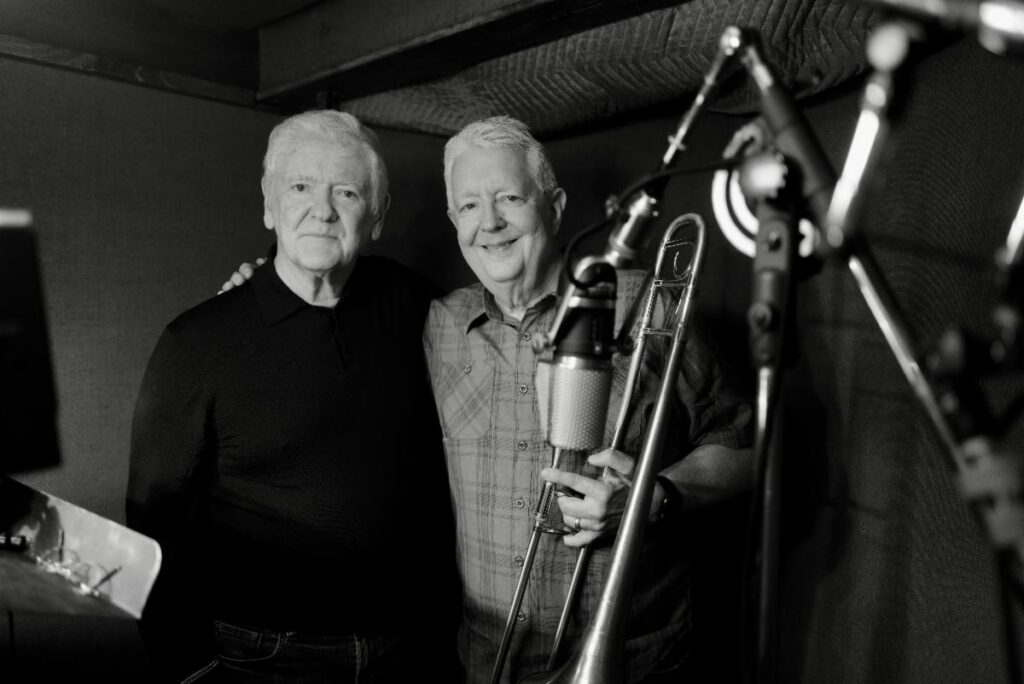
For Jim Pugh, the release is the culmination of a life spent in the studio, bringing the music of others to life—only to find that one of the most important pieces of music he would ever record was waiting for him in a box at the Library of Congress.
"It’s a completely immersive experience," Schwarz concludes, describing the final mix. "It’s about the listener, the music, and the space in between. We’ve tried to remove the barriers so that the listener can finally hear what Tommy Dorsey’s orchestra almost heard, and what the world is finally ready to appreciate."
About the Key Personnel
Jim Pugh
A graduate of the Eastman School of Music, Jim Pugh has built a career defined by versatility and excellence. From his early days touring with the Woody Herman Band and Chick Corea to his long-standing tenure as the solo trombonist for Steely Dan, Pugh has remained a fixture of the New York session scene. He currently imparts his knowledge as the Distinguished Professor of Jazz Trombone at the University of Illinois.
Jim Anderson & Ulrike Schwarz
The production team of Anderson and Schwarz is renowned for their ability to merge artistic sensitivity with scientific precision. Their work has been recognized globally for its high-resolution clarity and spatial depth. Together, they represent the pinnacle of audio engineering, with an unwavering commitment to the preservation of acoustic performance.
For further inquiries, media requests, or information regarding the album launch, please contact Taylor Perry at [email protected].