PUBLISHED: May 12, 2026
AUTHOR: Tone Publications Music Desk
SUBJECT: Vinyl Remastering Analysis, Van Halen Catalog Retrospective
Main Facts
More than forty-four years after its initial spring release in 1982, Van Halen’s Diver Down continues to occupy a uniquely polarizing space within the band’s legendary catalog. Often regarded by casual fans and critics alike as the band’s "wackiest" studio outing, the album famously relied heavily on cover songs—a stark contrast to the original composition-heavy formulas of Van Halen, Van Halen II, Women and Children First, and Fair Warning. While the band had successfully launched their career on the back of The Kinks’ "You Really Got Me," Diver Down doubled down on interpretive tracks, featuring eccentric selections such as Roy Orbison’s "Oh, Pretty Woman" and the a cappella cowboy standard "Happy Trails."
Yet, as decades pass, musical historians and audiophiles are re-examining the record not as a rushed contractual obligation or a sign of creative fatigue, but as a fascinating exercise in spontaneous studio bravado by a band operating at the absolute peak of their global commercial and technical powers.
Beneath its quirky tracklist lies a masterclass in guitar tone, rhythmic interplay, and experimental arrangements. However, discussing Diver Down in the modern era requires diving headfirst into the ongoing debate regarding how this music is experienced physically. A direct comparative analysis of the original 1982 pressing, the critically acclaimed Chris Bellman vinyl remaster, and the current Mobile Fidelity Sound Lab (MoFi) UltraDisc One-Step release reveals staggering differences in dynamic range, EQ choices, and historical revisions. Through these lenses, Diver Down transforms from a quirky mid-period miscellany into a fascinating case study in analog audio archaeology.
Chronology
To understand the polarizing legacy of Diver Down, one must examine the frantic, high-pressure timeline of its creation and the subsequent decades of its sonic evolution on physical media.
1981–1982: The Genesis of a Rapidly Assembled Record
By the close of 1981, Van Halen had just completed a grueling, highly successful world tour supporting their fourth studio album, Fair Warning. The band was creatively drained, particularly guitarist Eddie Van Halen, who was beginning to clash with producer Ted Templeman over the dark, heavy, and meticulously constructed sonic palette of that record.
Eager to capitalize on their commercial momentum without spending months writing a brand-new cycle of original material, the band retreated to Sunset Sound Recorders in Hollywood with a mandate: have fun, record fast, and let loose. The sessions yielded a mix of blistering originals—such as "Cathedral" and "Little Guitars"—alongside an eclectic basket of covers. Released on April 14, 1982, Diver Down flew up the Billboard charts, ultimately achieving multi-platinum status despite its unorthodox structure.
1982: The Original Pressing Era
Upon release, the original vinyl pressings rushed to record stores were optimized for the listening habits of the early 1980s. Cut quickly to meet insatiable consumer demand and tailored for standard radio play and mid-tier home stereo equipment, these initial pressings carried distinct sonic compromises. They featured noticeable dynamic compression and a truncated, restrained bottom end that failed to fully capture the low-end thunder of Alex Van Halen’s kick drum and Michael Anthony’s bass guitar.
The CD Era and the Chris Bellman Remasters
As the compact disc era took hold through the 1990s and 2000s, Van Halen’s catalog underwent several digital remastering phases. While CDs brought convenience and permanence, many suffered from the "loudness wars" era of mastering. Later, revered mastering engineer Chris Bellman stepped in to breathe new life into the analog vaults. Bellman’s work on the Warner Bros. vinyl reissues brought a revelation to fans, successfully restoring much of the midrange clarity and high-end air that had been smoothed over in the 1980s cuts.
The Modern Era: The MoFi UltraDisc One-Step Breakthrough
Fast-forward to the contemporary high-end audio landscape, where audiophile labels utilize ultra-pure vinyl formulations and specialized plating processes. The introduction of the Mobile Fidelity Sound Lab (MoFi) ONE-Step pressing of Diver Down represents the latest milestone in the record’s timeline. By bypassing traditional multi-step manufacturing processes and cutting directly from the original analog master tapes at half-speed, this edition offers a listening experience that strips away four decades of generational loss, revealing micro-details in the recording that have remained hidden since the tapes were first rolled in 1982.
Supporting Data
Evaluating the sonic fidelity of Diver Down across three distinct eras provides concrete data on how mastering decisions drastically alter the listener’s perception of musical genius.
The Original 1982 Pressing: Compromise and Compression
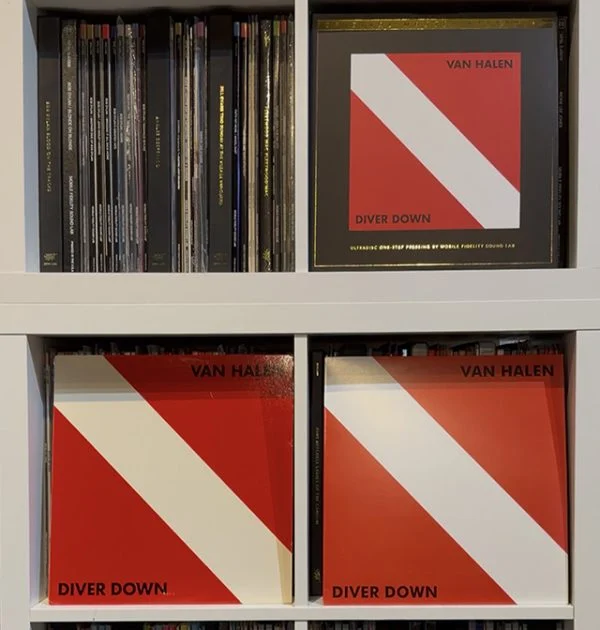
A side-by-side comparison between a pristine original 1982 commercial pressing and modern audiophile editions highlights the limitations of early-1980s mass-production vinyl.
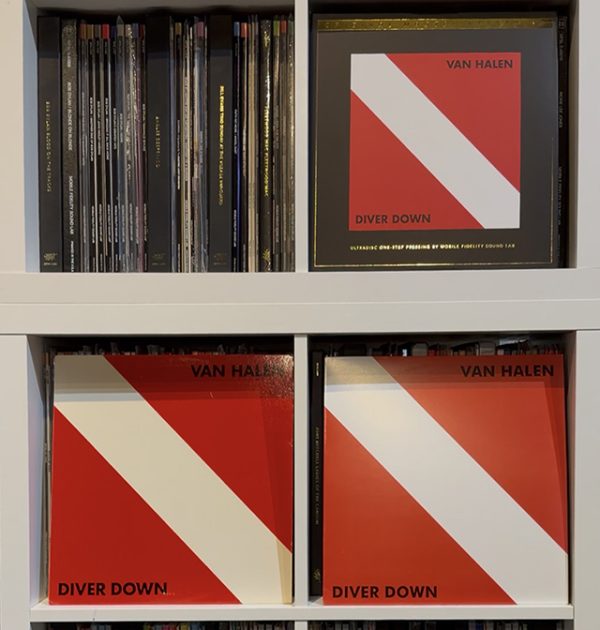
- Dynamic Range: Noticeably compressed, with peaks shaved off to prevent needle jump on lower-end turntables.
- Low-End Response: A severely truncated bottom end. Bass frequencies below 60Hz are rolled off significantly, reducing the physical impact of Michael Anthony’s bass lines.
- Midrange Congestion: Guitars and vocals fight for the same narrow sonic space, occasionally resulting in listener fatigue during dense passages like "Where Have All the Good Times Gone!"
Audiophile conspiracy theories often jokingly point the finger at the mixing desk dynamics, wondering if the dialed-back low end was passive-aggressiveness toward bassist Michael Anthony, though audio engineers attribute it strictly to standard radio-friendly mastering practices and the physical limitations of cutting dense rock albums onto standard vinyl blanks.
The Chris Bellman Remaster: A Major Corrective Course
Stepping up to the Chris Bellman vinyl cut shifts the paradigm entirely:
- Soundstage Width: Noticeably wider separation between Eddie Van Halen’s hard-panned guitar tracks and David Lee Roth’s flamboyant vocalizations.
- Transient Response: Drum hits possess a sharper, more natural decay, proving that a significant amount of musical information was lurking in the master tapes all along.
- Tonal Balance: A much more neutral EQ profile that tames harsh upper-midrange glare without sacrificing the aggressive bite that defined early-80s hard rock.
The MoFi UltraDisc One-Step: The Definitive Analog Experience
When examining the MoFi One-Step version, the improvements transition from incremental to revelatory. Nowhere is this more apparent than on the deep-cut track "Big Bad Bill (Is Sweet William Now)."
- Restoration of the Low End: The lost bottom end is restored to absolute perfection. Alex Van Halen’s kick drum and tom-toms possess a woody, organic resonance that physically pressurizes the room.
- Timbral Accuracy: The MoFi version captures the subtle, breath-generated nuances of Jan Van Halen’s (Eddie and Alex’s father) clarinet performance on "Big Bad Bill." The tone is buttery, smooth, and utterly distinct from the surrounding electric guitar wizardry.
- Format Superiority: While Mobile Fidelity’s Super Audio CD (SACD) release offers digital cleanliness and impressive detail, the physical vinyl MoFi One-Step maintains the organic warmth, bloom, and dimensional imaging that proves the magic of analog vinyl still rules the day.
Official Responses
While record labels and audiophile pressing plants rarely issue formal, press-release-style statements regarding catalog updates, engineers and industry stakeholders have frequently commented on the unique challenges posed by the Van Halen tape archive.
In historical interviews discussing the production of Diver Down, producer Ted Templeman emphasized the spontaneous, improvisational nature of the sessions. "We weren’t trying to make Dark Side of the Moon," Templeman noted regarding the quick turnaround of the record. "We were trying to capture a live wire in the studio. If it felt good, we printed it and moved on to the next track." This fast-and-loose tracking style meant that subsequent mastering engineers inherited tracks with variable phase alignments and unique tape saturation profiles.
Speaking on the challenges of working with the Warner Bros. vault tapes for vinyl reissues, remastering engineers have consistently praised the raw energy captured by engineer Donn Landee. While early digital and vinyl transfers often struggled to translate the massive acoustic volume of Eddie Van Halen’s "Brown Sound" without distortion, modern high-resolution chain developments have allowed engineers to peel back decades of generational EQ curves.
Mobile Fidelity Sound Lab’s production notes for their UltraDisc One-Step series emphasize an uncompromising commitment to source material transparency. By utilizing their proprietary One-Step pressing process—which eliminates two generations of stampers—MoFi aims to deliver a master-tape-quality experience directly to the consumer’s turntable, effectively allowing modern listeners to sit beside the mixing console at Sunset Sound in the spring of 1982.
Implications
The enduring debate surrounding the sonic presentation and artistic merits of Diver Down carries broad implications for both the rock music canon and the modern audiophile marketplace.
Reassessing the "Wacky" Mid-Period Album
For years, music critics dismissed Diver Down as a transitional filler album that signaled the beginning of the end for the classic David Lee Roth-era Van Halen lineup. However, modern critical reappraisal views the album through a different lens. By showcasing the band’s reverence for classic pop structures, blues, jazz, and country music alongside cutting-edge heavy metal innovation, Diver Down demonstrates a fearlessness that many of their contemporaries lacked. When heard through high-end playback systems that reveal the intricate interplay between the instruments—such as the nylon-string acoustic mastery on "Little Guitars"—the album’s historical reputation shifts from an oddball misstep to a masterclass in stylistic versatility.
The Economics and Philosophy of Audiophile Reissues
Furthermore, the existence of multiple tiered pressings of a single 1980s rock record highlights the booming economic viability of the high-end vinyl market. Consumers are no longer satisfied with generic, compressed digital files or flat, lifeless vinyl reissues cut from digital safety copies. The appetite for premium, audiophile-grade restorations—exemplified by the market fervor surrounding MoFi One-Step releases and Bellman remasters—proves that physical media enthusiasts are willing to invest heavily in historical fidelity.
As search algorithms and pop-culture retrospectives continue to query iconic tracks like the opening assault of "Where Have All the Good Times Gone!", the physical artifacts we use to listen to these songs matter more than ever. Through proper mastering, archival care, and premium vinyl manufacturing, a maligned 1982 record can be reborn, proving that even a band’s wildest, most eccentric studio experiments can stand the ultimate test of time.