In the high-stakes world of professional audio—where the difference between a pristine master and a failed forensic recovery can hinge on a single decibel—CEDAR Audio has long been the industry gold standard. On June 24, 2026, the company expanded its prestigious ICONS plugin range with the release of "Blade," a sophisticated hyper-resolution analyzer and equalizer designed to push the boundaries of spectral clarity.
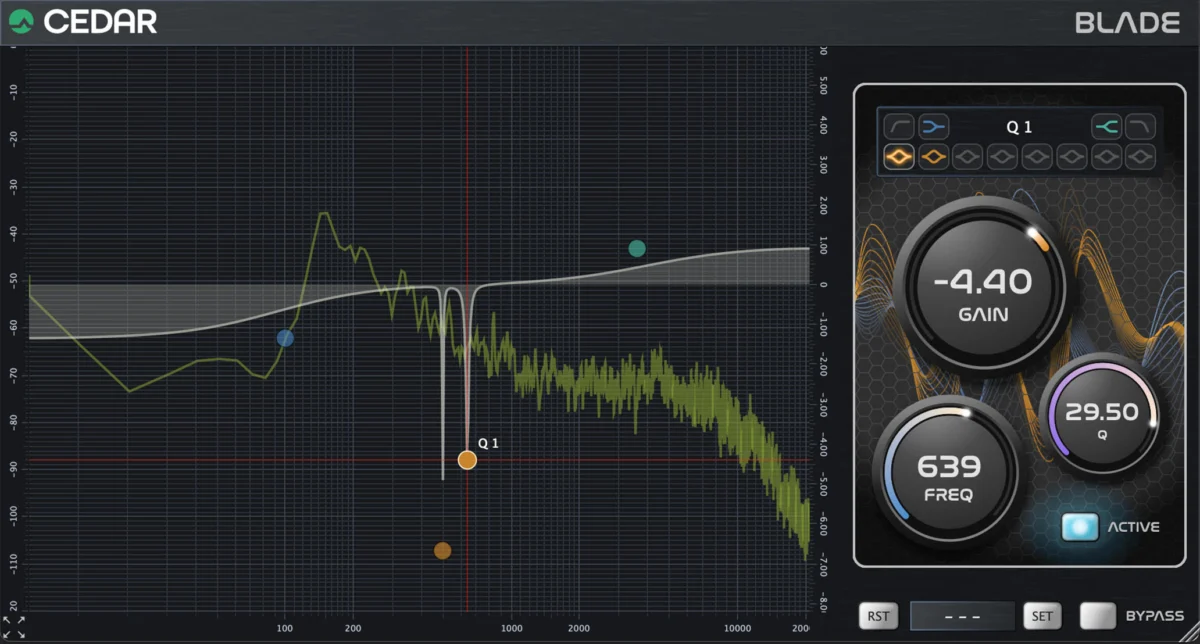
By marrying proprietary spectral analysis technology with a high-precision Infinite Impulse Response (IIR) equalizer, Blade aims to solve some of the most persistent challenges in audio engineering: the identification and mitigation of elusive, narrow-band resonances and tonal artifacts that standard FFT-based tools frequently overlook.
The Core Innovation: Beyond the Standard FFT
To understand the significance of Blade, one must first understand the limitations of the status quo. Most modern digital audio workstations (DAWs) and third-party plugins rely on Fast Fourier Transform (FFT) analysis to visualize frequency content. While FFT is a computational workhorse, it suffers from a fundamental trade-off: frequency resolution.
At low frequencies, standard FFT analyzers often "smear" data, making it impossible to distinguish between two closely spaced tones or to identify a narrow, problematic spike hidden in the sub-bass or low-mid range. CEDAR Audio has circumvented this limitation by adopting a methodology closer to that found in high-end, laboratory-grade signal analyzers.
"CEDAR Audio invented spectral editing and real-time audio restoration," explains CEO Andy Trott. "The unique spectrum analyzer in Blade is not an FFT analyzer, which is what you will find in other audio workstations and plugins. These suffer from poor resolution—especially at low frequencies—and are not suitable for the level of precise audio analysis our clients require. The Blade analyzer offers a maximum resolution of 0.02 Hz at any frequency. This allows you to identify unwanted tones with an accuracy that was previously unavailable in a plugin format."

Chronology and Development
The development of Blade follows a trajectory of evolution within CEDAR’s ICONS series. Over the past few years, the company has focused on migrating its legendary hardware-based restoration algorithms into a more flexible, software-based architecture.
- Early 2025: Initial R&D began, focusing on the synthesis of IIR filter structures with high-resolution signal tracking.
- Q4 2025: Beta testing commenced with select mastering engineers and forensic audio experts to refine the user interface and ensure the stability of the 0.02 Hz resolution engine.
- June 2026: The official launch of Blade, positioning it as the "surgical" companion to the broader ICONS suite.
The arrival of Blade signifies a shift in how CEDAR intends to service the professional market. Rather than offering a "catch-all" restoration tool, Blade is a specialized instrument, designed to be the first point of contact in a signal chain where surgical precision is required before heavy processing occurs.
Supporting Data: Why 0.02 Hz Matters
In audio mastering and forensic reconstruction, the "problem area" is rarely a wide, gentle slope. It is often a thin, persistent whistle, a 60Hz hum, or a sympathetic resonance in an acoustic guitar that only peaks at a specific harmonic interval.
Standard plugins often require the user to "guess" the frequency, dragging an EQ node around until the resonance disappears. Blade changes this dynamic entirely. With its zoomable interface, users can focus on a window as narrow as 20 Hz, effectively placing the audio under a microscope.
Key Technical Specifications:
- Analysis Engine: Non-FFT based, laboratory-grade spectral tracking.
- Resolution: 0.02 Hz maximum, ensuring distinct separation of close-proximity frequencies.
- Equalization: IIR-based EQ architecture with high-precision Q-factors (up to Q=100).
- Application Scope: Optimized for forensic audio evidence preparation, high-end mastering, and complex audio restoration.
By offering a Q-factor of up to 100, Blade allows for the surgical removal of unwanted artifacts. A Q-factor this narrow ensures that when a user targets a resonance, the surrounding frequencies—which often contain the "air" or "body" of the recording—remain entirely untouched, preventing the "hollow" or "swirly" artifacts often associated with over-processing in less sophisticated EQs.

Implications for the Audio Industry
The release of Blade has profound implications for three specific sectors:
1. Forensic Audio and Law Enforcement
In forensic contexts, removing background noise without damaging the clarity of speech is the ultimate objective. Often, noise (like hums or electrical interference) sits at specific frequencies. The ability to isolate these to within 0.02 Hz means that forensic investigators can strip away interference that was previously thought to be "baked into" the recording, significantly increasing the intelligibility of voice evidence.
2. High-End Audio Mastering
Mastering engineers are often tasked with fixing problems in a final stereo mix. When a mix contains a singular, persistent resonance—such as a snare drum ringing at a specific frequency or a vocal "whistle"—a standard EQ might cut too wide, damaging the mix’s energy. Blade provides the surgeon’s scalpel that allows the engineer to "notch out" the resonance without affecting the overall musicality of the track.
3. Audio Restoration and Archiving
For archivists working with legacy media (tape, vinyl, or early digital recordings), spectral artifacts are a constant struggle. Blade’s ability to "see" what is happening at a micro-frequency level allows for a more transparent restoration process. It enables the preservation of the original performance’s character while silencing the mechanical or electronic flaws of the source medium.
Official Responses and Availability
Industry reception has been swift. Early adopters have praised the interface for its intuitive nature, noting that despite its immense power, it does not feel like a "calculator." The UI is designed to guide the user toward the problem, with the visual representation of the spectrum providing immediate feedback as adjustments are made.

CEDAR Audio has confirmed that the plugin is available immediately. As a member of the ICONS range, it is designed to integrate seamlessly into existing DAW environments, including Pro Tools, Logic Pro, and Nuendo, among others.
- Pricing: The plugin is available directly from the CEDAR Audio website at a price point of £119 / €139 / $159 (plus applicable taxes).
- Support: CEDAR has provided extensive documentation and video tutorials, emphasizing the workflow differences between traditional FFT-based EQs and the new Blade architecture.
Conclusion: A New Standard for Accuracy
In an era where software plugins are often judged by their ability to emulate vintage hardware, CEDAR Audio has taken a different, more functional path. Blade does not seek to emulate the past; it seeks to solve the technical hurdles of the present.
By providing a tool that prioritizes scientific accuracy and resolution, CEDAR has created an essential utility for anyone whose work requires absolute precision. Whether it is uncovering evidence in a forensic recording or polishing a master for commercial release, the "Blade" of CEDAR Audio promises to cut through the noise with unprecedented clarity. For the audio engineer who demands to know exactly what is happening in the frequency spectrum, the bar has been raised.