NEW YORK, NY — In the high-stakes world of professional live sound, the distance between a theoretical model and the physical reality of a venue can be measured in decibels, coverage gaps, and ultimately, the audience experience. Recognizing that architectural blueprints rarely survive the test of time or the reality of renovation, L-Acoustics has announced the launch of Digital Construction. This new, high-resolution LiDAR-based service is designed to bridge the gap between "as-designed" and "as-built" environments, providing sound engineers and venue owners with a verified geometric foundation for acoustic modeling.
Set to be a centerpiece of the company’s presentation at InfoComm 2026 in Las Vegas, Digital Construction represents a significant pivot for the French audio giant. By moving beyond hardware and software into specialized site-capture services, L-Acoustics is addressing a fundamental pain point in the industry: the inaccuracy of legacy venue data.
I. Main Facts: The Evolution of Venue Geometry
The core of the Digital Construction service is the utilization of advanced Light Detection and Ranging (LiDAR) technology to create a "Digital Twin" of any performance space. While L-Acoustics has long been a leader in acoustic simulation via its industry-standard Soundvision software, the efficacy of those simulations has always been dependent on the accuracy of the room’s geometry entered by the user.
A New Standard for Accuracy
Digital Construction is a comprehensive service package. L-Acoustics technicians or certified partners use handheld LiDAR scanners to conduct on-site surveys. Unlike traditional surveying methods that rely on laser distos and tape measures—which can take days and are prone to human error—the LiDAR workflow captures millions of data points per second. This allows for the mapping of complex geometries, such as curved balconies, ornate proscenium arches, and intricate raked seating, with millimeter precision.
The Deliverables
The service provides clients with two distinct files:
- A Detailed Point-Cloud File: A high-resolution 3D map of the venue for the client’s internal records, useful for architectural reference, lighting design, and facility management.
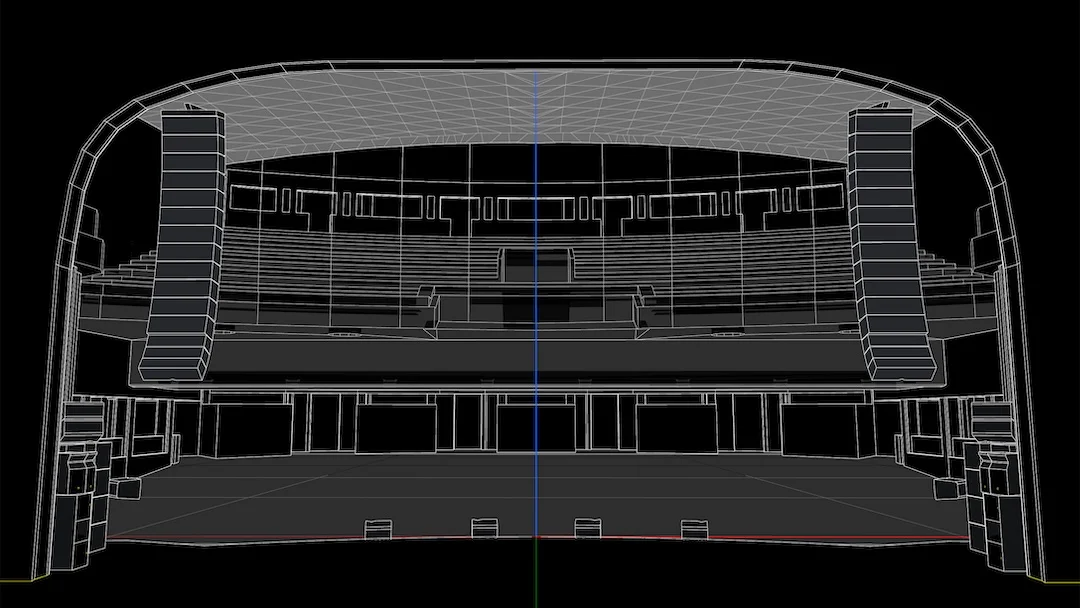
- A Soundvision-Ready Model: A simplified, optimized geometric model specifically tailored for acoustic simulation. This removes the "noise" of the raw point cloud (like chairs or decor) while retaining the critical surfaces that affect sound propagation.
II. Chronology: From Tape Measures to Digital Twins
To understand the necessity of Digital Construction, one must look at the evolution of venue documentation over the last century.
The Blueprint Era (1920–1990)
For decades, sound system design was an exercise in estimation. Engineers relied on paper blueprints, often dating back to the venue’s original construction. However, venues are living organisms. Over decades, a theater might undergo three renovations, have its ceiling lowered for HVAC, or have new VIP boxes installed. These changes were rarely updated on the original master plans.
The CAD Revolution (1990–2010)
The advent of Computer-Aided Design (CAD) allowed for more sophisticated modeling. However, the "garbage in, garbage out" rule applied. If the CAD file was based on inaccurate original drawings, the resulting acoustic model would be flawed. Engineers often found themselves on-site during installation realizing that a speaker array couldn’t be hung where planned because a structural beam existed in reality but not in the digital file.
The Soundvision Era (2010–2025)
L-Acoustics’ Soundvision became the first 3D real-time prediction software to allow for complex room modeling. It empowered designers to predict SPL and frequency response across the entire audience. Yet, the burden of measuring the room remained with the user. In recent years, the demand for immersive audio (such as L-ISA technology) has made geometric accuracy even more critical, as spatial positioning requires exact coordinates to maintain the psychoacoustic illusion.
The Launch of Digital Construction (June 2026)
Announced on June 15, 2026, Digital Construction marks the official entry of L-Acoustics into the field of professional site surveying. The service will be formally demonstrated to the public at InfoComm 2026 in Las Vegas (June 17–19), signaling a new era where the manufacturer takes responsibility for the integrity of the venue data itself.
III. Supporting Data: The Tech Behind the Scan
The technical backbone of Digital Construction is the handheld LiDAR scanner, a device that has revolutionized the Architecture, Engineering, and Construction (AEC) industries and is now being tailored for Pro AV.
How LiDAR Functions in Professional Venues
LiDAR works by emitting laser pulses and measuring the time it takes for them to reflect off surfaces. Because the scanners used in Digital Construction are handheld, operators can walk through a venue—moving under balconies, behind stage thrusts, and into narrow corridors—ensuring that "shadow zones" (areas blocked from a single tripod-mounted scan) are eliminated.
Speed and Resolution
- Time Efficiency: A standard 2,000-seat theater can often be scanned in under two hours, a process that would take a manual team two full days to measure with comparable detail.
- Point Density: The scanners capture hundreds of thousands of points per second, creating a "cloud" so dense it looks like a photograph.
- Verification: L-Acoustics has implemented a standardized workflow that includes quality checks at every stage. This ensures that the final model delivered to the Soundvision user is a "verified" representation, removing the liability of measurement error from the sound designer.
Integration with the Ecosystem
Digital Construction does not replace Soundvision; it fuels it. The service works alongside L-Acoustics’ existing Architectural Drafting services. By providing a "Soundvision-ready" model, the service bypasses the tedious hours sound engineers usually spend cleaning up complex CAD files or building rooms from scratch.
IV. Official Responses: The Philosophy of Precision
While official statements from the InfoComm floor highlight the technical specs, the underlying philosophy from L-Acoustics emphasizes a commitment to the "end-to-end" user experience.
According to company representatives, the motivation for Digital Construction stems from the increasing complexity of modern sound systems. "Everything changes in life… and that includes venues," the company noted in its launch announcement. "Renovations, retrofits, and years of small modifications can gradually alter a space until it is a far cry from what first appeared on architectural drawings."
Industry analysts suggest that this move is a strategic response to the rise of immersive audio. In a traditional stereo hang, a few degrees of error in a room’s width might be negligible. In an L-ISA immersive hyperreal environment, where 15 to 30 speaker arrays must be precisely timed and aimed to create a coherent soundstage, a 12-inch discrepancy in a wall’s location can compromise the entire system’s performance.
By offering Digital Construction, L-Acoustics is essentially providing an insurance policy for their systems. They are ensuring that the multi-million dollar investment a venue makes in a K-Series or L-Series rig is backed by a mathematical certainty that the system will perform exactly as predicted.
V. Implications: A Paradigm Shift for the Pro AV Industry
The introduction of Digital Construction has wide-ranging implications for consultants, integrators, and venue owners.
1. Reducing On-Site Troubleshooting
One of the most expensive aspects of any permanent installation or major tour is the "discovery" phase—finding out that a speaker cannot be rigged in its planned location. Digital Construction identifies these physical obstacles before the equipment even leaves the warehouse. This reduces labor costs and prevents last-minute engineering "hacks" that can degrade sound quality.
2. The Future of Venue Management
For venue owners, the high-resolution point-cloud file is a valuable asset. It can be used for more than just sound. Lighting designers can use it to check sightlines and beam angles; architects can use it for future renovations; and marketing teams can use it to create virtual tours for prospective clients.
3. A New Revenue Stream for Certified Providers
The Digital Construction service is designed to be delivered through L-Acoustics’ network of Certified Providers. This empowers local rental houses and integrators to offer high-value consulting services, further embedding them into the lifecycle of a venue’s development.
4. Convergence of AEC and Pro AV
This move signals the continued convergence of the construction and audio industries. As building information modeling (BIM) becomes the standard for all modern construction, the audio industry is finally catching up. L-Acoustics is positioning itself not just as a loudspeaker manufacturer, but as a technology partner capable of navigating the digital complexities of modern architecture.
5. Impact on the "Recording Studio Class of 2026"
As noted in Mix magazine’s recent coverage of the "Recording Studio Class of 2026," the trend toward hyper-accurate, digitally-integrated spaces is accelerating. Studios and performance venues are being built with integrated sensors and digital backbones. Digital Construction fits perfectly into this trend, providing the spatial data required for the next generation of "smart" acoustic environments.
Conclusion: The Road to InfoComm 2026
As the industry gathers at the Las Vegas Convention Center from June 17 to 19, all eyes will be on Booth N6336. L-Acoustics’ Digital Construction is more than just a new tool; it is a statement of intent. It acknowledges that in the modern era, the "software" of sound—the predictions, the processing, and the spatialization—is only as good as the "hardware" of the room’s geometry.
By mastering the third dimension, L-Acoustics is ensuring that the fourth dimension—the time-based experience of sound—remains as perfect as the laws of physics allow. For the sound designers of tomorrow, the days of the tape measure may finally be numbered.