By the Editorial Team
Based on original evaluation data and technical disclosures.
Main Facts: The Anatomy of an Ultra-Portable Contender
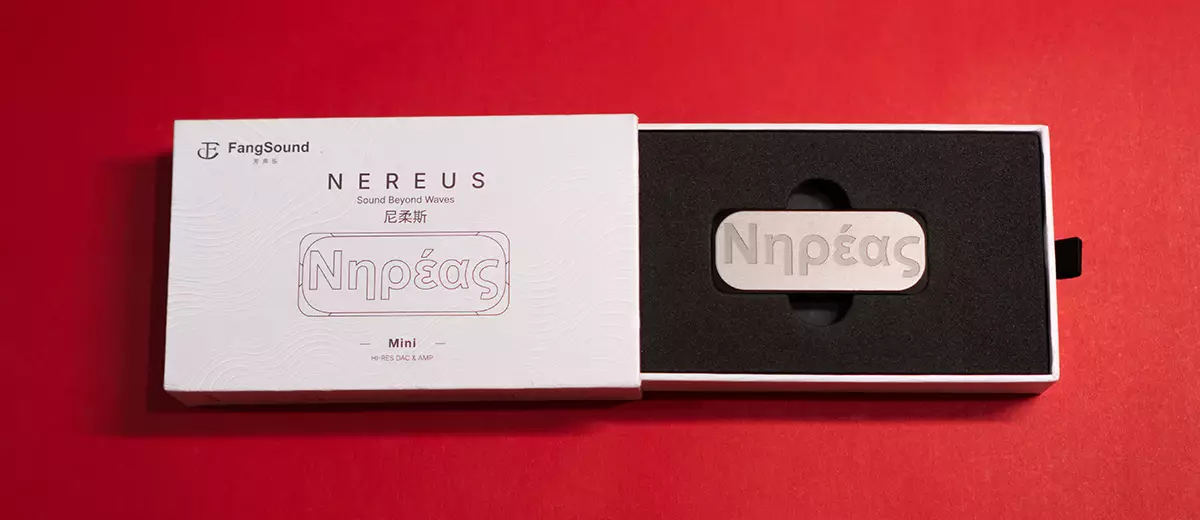
In the fast-paced world of personal audio, dongle DACs have transitioned from simple headphone jack replacements to high-fidelity miniaturized command centers. Entering this crowded arena is the FangSound NEREUS Mini, an ultra-portable, 25.5-gram digital-to-analog converter that packs a punch with 515mW of balanced output power.

Priced competitively at $163, the NEREUS Mini is the newest and most accessible entry in FangSound’s growing catalog—a product family uniquely characterized by nomenclature drawn from figures of Greek mythology. Sitting a few price tiers below the brand’s flagship Prometheus dongle, the NEREUS Mini utilizes a single ESS ES9039Q2M chip built on ESS Technology’s advanced HyperStream IV architecture.
Despite utilizing a silicon component that has been widely adopted by manufacturers since its 2003 release for its balance of high resolution and low power consumption, FangSound has set its device apart through proprietary tuning. By carefully altering the DAC’s analog output stage and the balanced amplifier’s power supply, the engineers have engineered a warmer, fuller sound profile that resists the clinical, sterile reputation often associated with off-the-shelf ESS implementations.

Chronology: From Concept to the Modern Dongle Market
The trajectory of portable USB-C audio hardware has evolved rapidly over the past half-decade. As smartphones systematically stripped away analog 3.5mm headphone jacks, audiophiles demanded portable solutions that didn’t require lugging around bulky desktop stacks or dedicated Digital Audio Players (DAPs).
- The ESS Integration Era (2023–Present): The introduction of the ES9039Q2M chip provided manufacturers with a reliable, power-efficient canvas capable of handling high-resolution audio streams (supporting PCM up to 32-bit/768kHz).
- FangSound’s Mythological Expansion: FangSound carved out its niche by launching a series of Greek-mythology-inspired audio devices, focusing heavily on meticulous chassis machining and refined power delivery systems.
- The NEREUS Mini Launch: Positioning itself directly in the crosshairs of established rivals—such as the budget-friendly Cayin RU3 ($99), the analytical AFUL ICEBORNE ($149.99), and the xDuoo Link3—the NEREUS Mini represents the brand’s push into the highly contested sub-$200 portable market.
Supporting Data & Hardware Specifications
To understand how the NEREUS Mini performs in daily use, one must look closely at its physical build, connectivity architecture, and sonic behavior.

Build Quality and Design
Machined from a solid block of aluminum alloy, the NEREUS Mini’s chassis is held together with precision titanium screws. Finished in a low-key, understated matte gray, the device sports diagonal side grooves that double as functional heatsinks for thermal dissipation.
- Dimensions: 62mm × 12.5mm × 25mm
- Weight: 25.5g
- Markings: Engraved with the Greek alphabet spelling out "Nereus" on one flank and the stylized FangSound logo on the other.
I/O and Control Interface
The device features a completely driverless plug-and-play architecture. It connects via a standard USB-C OTG port that handles both power delivery and digital audio transmission simultaneously. Because it houses no internal battery, it draws minimal power directly from the host device (whether smartphone, tablet, or laptop).

On the output side, it offers dual headphone terminations:
- 3.5mm Single-Ended Jack
- 4.4mm Balanced Jack (delivering up to 515mW)
Note: The unit features no physical onboard control buttons or companion app ecosystem. Volume and playback are managed strictly through the connected host device, maintaining a minimalist design philosophy.

Sonic Performance Breakdown
Evaluated across a variety of IEMs (EarAcoustics SPA, Hidizs MP145 Pro, FlipEars Aegis) and full-size headphones (TANGZU Ox Demon King, Sennheiser HD 620s), the NEREUS Mini presents a distinct sonic signature:
- Bass: Offers a neutral yet warm presentation with tight, well-controlled punch and organic rumble. It avoids muddy bleed into the midrange, though it trades off some of the absolute analytical resolution found in rivals like the AFUL ICEBORNE.
- Mids: Leans toward a smooth, organic vocal delivery reminiscent of the Cayin RU3. Male vocals benefit from a chesty, deep, and physically weighty lower midrange presentation, sounding more forward and authoritative compared to female vocals.
- Treble: Smooth, clean, and relaxed. It successfully tames harsh peaks (such as those on the FlipEars Aegis), favoring musicality, airy extension, and controlled sibilance over a fatiguing analytical edge.
- Staging and Imaging: The soundstage prioritizes intimacy over sheer width. It features a center-focused, highly cohesive presentation with fast decay, keeping instrument separation immaculate and layering clean without cross-bleed.
Official Responses and Industry Context
While FangSound provides transparent specifications regarding its digital decoding capabilities (PCM up to 32-bit/768kHz via the HyperStream IV multibit delta-sigma design), the company has kept certain proprietary details close to the chest. Notably, specifications sheets and official documentation omit the exact amplification topology utilized (whether Class AB, hybrid, or discrete), focusing instead on the subjective tuning results of their analog output stage modifications.

Reviewers and industry observers have noted that while the hardware design is exceptional, the unboxing and accessories package remains sparse. The retail box includes only the unit, an instruction manual, a warranty card, and a single Type-C to Type-C cable—omitting protective carrying pouches or legacy adapters (such as Lightning cables for older iOS devices) that consumers often expect at a $163 price point.
Implications: Where the NEREUS Mini Fits in the Audiophile Ecosystem
The launch and reception of the FangSound NEREUS Mini highlight several shifting trends within the personal audio market:

- The Premium on Musicality: As consumers grow fatigued by ultra-analytical, fatiguing portable gear, manufacturers are increasingly tuning hardware to favor warmth, organic tone, and relaxed long-term listening comfort.
- The Power-to-Size Ratio Benchmark: Delivering 515mW of balanced output power out of a 25.5g chassis proves that physical heft is no longer a prerequisite for driving demanding IEMs and efficient portable headphones.
- Limitations with Full-Size Gear: While the NEREUS Mini excels with in-ear monitors and low-to-medium impedance headphones, its performance limitations—notably thinning out and losing spatial headroom when paired with demanding full-size studio headphones—serve as a reminder of the inherent physical boundaries of bus-powered dongles.
Ultimately, the FangSound NEREUS Mini successfully carves out a lane for itself. For users seeking a robust, elegantly machined, plug-and-play dongle that prioritizes musical engagement and a silent noise floor over complex app integrations, it stands as a formidable contender in the modern portable audio sea.