Main Facts
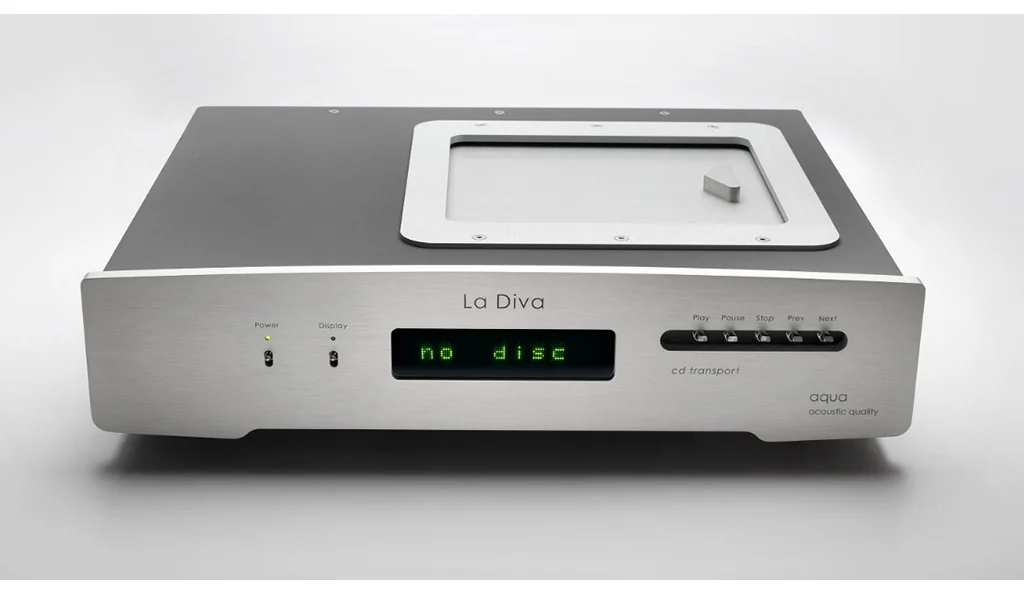
The high-end audiophile landscape is buzzing with anticipation as two flagships of digital audio reproduction arrive for comprehensive, long-term evaluation. Aqua Acoustic Quality (commonly known as Aqua), the renowned Italian manufacturer of uncompromising digital-to-analog converters and transports, has shipped its latest reference-tier digital front-end to the testing laboratories. The system comprises the newly minted LaScala Mk. III R2R Ladder DAC and the matching LaDiva dedicated CD transport.
Building upon a legacy of musicality and technical innovation, the LaScala Mk. III represents the third iteration of Aqua’s celebrated DAC architecture. It employs a pure R2R (Resistor-to-Resistor) ladder DAC design, paired with an analog tube output stage and a brand-new proprietary circuit module: the Pilot Buffer. Every critical element within the internal digital-to-analog conversion circuit has been meticulously redesigned or upgraded from its predecessor.
Complementing the DAC is the LaDiva CD transport, engineered specifically to extract the absolute maximum performance from Red Book compact discs. Designed to interface seamlessly via high-bandwidth proprietary digital links, the LaDiva and LaScala Mk. III combination aims to deliver a standard of silver-disc playback that rivals, and often surpasses, high-resolution file-based streaming.
Positioned firmly in the ultra-high-end tier of the market, the components carry a significant financial investment: the LaScala Mk. III DAC commands an MSRP of $9,850, while the LaDiva transport is priced at $9,960, placing the complete digital stack at just under $20,000 before cabling and isolation accessories.
Chronology
The journey toward the release of the LaScala Mk. III and the continued refinement of the LaDiva transport spans over a decade of continuous research, engineering iterations, and market feedback within the high-end audio sector.
- Early 2010s: Aqua Acoustic Quality establishes its reputation globally with modular, non-oversampling (NOS) R2R digital designs that reject mainstream off-the-shelf silicon chips in favor of discrete resistor ladders, prioritizing natural timbres and temporal accuracy over clinical measurements.
- The Mid-LaScala Era (Mk. I and Mk. II): The original LaScala DAC captures the attention of audiophiles and reviewers worldwide by successfully blending the resolution of digital audio with the harmonic richness, organic flow, and dimensionality typically associated with analog vinyl playback. Subsequent updates (Mk. II) refine the power supply and output stages.
- Introduction of the LaDiva: Recognizing that physical media—specifically the Compact Disc—remains a deeply treasured format for collectors and purists, Aqua develops the LaDiva transport, utilizing advanced mechanical isolation, precision laser mechanisms, and jitter-reduction topologies.
- Recent Development Cycle: Aqua’s engineering team spends years designing a new analog board topology. Their focus centers on developing the "Pilot Buffer"—a novel module designed to optimize impedance matching and transient response between the R2R ladder network and the tube-based output stage.
- Present Day: Following rigorous factory prototyping and calibration, review samples of the LaScala Mk. III and LaDiva are dispatched for long-term evaluation, signaling the official commercial rollout of these reference-grade components to the international audiophile press.
Supporting Data & Technical Specifications
To fully understand the weight of this review assignment, one must examine the engineering philosophy and hardware specifics that distinguish Aqua Acoustic Quality from mass-market digital manufacturers.
Aqua LaScala Mk. III R2R Ladder DAC
Unlike delta-sigma DAC chips—which rely on high-frequency noise shaping and mathematical approximation—the LaScala Mk. III utilizes a discrete R2R ladder architecture. This means digital data is converted into analog voltages via a precision array of physical resistors. Proponents argue this approach yields superior harmonic integrity and avoids the listening fatigue often attributed to mainstream silicon.
- Conversion Topology: Pure R2R ladder DAC (discrete design).
- Analog Stage: Vacuum tube-based output stage combined with solid-state discrete buffering.
- Key Innovation: Introduction of the proprietary Pilot Buffer module on the analog board, engineered to lower output impedance and enhance signal transfer purity.
- Circuit Enhancements: Comprehensive component upgrades throughout the entire digital-to-analog conversion chain, including refined power regulation and reduced internal jitter pathways.
- MSRP: $9,850 USD.
Aqua LaDiva CD Transport
While streaming services dominate modern consumer habits, the transport remains the critical mechanical heart of a physical-media playback system. The LaDiva is built to combat micro-vibrations, laser tracking errors, and phase noise.
- Format Compatibility: Red Book CD, CD-R, CD-RW.
- Chassis & Isolation: Heavily damped, resonance-optimized mechanical construction designed to shield sensitive laser optics from internal and external acoustic feedback.
- Digital Outputs: Multiple high-grade output configurations (including proprietary I2S via RJ45/HDMI-style interfaces, BNC, AES/EBU, and Coaxial) designed to maintain ultra-low jitter when paired with Aqua DACs.
- MSRP: $9,960 USD.
Official Responses & Industry Perspectives
While formal review conclusions for the Mk. III and LaDiva pairing are still weeks away as the break-in and critical listening periods unfold, early reactions from the reviewing team and initial manufacturer statements shed light on the design goals.
Reviewers familiar with Aqua’s previous catalog have noted high expectations, emphasizing the brand’s unique ability to bridge the gap between digital precision and analog warmth. Editorial feedback from early handling highlights the robust industrial build quality: heavy-gauge aluminum chassis panels, cleanly laid-out rear-panel connectivity, and a satisfying mechanical tactility to the switches and transport drawer.
From the manufacturer’s standpoint, Aqua Acoustic Quality has consistently maintained that digital audio is an evolving frontier where measurements alone do not tell the whole story. In past technical briefs, the company underscored its commitment to modular upgradability—a philosophy that allows owners of earlier Aqua hardware to benefit from ongoing engineering breakthroughs without rendering their investments obsolete. The implementation of the Pilot Buffer in the LaScala Mk. III is a direct manifestation of this ethos, representing an evolutionary leap rather than a disruptive reinvention.
Implications
The arrival of the Aqua LaScala Mk. III and LaDiva transport carries several notable implications for the high-end audio market, particularly for enthusiasts navigating the ongoing debate between physical media, local file servers, and cloud streaming.
1. The Resilience of Physical Media
Despite the absolute market dominance of streaming platforms like Qobuz, Tidal, and Roon-integrated libraries, high-end manufacturers continue to invest heavily in physical transport design. The nearly $10,000 price point of the LaDiva proves that a passionate, affluent segment of the audiophile community values the ritual, permanence, and uncompressed resolution of the Compact Disc. By pairing the LaDiva with a state-of-the-art R2R DAC like the LaScala Mk. III, listeners are demonstrating that standard 16-bit/44.1kHz silver discs, when spun on reference-grade hardware, can extract performance levels that frequently humble high-resolution digital files played on lesser gear.
2. The R2R Resurgence
The audio industry has experienced a distinct polarization between delta-sigma chip implementations and multi-bit R2R resistor ladder designs. By refining the LaScala into its third generation—specifically integrating the new Pilot Buffer and upgrading every internal circuit node—Aqua is placing a major bet on the enduring appeal of discrete ladder conversion. If the Mk. III succeeds in marrying the microscopic detail retrieval of modern digital with the fluid, organic liquidity of vacuum tube output stages, it could set a new benchmark for what music lovers can expect from non-oversampling/R2R topologies.
3. Long-Term Evaluation Standards
In an era dominated by quick-turnaround internet reviews, the decision to subject the LaScala Mk. III and LaDiva to an extended, long-term review process underscores the necessity of proper break-in time for complex vacuum tube and discrete R2R electronics. High-end components of this caliber often require hundreds of hours of signal pass-through to fully stabilize thermally and mechanically. Readers and consumers can look forward to a deeply thorough, multi-part evaluation in the coming months as these Italian masterpieces settle into their reference listening environment.