High-End Audio Excellence Arrives: Aqua Acoustic Quality’s LaScala Mk. III DAC and LaDiva CD Transport Under Review
015 mins
By the Editorial Review Board Published in Audiophile Equipment & Critical Listening
Main Facts
The landscape of high-end digital-to-analog conversion and physical media playback has just shifted slightly higher with the arrival of Aqua Acoustic Quality’s latest flagship offerings. Known in the audiophile community simply as "Aqua," the Italian high-end audio manufacturer has officially dispatched its newly minted LaScala Mk. III R2R Ladder DAC and matching LaDiva CD Transport to our listening rooms for an exhaustive, long-term evaluation.
Building upon a lineage of celebrated digital components, the LaScala Mk. III represents the third generational evolution of Aqua’s pure R2R (Resistor-to-Resistor) ladder architecture. This iteration is not merely a superficial refresh; it introduces a sophisticated vacuum tube output stage coupled with a proprietary, newly developed analog board module known as the "Pilot Buffer." Alongside these headline additions, virtually every critical component within the internal DAC topology has been thoroughly re-engineered, optimized, and upgraded to squeeze the absolute highest degree of musicality and transient fidelity from digital streams and files.
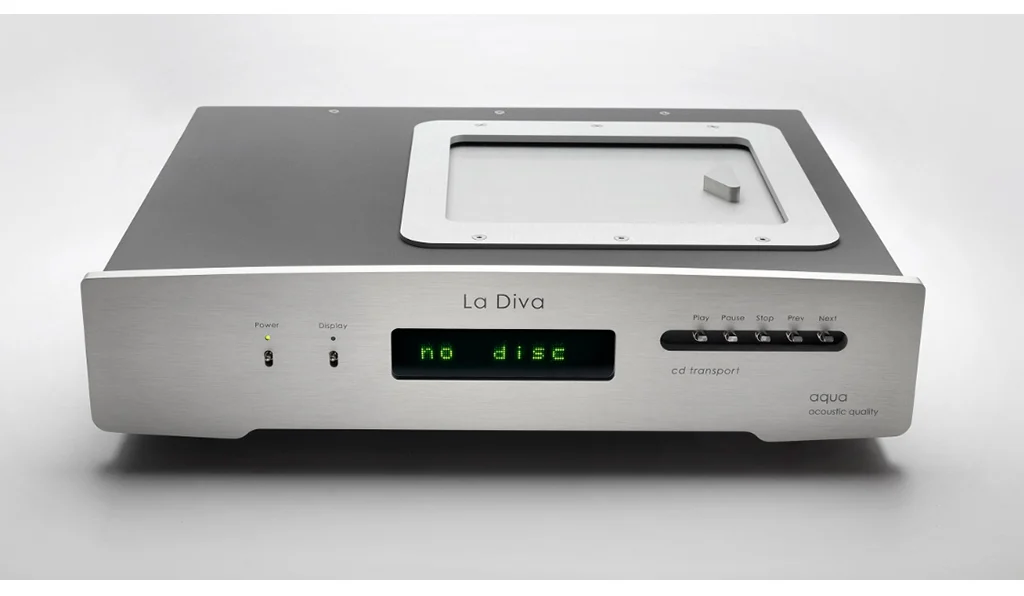
To evaluate this decoding prowess in its purest native environment, Aqua has thoughtfully paired the DAC with the LaDiva CD transport—a dedicated, no-compromise mechanism engineered specifically to extract red-book compact disc data with microscopic precision.
In terms of market positioning, these components command serious investment, reflecting their boutique, hand-assembled Italian pedigree. The LaScala Mk. III DAC carries a Manufacturer’s Suggested Retail Price (MSRP) of $9,850, while the companion LaDiva CD Transport is priced at $9,960. Together, they form a near-$20,000 digital front-end that promises to redefine the boundaries of what is possible from both legacy silver discs and modern high-resolution digital playback.
Chronology
To understand the weight of this new arrival, it is essential to contextualize the timeline of Aqua Acoustic Quality and the evolutionary steps that led to the LaScala Mk. III and LaDiva pairing.
The Foundation Era (Early 2010s): Aqua Acoustic Quality established itself as a purist digital audio brand based in Milan, Italy. Eschewing off-the-shelf, mass-market silicon chips (such as Delta-Sigma architectures commonly found in commercial electronics), Aqua doubled down on discrete R2R ladder DAC designs, believing them to offer superior timbral accuracy, natural decay, and an absence of digital fatigue.
The Genesis of LaScala (Mid 2010s): The original LaScala DAC was introduced to critical acclaim, successfully bridging the gap between the organic warmth of vinyl playback and the convenience and detail of digital audio. Its unique hybrid design—combining solid-state digital processing with a tube output stage—became a signature calling card for the company.
The Mk. II Iteration (Late 2010s): As digital sampling rates climbed and consumer demand for modular, upgradeable hardware grew, Aqua released the LaScala Mk. II. This version refined the power supply architecture and updated the digital receiver board, keeping the platform competitive in a rapidly shifting technological landscape.
The Birth of LaDiva: Recognizing that the best DACs are starved of potential if fed by inferior transports, Aqua developed the LaDiva. Built from the ground up as a dedicated CD transport—avoiding the compromises inherent in multi-format DVD or Blu-ray chassis—the LaDiva utilized top-loading Philips mechanisms and proprietary jitter-reduction clocking systems.
Present Day (2026): Aqua announces and begins shipping the third-generation LaScala Mk. III and the refined LaDiva. Featuring the newly minted "Pilot Buffer" analog module and extensive internal overhauls, these units have officially touched down on our reference test benches for long-term critical appraisal.
Supporting Data
High-end audio evaluation requires looking past marketing hyperbole and examining the hard engineering choices, specifications, and architectural topologies that dictate performance. Below is a breakdown of the technical data surrounding the Aqua LaScala Mk. III and LaDiva pairing.
Aqua LaScala Mk. III DAC Specifications & Architectural Highlights
Analog Stage: Hybrid topology featuring a dedicated vacuum tube output stage for natural harmonic structure and spatial bloom.
Proprietary Innovations: Introduction of the new "Pilot Buffer" module on the analog board, designed to lower output impedance, enhance drive capability, and improve impedance matching with downstream preamplifiers.
Circuitry Overhaul: Comprehensive redesign of internal digital-to-analog signal paths, power regulation stages, and grounding planes compared to the preceding Mk. II model.
Chassis & Build: Resonance-optimized mechanical chassis construction, featuring isolated compartments to shield sensitive analog circuitry from electromagnetic and radio-frequency interference (EMI/RFI).
MSRP: $9,850 USD.
Aqua LaDiva CD Transport Specifications & Architectural Highlights
Media Support: Red Book CD, CD-R, CD-RW (optimized strictly for audio reproduction).
Drive Mechanism: High-precision, proprietary CD transport mechanism featuring a top-loading magnetic clamp system designed to eliminate disc wobble and read errors.
Jitter Reduction: Advanced digital reclocking and jitter-attenuation circuitry prior to output transmission.
Output Connectivity: Multiple galvanic-isolated digital output options, ensuring pristine signal transmission to compatible DACs.
Power Supply: Multi-stage linear power supply featuring custom-wound transformers with separate windings for digital processing, transport mechanics, and display logic.
MSRP: $9,960 USD.
Official Responses and Manufacturer Philosophy
While formal press releases detail the technical specifications, the true ethos of a boutique audio manufacturer is found in its design philosophy. In statements accompanying the release of the LaScala Mk. III and LaDiva, Aqua’s engineering team elaborated on their stubborn adherence to discrete R2R topology and physical media in an increasingly streaming-dominated world.
"In our pursuit of true musical reproduction, we found that mass-market conversion chips impose a homogenized, sterile signature on the music," notes the lead design team at Aqua Acoustic Quality. "The R2R ladder architecture allows us to preserve the temporal relationships and micro-dynamic shifts of a live performance. With the LaScala Mk. III, our goal was not to reinvent our philosophy, but to push the limits of what our discrete ladder network could achieve when paired with our newly developed Pilot Buffer."
Regarding the continued relevance of the dedicated CD transport via the LaDiva, the company emphasizes that physical media remains an uncompressed treasure trove of musical data that often outclasses heavily compressed or poorly mastered network streams.
"Many listeners assume that physical compact discs are an obsolete medium," the manufacturer states. "However, when a CD is read by a transport engineered without compromise—free from the electrical noise of computer USB buses and switching power supplies—the resulting sound quality rivals or exceeds high-resolution files. The LaDiva was built to prove that the Compact Disc still has secrets left to reveal."
Implications
The arrival of the Aqua LaScala Mk. III and LaDiva transport for long-term review carries several significant implications for the audiophile market, the ongoing debate over digital conversion topologies, and the resurgence of physical media.
1. The Endurance of R2R Ladder DACs
In an industry heavily saturated by Delta-Sigma DAC chips from manufacturers like ESS Sabre and AKM, Aqua’s continued commitment to discrete R2R ladder design highlights a major ideological divide in high-end audio. While Delta-Sigma chips often boast extraordinary signal-to-noise ratios and vanishingly low distortion figures on paper, critics argue they can sound clinical or fatiguing over extended listening sessions. R2R ladder DACs, by contrast, are notoriously difficult and expensive to manufacture because they require exceptionally tight resistor tolerances. By releasing the Mk. III, Aqua is signaling that the labor-intensive, organic sound of R2R conversion remains highly viable—and arguably superior—for listeners prioritizing emotional engagement over raw spec-sheet dominance.
2. The Evolution of the Hybrid Tube-Solid-State Bridge
By incorporating both a pure R2R digital section and a vacuum tube output stage equipped with the new "Pilot Buffer," the LaScala Mk. III addresses a classic audiophile dilemma: how to get the razor-sharp transient speed and micro-detail of digital audio without sacrificing the warmth, texture, and three-dimensional soundstaging traditionally associated with tubes. The performance of this new analog board module will heavily influence how future designers approach hybrid analog stages.
3. The Re-Valuation of the Compact Disc
With streaming services dominating consumer habits, the market for high-end CD transports might seem counterintuitive. Yet, a growing segment of audiophiles is experiencing "streaming fatigue"—growing weary of network dropouts, algorithmic curation, and the variable quality of streaming masters. A reference-grade transport like the LaDiva ($9,960), paired with an elite DAC like the LaScala ($9,850), validates the investment consumers have made in physical CD libraries over the past four decades, proving that silver discs, when spun on uncompromising hardware, can compete at the absolute apex of modern digital playback.
Outlook for the Review
Over the coming weeks and months, our evaluation team will subject the Aqua LaScala Mk. III and LaDiva transport to rigorous bench testing and prolonged critical listening across a wide variety of musical genres, partnering them with reference-grade amplification and loudspeakers. We will examine how the new Pilot Buffer handles complex orchestral passages, subtle vocal nuances, and demanding transient peaks.
Stay tuned for our comprehensive, long-term review as we determine whether this nearly $20,000 Italian digital pairing delivers the sonic revelation its pedigree promises.