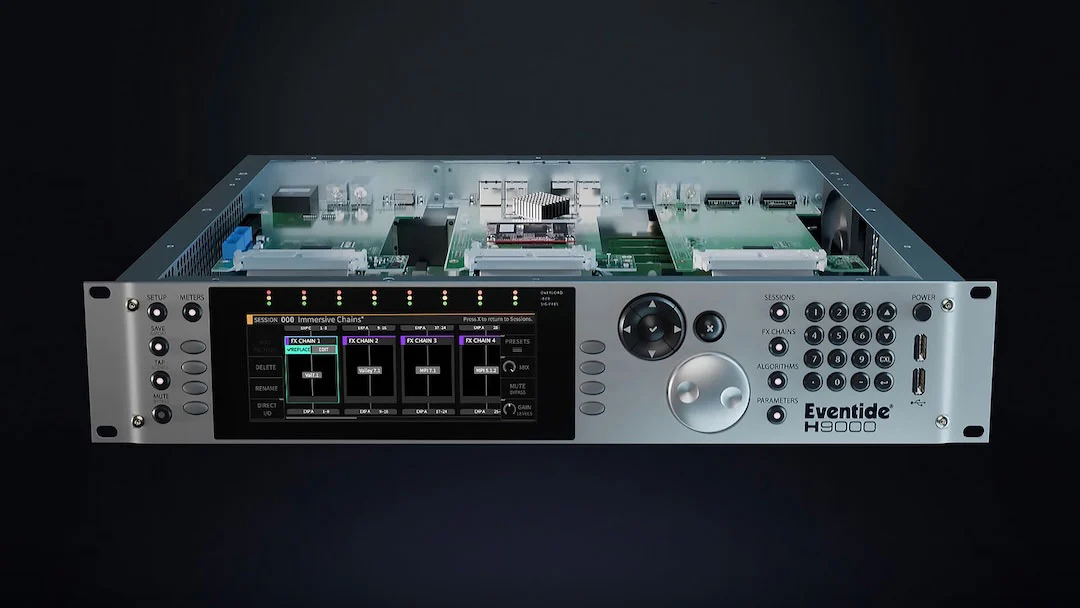
Little Ferry, NJ (September 18, 2026) — In a move that reaffirms its status as a titan of digital signal processing (DSP), Eventide has unveiled a massive expansion to the H9000 Harmonizer Gen2 platform. This latest update introduces a robust suite of immersive audio algorithms, specifically engineered to tackle the increasingly complex demands of modern surround and spatial sound design. By extending high-fidelity processing to Quad, 5.1, 5.1.2, and 7.1 configurations, Eventide is positioning the H9000 Gen2 as the definitive hardware hub for studios navigating the transition into the immersive era.
The Evolution of the Harmonizer: Main Facts
The core of this update lies in three distinct pillars of sound design: the MicroPitch Immersive effect, the Valley reverb engine, and a suite of advanced Upmixing tools. For the professional audio community, this represents a significant shift in how multichannel content is crafted.
The MicroPitch Immersive algorithm is perhaps the most anticipated addition. Building on the legacy of Eventide’s legendary pitch-shifting technology, this iteration provides up to eight channels of spatialized, detuned delays. It is not merely a widening tool; it offers a sophisticated ecosystem of independent delay and pitch processing, complemented by deep modulation, equalization, and crossfeed controls.
Complementing the pitch engine is Valley, a new reverb algorithm designed for multidimensional spatial creation. Unlike standard reverbs that often feel "tacked on" to a mix, Valley allows for surgical control over the character and density of the space. It supports configurations ranging from Stereo to 7.1, and includes a proprietary feature called "Haze." In multichannel setups, Haze dynamically spreads the reverb output from a single speaker into its neighboring channels, effectively smoothing the "seams" of a soundfield and creating a more cohesive, immersive envelopment.
Finally, the new Upmixer algorithms allow engineers to take legacy stereo or mono sources and intelligently map them into immersive environments. This is a critical workflow improvement for post-production facilities tasked with re-mastering archival content or spatializing stereo music for modern immersive streaming formats.
A Chronology of Innovation
To understand the significance of this update, one must look at the trajectory of Eventide’s flagship hardware. The Harmonizer has been a staple of studio production since the 1970s, famously shaping the sound of countless platinum records.
- The Gen1 Era: The original H9000 set a new benchmark for DSP power, offering a modular, network-ready interface that bridged the gap between legacy analog workflows and modern digital production.
- The Transition to Gen2: Released to address the growing need for higher-density processing, the H9000 Gen2 introduced upgraded internal architecture, allowing for significantly more complex signal chains.
- The September 2026 Update: By focusing exclusively on immersive workflows, Eventide is signaling that the "Gen2" hardware was always intended to be the backbone of spatial audio production. This update serves as the software maturation of that hardware promise.
Supporting Data and Technical Specifications
The H9000 Gen2 remains a powerhouse of sheer processing capacity. Its ability to manage complex, multi-channel FX chains without latency is the primary reason it remains a favorite in professional scoring stages and high-end mixing suites.
- Configurations Supported: Quad, 5.1, 5.1.2, and 7.1.
- Preset Integration: The update includes over 200 new FX Chains and presets, meticulously crafted by sound designers to demonstrate the capabilities of the new algorithms.
- Platform Compatibility: The update is delivered via the Emote software, Eventide’s cross-platform control application.
- Accessibility: Existing H9000 Gen2 owners receive this update free of charge. H9000 Gen1 owners are not entirely left behind; they gain access to the Valley reverb in a stereo configuration, and have the option to purchase Gen2 DSP Upgrade Kits to unlock the full immersive feature set.
- Market Positioning: The H9000 Gen2 is priced at $7,999 (with front-panel display) and $5,999 (the H9000R rack-mount unit without a display).
Official Perspectives and Industry Impact
While Eventide has historically let its sound quality speak for itself, the release of this suite is a direct response to the "Immersive Revolution" currently sweeping through film, television, and music production.
"The goal with the Gen2 architecture was always to provide a sandbox for the future of audio," noted an Eventide representative during the announcement. "By introducing MicroPitch Immersive and the Valley reverb, we aren’t just giving engineers more tools; we are giving them a new way to interact with space. The ability to manipulate the relationship between speakers in a 7.1 array through features like Haze is something that, until now, required cumbersome, multi-plugin chains in a DAW. We’ve brought that back into the hardware domain, where it belongs."
Industry analysts have noted that the timing of this release aligns with a broader trend in professional audio: the move away from software-only processing. As immersive mixes become more complex, the CPU overhead required to run high-quality, multichannel spatial algorithms can often destabilize a DAW session. Offloading this processing to dedicated hardware like the H9000 provides a "safety net" for high-stakes projects, such as feature film dubbing or large-scale live events.
Implications for the Future of Sound Design
The introduction of these algorithms will likely have a cascading effect on studio workflows over the next 18 to 24 months.
1. The Death of the "Artificial" Mix
One of the most common criticisms of early immersive audio was that it sounded "disconnected"—a collection of sounds emanating from discrete points rather than a cohesive soundfield. By incorporating the "Haze" control and advanced crossfeed algorithms, Eventide is helping to solve the fundamental issue of phantom imaging in multichannel arrays. This will enable sound designers to push the boundaries of realism, creating spaces that feel vast yet grounded.
2. Streamlining Post-Production
For those working in television and film, the new Upmixer is a time-saver. Rather than relying on simple phase-shifting or automated panning, the H9000’s Upmixer provides the granular control necessary to ensure that dialogue remains anchored in the center channel while music and ambiance occupy the surround field with precision. This reduces the time spent on "spatial cleanup," allowing mixers to focus more on the artistic intent of the soundscape.
3. The Democratization of Immersive
While $5,999 is a significant investment, the ability for H9000 Gen1 owners to upgrade to Gen2 capabilities provides a sustainable path forward. It prevents hardware obsolescence and keeps the professional community unified on a single, powerful platform. As more home studios and independent mixing rooms adopt these immersive formats, the standardization of the H9000 as the "go-to" hardware processor becomes increasingly likely.
Conclusion
The September 2026 update to the Eventide H9000 Gen2 is more than just a firmware patch; it is a declaration of intent. As the industry moves toward a future where spatial audio is the standard rather than the exception, Eventide is ensuring that its users have the processing power to lead that transition. With the addition of MicroPitch Immersive, the Valley reverb, and sophisticated Upmixing tools, the H9000 continues its legacy as the Swiss Army knife of the recording studio—now with a much larger, and much more immersive, blade.
For engineers and studios looking to solidify their infrastructure for the next decade of sound, the path forward is clear: the H9000 Gen2 has just set a new standard for what is possible in the multichannel realm. Whether you are mixing a blockbuster film score or crafting the next generation of spatial music, these tools offer the precision, depth, and character that have defined the Eventide name for half a century.