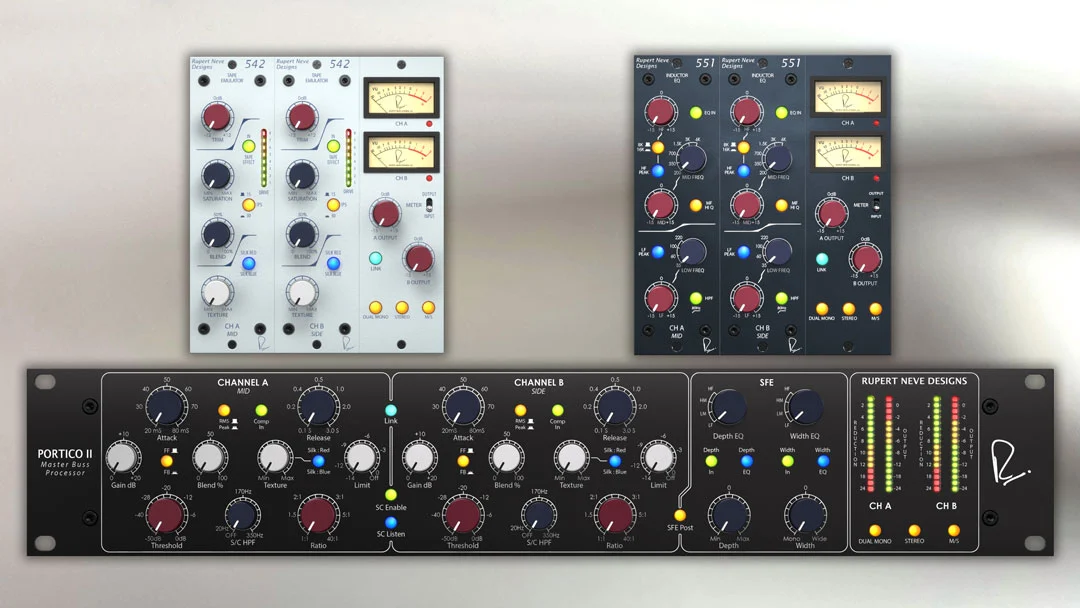
Wimberley, TX (September 17, 2026) — For decades, the name "Rupert Neve" has stood as the gold standard in audio engineering. From the legendary consoles that defined the sound of 1970s rock to the sophisticated 500-Series modules that grace modern hybrid studios, Rupert Neve Designs (RND) has remained the pinnacle of analog warmth, precision, and musicality. Today, that legacy makes a historic leap. In a move that signals a significant strategic shift for the company, RND has announced the launch of its first-ever proprietary line of plug-ins: the Portico II Master Buss Processor, the 551 Inductor EQ, and the 542 Tape Emulator.
While the brand has previously lent its circuit topology and brand identity to third-party software collaborations, this release marks the first time Rupert Neve Designs has entered the digital ecosystem as a standalone software developer. By partnering with the esteemed plug-in engineers at McDSP, RND aims to bridge the gap between their storied hardware lineage and the modern, in-the-box production environment.
The Main Facts: Bringing Hardware DNA to the DAW
The transition of these three iconic units into the digital domain is not merely a "skinning" of existing algorithms. According to RND, the development process was an exhaustive effort to model the specific nonlinearities, voltage-controlled amplifier (VCA) behaviors, and transformer-coupled saturation that have made these units industry staples.
1. The Portico II Master Buss Processor
As the flagship offering in this collection, the Master Buss Processor plug-in is designed to replicate the immense sonic footprint of the original hardware. Known for its ability to "glue" a mix together, the plug-in retains the original’s VCA compressor, limiter, and—crucially—the field-effect transistor (FET) and VCA-based stereo field control. Users can now harness the unit’s legendary "Silk" textures and parallel processing capabilities directly within their DAW, offering the same precision control over dynamic range that has graced countless platinum-selling records.
2. The 551 Inductor EQ
The 551 Inductor EQ holds a special place in the RND catalog as the only 500-Series equalizer ever designed by the late Rupert Neve himself. By utilizing custom-wound inductors, the plug-in emulates the rich, musical curves that define Neve’s classic designs. The three-band design, which draws inspiration from the legendary 1073 and 1084 modules, provides the same high-pass filter and mid-frequency resonance that engineers rely on to shape vocals and instruments without harshness.
3. The 542 Tape Emulator
The 542 plug-in brings the elusive sound of analog tape to the digital world. Beyond simple saturation, it replicates RND’s proprietary tape emulation circuitry. It offers a soft-clipper to manage transient peaks, alongside the company’s signature "Silk Red" and "Silk Blue" modes, which allow users to shift the harmonic content of a signal—enhancing high-frequency sparkle or mid-range weight, respectively.
Chronology: A Legacy of Innovation
The history of Rupert Neve Designs is a trajectory of constant refinement. Rupert Neve, who founded his first company in 1961, spent over 60 years refining the relationship between electronic components and human perception.
- The Analog Foundations (1960s–2000s): The creation of the Neve 80-series consoles established the "Neve sound"—a combination of high-headroom transformers and class-A amplification.
- The RND Rebirth (2005): Following the launch of Rupert Neve Designs, the company focused on smaller-format, high-end hardware like the Portico series, proving that modular, boutique gear could outperform vintage consoles in terms of noise floor and reliability.
- The Hybrid Experimentation (2010s–2024): Throughout the last decade, RND observed the shift in the industry toward "In-The-Box" (ITB) mixing. During this period, the company permitted select partners to emulate their circuits, acting as a consultant for high-end digital emulations.
- The Strategic Shift (2025–2026): Recognizing that the fidelity of digital signal processing (DSP) had reached a point where it could finally do justice to their hardware, RND began the development of their own internal software division. The partnership with McDSP was finalized in early 2025, leading to the intensive modeling phase that culminates in today’s release.
Supporting Data: Technical Integration and Compatibility
For the professional studio engineer, the utility of a plug-in is defined as much by its workflow integration as its sound. RND has prioritized broad compatibility to ensure that these tools fit into any professional ecosystem.
The plug-ins are fully optimized for both Intel and Apple Silicon architectures, ensuring low-latency performance during tracking and mixing. Furthermore, the software supports a wide array of industry-standard Digital Audio Workstations (DAWs), including:
- Avid Pro Tools (AAX)
- Logic Pro (AU)
- Steinberg Cubase & Nuendo (VST3)
- Ableton Live, FL Studio, LUNA, Reaper, Studio One, and Sonar.
By adopting the VST3, AU, and AAX formats, RND ensures that these tools are not relegated to a specific studio environment but can be used by everyone from independent bedroom producers to large-scale post-production facilities. The MSRP structure—$199 for the Master Buss Processor and $129 each for the EQ and Tape Emulator—positions them competitively against high-end boutique plug-in developers like Universal Audio and FabFilter.
Official Responses and Philosophy
In a statement accompanying the launch, the engineering team at RND emphasized that the goal was never to replace hardware, but to provide a "digital extension" of the RND philosophy.
"Our hardware has always been about the interaction between the operator and the circuit," said a spokesperson for the company. "When we approached the software development, we didn’t just want to copy the curves; we wanted to capture the behavior of the transformers when pushed to their limits. By collaborating with McDSP, we’ve been able to implement unique digital-only features that enhance the original designs, such as extended frequency ranges and enhanced harmonic saturation controls that weren’t possible in the analog domain."
The inclusion of these "extra" features is a departure from traditional "vintage-only" modeling. It suggests that RND intends to grow this software line into a hybrid ecosystem where the digital versions eventually become more versatile than the hardware, without sacrificing the core sonic identity.
Implications for the Audio Industry
The release of these plug-ins marks a significant inflection point for the professional audio market. Several key implications arise from this move:
1. The Death of the "Hardware vs. Software" Debate
For years, the industry has been divided into camps: those who swear by the sound of physical transformers and those who prefer the recallable convenience of software. By entering the plug-in space, Rupert Neve Designs is effectively validating the digital medium as a legitimate, high-fidelity platform for their brand. It suggests that the future of audio is not a choice between the two, but an integration of both.
2. Standardization of High-End Modeling
With RND now in the software game, the bar for "accurate" emulation has been raised. Competitors will likely feel increased pressure to improve the fidelity of their transformer-saturation models. This is a win for the end-user, as the competitive landscape will drive further innovation in DSP efficiency and analog-modeling accuracy.
3. The Future of the "Hybrid Studio"
As studios shrink in physical size but grow in processing power, the ability to pull up a "Rupert Neve" chain on every single channel of a mix—something that would be cost-prohibitive with hardware—changes the sonic possibilities for producers. The "Neve sound" is no longer reserved for the final mix bus or the lead vocal chain; it can now be applied to background synths, room mics, and experimental textures.
Conclusion: A New Chapter
The transition of the Portico II Master Buss Processor, 551 Inductor EQ, and 542 Tape Emulator into the digital domain is a testament to the endurance of Rupert Neve’s vision. While the hardware will always hold a place in the hearts of engineers who crave the tactile experience of turning a physical knob, the digital versions ensure that the legacy of those designs will persist in a world that is increasingly defined by code and computation.
As these tools make their way into the hands of mixers, sound designers, and musicians worldwide, the impact on the modern soundscape will be profound. By bringing the soul of the analog studio into the modern DAW, Rupert Neve Designs has not just kept pace with the industry—they have reminded us that at the end of the day, it is not the format that matters, but the music itself.