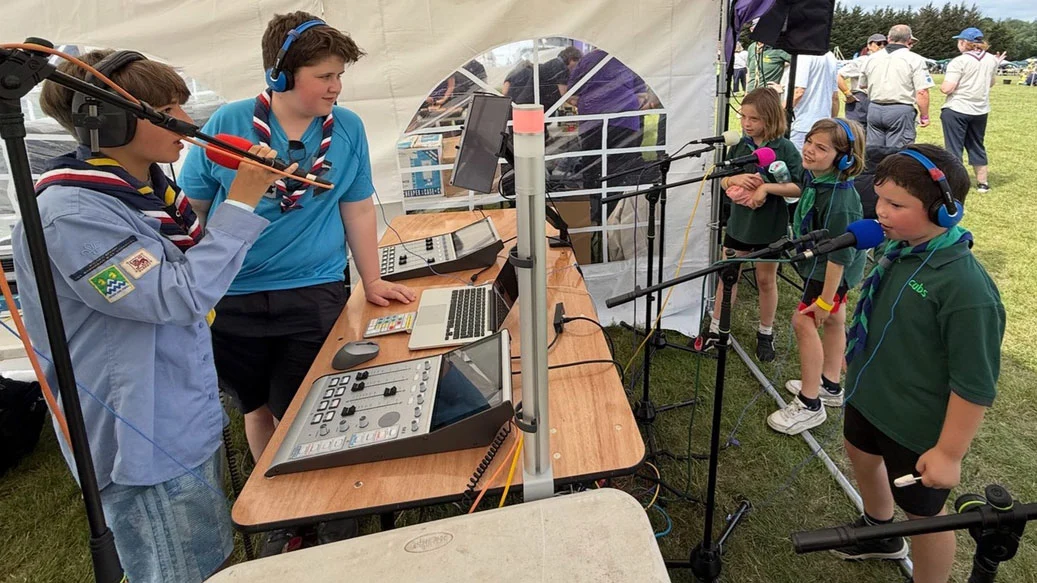
WALTON-ON-THAMES, UK — The venerable Scout motto, "Be Prepared," has long been synonymous with knot-tying, camping, and wilderness survival. Yet, in an increasingly digital landscape, the definition of "preparedness" is undergoing a quiet revolution. At the heart of this shift is Andrew Kemp, a seasoned broadcast engineer who is bridging the gap between high-end professional media production and youth education. By deploying sophisticated DHD.audio technology at the recent Surrey Scouts SCRAM 2026 event, Kemp is proving that the future of broadcast engineering doesn’t just belong in corporate studios—it belongs in the hands of the next generation.
The Architect of Innovation: Andrew Kemp
To understand the significance of this initiative, one must first look at the man behind the console. Andrew Kemp is not a newcomer to the industry; he is a veteran with over 25 years of experience navigating the complexities of linear and non-linear television playout, video-on-demand (VOD) infrastructure, and intricate media asset management.
Having spent decades in the trenches of professional broadcasting, Kemp possesses a rare perspective: he understands the daunting technical barriers that often keep young talent from entering the field. His mission as a volunteer Scouting supporter is simple but ambitious—to demystify the "black box" of professional audio. By leveraging his professional network and personal equipment, Kemp has created a portable, high-fidelity media lab that transforms a standard Scout meeting space into a functioning broadcast center.
The Hardware: DHD.audio and the SCRAM 2026 Deployment
The centerpiece of Kemp’s educational toolkit is the DHD.audio SX2 mixer, a console renowned in the professional sphere for its reliability, modularity, and intuitive interface. At the Surrey Scouts SCRAM 2026 event held in Walton-on-Thames, the setup comprised a 10-fader configuration—a 6-fader main unit paired with a 4-fader expansion module—powered by an XS3 processing core.
To ensure the system remained cutting-edge, the rig integrated a Dante multichannel audio-over-IP interface. This allowed for seamless networking and signal routing, mimicking the architecture used in modern global broadcasting facilities.
"Our first project with the new mixer was at the Surrey Scouts SCRAM 2026 event," Kemp explained. "The SX2 enabled young scout leaders to gain hands-on experience in audio media production. It also allowed Cub Scouts and Brownies to gain confidence in live audio presentation—in this case, with everything relayed on a site-wide public-address system. The mixer proved an ideal training resource and encouraged the user team to propose ideas for future events."
Chronology of a Technical Training Initiative
The integration of professional-grade audio gear into the Scouting program did not happen overnight. The initiative followed a strategic rollout designed to maximize educational impact:
- Phase I: Concept and Curation (Early 2026): Kemp identified a gap in the local Scouting curriculum regarding STEM and media arts. He selected the DHD.audio SX2 specifically for its "training mode" capabilities and compact footprint, which were essential for outdoor, site-wide event deployments.
- Phase II: The "Sandbox" Testing (Mid-2026): Before the SCRAM event, Kemp conducted small-scale workshops to gauge the learning curve for young users. He discovered that the DHD Views App—a software interface that mirrors console controls on a tablet—significantly reduced the intimidation factor for younger participants.
- Phase III: The SCRAM 2026 Live Deployment (October 2026): The system was moved from the lab to the field. For the first time, Cub Scouts were not just observers; they were active operators of a professional PA system, learning the nuances of gain staging, microphone discipline, and real-time mixing.
- Phase IV: Post-Event Review and Scalability: Following the success at Walton-on-Thames, the team began documenting the workflow to create a "plug-and-play" manual that could be replicated by other Scouting districts across the UK.
Supporting Data: The SX2 Ecosystem
The success of this project is largely attributed to the hardware’s design philosophy. DHD.audio built the SX2 system with a "central panel first" approach, which is ideal for pedagogical environments. The central panel provides immediate access to primary I/O, including local microphone and headphone jacks, allowing users to connect hardware directly to the console without a complex external patch bay.
Key Technical Specifications of the Training Rig:
- Console Architecture: 4-fader central panel, expandable via daisy-chained modules.
- Processing Power: XS3 core, providing robust, low-latency audio processing suitable for live event environments.
- Interface Control: DHD Views App, allowing for tablet-based remote supervision and adjustment.
- Connectivity: Dante AoIP integration, ensuring the system can scale with additional network-capable peripherals.
The Views App, in particular, has been a game-changer. By allowing supervisors to monitor the levels and settings on a secondary screen, Kemp could provide real-time guidance without hovering over the student’s shoulder, fostering an environment of independent learning.
Official Responses and Educational Implications
The reaction from the Scouting community has been overwhelmingly positive. Local leaders have noted that the inclusion of high-tech equipment like the DHD system serves as a powerful recruitment and retention tool. In an era where digital literacy is paramount, the ability to operate a broadcast console provides Scouts with tangible, marketable skills that extend far beyond the campsite.
"We are seeing a shift in how children interact with media," noted a regional Scouting representative. "They are no longer just consumers of content; through Andrew’s efforts, they are becoming creators. The fact that they are learning on industry-standard hardware means they are developing professional-grade habits from day one."
The pedagogical implication here is significant. Traditional STEM education often focuses on coding or robotics, but broadcast engineering is a unique intersection of physics, art, and logistics. It teaches students about the behavior of sound waves, the importance of signal-to-noise ratios, and the high-pressure environment of live production—all while working in a collaborative team setting.
Implications for the Future: Beyond the Scout Hall
Looking ahead, Kemp’s project has sparked a conversation about the role of media technology in youth organizations. If a mobile, transportable media-training resource can be successfully deployed in a field in Walton-on-Thames, the potential for wider adoption is clear.
For DHD.audio, this initiative serves as a real-world case study for the versatility of their equipment. While designed for the rigors of 24/7 radio and TV operations, the SX2 has proven that it is equally at home in an educational setting. The "small learning curve" of the interface is perhaps the most important feature, as it allows the hardware to disappear into the background, leaving the user to focus on the content they are creating rather than the machine they are operating.
As for the Scouts themselves, the impact is personal. One young participant at the SCRAM event noted that hearing their own voice broadcast across the site via the PA system was a "transformative experience." That single moment of confidence-building is the ultimate goal of Kemp’s project.
Conclusion
The intersection of professional broadcast engineering and Scouting may seem unconventional, but it is a perfect match for the digital age. Andrew Kemp has demonstrated that with the right equipment and the right mentorship, the barrier to entry for complex technical fields can be lowered significantly.
As these young Scouts graduate from Cub Scouts to more advanced levels, they will carry with them the foundational knowledge of audio engineering—a skill set that is increasingly relevant in a world dominated by streaming, podcasting, and immersive media. By being "prepared" with the right technology and the right guidance, these young people are not just learning how to operate a mixer; they are learning how to amplify their voices in a global, connected landscape.
The success at Walton-on-Thames is likely only the beginning. As more volunteers look to modernize their outreach programs, the blueprint laid out by Kemp and his DHD.audio setup provides a clear path forward: keep the technology professional, the interfaces intuitive, and the educational focus on the limitless potential of the students.