LAS VEGAS – As the professional audio industry gathers at the Las Vegas Convention Center for InfoComm 2026, DAS Audio has marked its 55th anniversary with a strategic expansion of its installation portfolio. The company officially pulled back the curtain on the MIA Series, a comprehensive line of coaxial point source loudspeakers and low-profile subwoofers designed to address the evolving complexities of modern integrated environments.
The launch, centered at booth N6437 and supported by immersive demonstrations in room N114, represents more than just a new product release; it is a calculated effort by the Spanish manufacturer to provide systems integrators with a versatile toolkit capable of handling everything from high-end corporate boardrooms and houses of worship to complex hospitality venues.
The Core Offering: Engineering for Flexibility
The MIA Series arrives at a time when integrators are demanding higher performance from smaller, more aesthetically unobtrusive footprints. By utilizing coaxial point source technology, the MIA Series aims to deliver a coherent phase response and consistent off-axis performance, which are critical in environments where listener positioning is varied.
The Full MIA Lineup
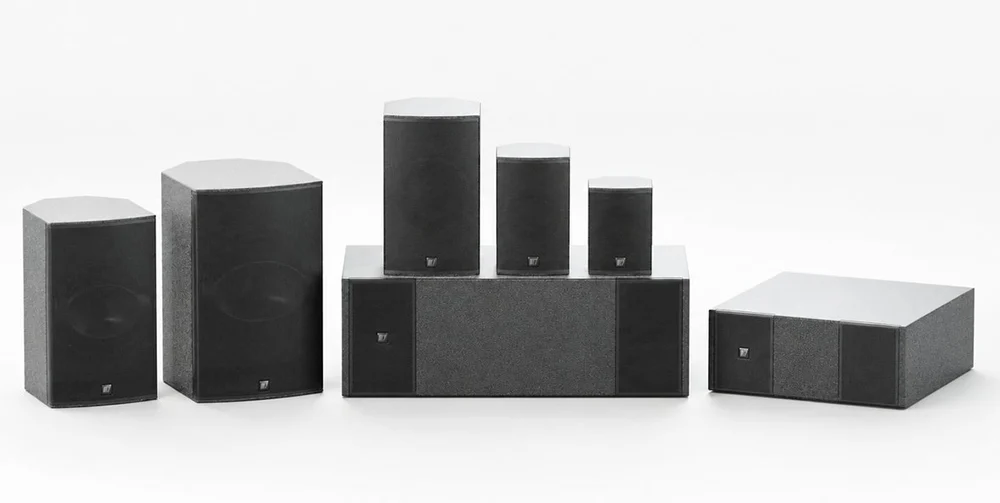
The series comprises seven distinct models, categorized by their driver size and coverage capabilities:
- MIA-X5: A 5-inch coaxial point source loudspeaker featuring 120-degree conical coverage.
- MIA-X6: A 6-inch coaxial point source loudspeaker with 120-degree conical coverage.
- MIA-X8: An 8-inch coaxial point source loudspeaker featuring 110-degree conical coverage.
- MIA-X10: A 10-inch coaxial point source loudspeaker offering flexible deployment via 70 x 50-degree or 110 x 60-degree rotatable horn options.
- MIA-X12: A 12-inch coaxial point source loudspeaker, also available with 70 x 50-degree or 110 x 60-degree rotatable horn configurations.
- MIA-S110: A 10-inch low-profile band-pass subwoofer.
- MIA-S115: A 15-inch low-profile band-pass subwoofer.
The inclusion of rotatable horns on the larger models—the X10 and X12—underscores the series’ intent to solve the "coverage versus aesthetics" dilemma. By allowing integrators to adjust the dispersion pattern regardless of the cabinet’s physical orientation, DAS Audio provides a solution that adapts to the architecture rather than forcing the architecture to adapt to the sound system.
A Legacy of Innovation: The 55-Year Milestone
To understand the significance of the MIA Series, one must look at the trajectory of DAS Audio. Founded over five decades ago, the company has grown from a specialized manufacturer into a global powerhouse in pro-audio.
Chronology of Development
- 1971: DAS Audio is established, beginning a long journey of acoustic research and development in Valencia, Spain.
- 2010s: The company pivots heavily toward the digital age, integrating advanced DSP and network control into its flagship line arrays.
- Early 2026: DAS Audio finds significant success at the NAMM show, where its EVENT-30A line array and EVENT-S218A subwoofer earn "Best of Show" honors, setting a high bar for the year’s product roadmap.
- June 2026: The official debut of the MIA Series at InfoComm, marking the midpoint of their 55th-anniversary celebrations.
The timing of the MIA launch is not accidental. By rolling out this series shortly after the industry accolades received for the EVENT line, DAS Audio is signaling a "full-spectrum" approach to the market—covering both the large-scale touring and installation sector with the EVENT series and the refined, compact installation sector with the MIA family.

Official Perspective: The "Integrator-First" Philosophy
During the unveiling, Michael Palmer, Vice President of Sales for North America at DAS Audio, emphasized that the design process for the MIA series was heavily influenced by direct feedback from the field.
"The MIA Series is an important launch for DAS Audio, especially as we celebrate 55 years as a company," Palmer stated during the press briefing. "With MIA, we saw an opportunity to create a loudspeaker line that gives integrators more choices while maintaining the performance and reliability we’re known for. We didn’t just want to build another speaker; we wanted to build a system that makes the integrator’s job easier on site."
Palmer’s comments highlight a recurring theme in the modern AV industry: the shift away from "product-only" selling toward "solution-oriented" selling. Integrators today face tighter margins and shorter installation windows. By providing a cohesive family of products that share voicing characteristics and mounting hardware, DAS Audio aims to reduce the "learning curve" associated with commissioning new systems.
Technical Implications: Why Coaxial Matters
The industry’s move toward coaxial designs is driven by the physics of sound. In traditional two-way designs, the physical separation between the high-frequency tweeter and the low-frequency woofer can lead to lobing or "comb filtering" as the listener moves around the room.
By placing the high-frequency driver at the acoustic center of the woofer, the MIA Series ensures that the sound emanates from a single point. This results in:
- Improved Off-Axis Response: Listeners seated to the far left or right of a stage experience the same frequency balance as those in the center.
- Compact Cabinetry: Coaxial drivers allow for smaller cabinet designs without sacrificing low-frequency extension, perfect for installations where sightlines are a concern.
- Predictable Coverage: The rotatable horns on the X10 and X12 models further refine this, allowing installers to "aim" the sound precisely where it is needed, minimizing reflections off walls and ceilings.
Beyond MIA: The Ecosystem Approach
While the MIA Series is the star of the InfoComm booth, DAS Audio is using the show to reinforce its broader ecosystem. The continued presence of the EVENT-30A line array alongside the new MIA products suggests that the company is aiming to be a "one-stop shop" for large-scale integrators.
The live demonstration schedule at room N114—offering sessions in both English and Spanish—demonstrates the company’s commitment to its global client base. By providing scheduled, professional-grade demonstrations, they are allowing engineers to hear the MIA series in a controlled environment, proving that the technical specifications translate to real-world performance.

Demo Room Schedule (Daily):
- 10:00 AM: English Presentation
- 12:00 PM: Spanish Presentation
- 2:00 PM: English Presentation
- 4:00 PM: English Presentation
Industry Implications and Future Outlook
The debut of the MIA Series arrives at a pivotal moment for the installation market. Post-pandemic, venues are undergoing massive renovations to accommodate hybrid events, better streaming capabilities, and higher-quality audio experiences.
The MIA Series sits in a "sweet spot" for these projects. Its low-profile subwoofers (S110 and S115) address the demand for "invisible" bass, while the wide variety of coaxial sizes (5, 6, 8, 10, and 12-inch) means that a single project can use the same brand and series for everything from a small lobby to a large banquet hall.
This level of uniformity is a significant advantage for inventory management and system calibration. As DAS Audio moves into the latter half of its 55th year, the MIA Series appears to be the cornerstone of its strategy to consolidate its market share in the professional installation sector.
For integrators, the implications are clear: the barrier between "high-performance" and "easy-to-install" is continuing to shrink. As manufacturers like DAS Audio continue to iterate on form factor and acoustic consistency, the end-user experience in public and private spaces is set to reach new heights of clarity and reliability.
For more information on the MIA Series or to schedule a demonstration, visit the official DAS Audio website.