In the world of professional live sound reinforcement, the quest for a "clean" low-frequency response is a perpetual pursuit. Engineers often find themselves battling muddy, undefined sub-bass that obscures the articulation of a mix. While the standard industry practice has long been to apply a Low-Pass Filter (LPF) to subwoofers to keep them within their intended range, a growing movement of system engineers is challenging the necessity—and the side effects—of this traditional approach.
By analyzing the intersection of frequency-domain magnitude and time-domain impulse response, we can uncover a more surgical method for shaping subwoofer performance: the use of Parametric Equalization (PEQ) cuts instead of traditional brick-wall filtering.
The Problem with Traditional Subwoofer Tuning
Not all subwoofers are manufactured with the same acoustic roll-off characteristics. Some cabinets exhibit a steep, rapid decline in output at the top of their passband, while others decay with a gentle, extended slope. When integrating these systems into a large-format PA, engineers often feel compelled to "clean up" the signal by adding an aggressive LPF via a console matrix or system processor.
The motivation is understandable. When subwoofers are allowed to reproduce higher frequencies—often extending well into the 100 Hz to 150 Hz range—the result is often increased "beaming" and inconsistent polar performance. This lack of directionality can make the low-end feel unfocused and disconnected from the full-range main arrays.
However, by relying solely on an LPF to solve this, engineers may inadvertently be creating a new problem: "time smearing." While the LPF successfully removes the unwanted high-frequency energy, it introduces significant phase shift and alters the impulse response of the subwoofer array, ultimately undermining the very "punch" and articulation that the engineer was trying to protect.

The Mathematical Reality: Frequency vs. Time
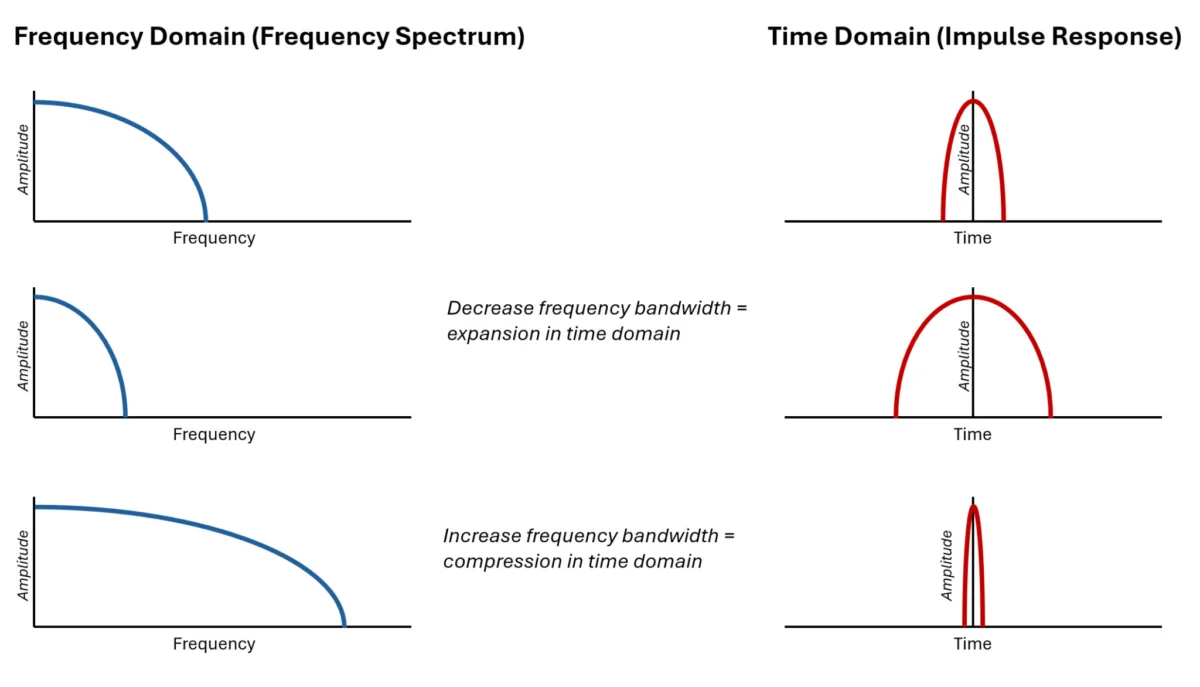
To understand why an LPF might be hurting your mix, we must look at the mathematical relationship between the frequency domain and the time domain. According to Fourier theory, these two domains are essentially two different ways of viewing the same physical reality. They are inextricably linked: a change in one domain inevitably forces a change in the other.
A fundamental rule of signal processing is that the compression of a signal in one domain results in an expansion in the other. When you apply a steep LPF to your subwoofers, you are effectively "compressing" the bandwidth in the frequency domain. The mathematical trade-off for this narrowing of bandwidth is an "expansion" or "smearing" of the impulse response in the time domain.
In practical terms, the sharper the LPF, the more the energy is spread out over time. This smearing manifests as a perceived loss of "attack" or "tightness." The sharp, instantaneous wavefront of a kick drum or bass guitar note is rounded off, leading to a softer, less defined transient. It is not a failure of the hardware or a design flaw by the manufacturer; it is a fundamental law of signal processing. If you want to keep the "punch," you must keep the energy coherent in time.
Comparative Analysis: LPF vs. PEQ
To visualize this, consider a comparison between a 4th-order 90 Hz LPF and a 115 Hz parametric EQ (PEQ) cut.
When observing the impulse response (IR) of these two approaches, the difference is stark. The LPF creates a noticeable "hump" in the IR, with the peak delayed by nearly 5 milliseconds compared to the PEQ approach. More importantly, the leading edge of the envelope—the part of the wave that conveys the initial impact of a sound—is significantly rounded and dulled in the LPF scenario. In contrast, the PEQ cut, which gently attenuates the frequency peak without imposing a hard band-limit, allows the sharp leading peak of the impulse to remain intact.

Furthermore, the phase response of the two methods provides additional evidence. An LPF introduces a full phase wrap, which creates significant time-domain artifacts. A PEQ cut, by comparison, exhibits a much more subtle "out and back" phase response. Because the PEQ keeps the phase closer to flat for a larger portion of the bandwidth, it maintains greater temporal cohesion, resulting in a sound that is perceived as tighter, more articulate, and significantly more "musical."
Chronology of System Optimization
The industry’s approach to low-frequency management has evolved through three distinct phases:
- The "Raw" Era: Early sound systems often ran subwoofers wide open or with minimal, rudimentary analog filtering. This resulted in high output but significant interference and muddy mid-bass.
- The LPF Standard: As digital signal processing (DSP) became standard, the 4th-order (24dB/octave) LPF became the "stock" setting. While it solved the issue of subwoofer beaming, it introduced the time-domain smearing that many engineers now recognize as a degradation of sound quality.
- The Precision Era: Today, advanced measurement platforms (such as SMAART, Rational Acoustics, or similar) allow engineers to see the phase and impulse response in real-time. This has led to the current shift toward surgical PEQ-based filtering, allowing engineers to clean up the crossover region while preserving the transient integrity of the sub-bass.
Supporting Data and Practical Application
For engineers looking to implement this shift, the process involves replacing the standard LPF with a series of stacked PEQ cuts. By using multiple, narrow-Q filters at the top of the subwoofer’s range, one can achieve the same "cleanliness" as an LPF while maintaining a vastly superior time-domain response.
In measurements, the composite phase response of these stacked PEQs typically remains well within a fraction of a cycle. This keeps the energy concentrated in time, avoiding the "smearing" effect. When listening tests are conducted, the result is almost universally perceived as "tighter."
Implementing the Strategy
- Measurement First: Use a dual-channel FFT analyzer to observe the subwoofer’s natural roll-off.
- Identify the Target: Determine the frequency range where the subwoofer begins to beam or interfere with the main arrays.
- Apply PEQ: Instead of a single, steep LPF, deploy 2-3 narrow-Q parametric cuts at the target frequency.
- Listen Critically: Compare the "attack" of a kick drum between the LPF setting and the PEQ setting. The difference is often immediate and audible.
Implications for Future System Design
The move toward PEQ-based subwoofer management represents a broader shift in audio engineering: a move away from "set-and-forget" presets toward a more informed, surgical approach to system tuning.

Manufacturers are also beginning to take note. As more engineers prioritize impulse response and phase coherence, we may see more "active" subwoofer designs that incorporate sophisticated, phase-linear filtering rather than relying on traditional IIR-based low-pass filters.
However, the responsibility remains with the system technician. The tools available in modern DSP are powerful, but they require a deeper understanding of the underlying physics. As the late Dr. Steven W. Smith noted in The Scientist and Engineer’s Guide to Digital Signal Processing, understanding the trade-offs between the frequency and time domains is the hallmark of a truly proficient engineer.
Conclusion
The pursuit of a "clean" low end does not have to come at the expense of "punch" and articulation. By recognizing the limitations of the traditional Low-Pass Filter and embracing the benefits of surgical Parametric Equalization, engineers can achieve a more coherent, tight, and professional sound. As always, the best approach is to let your ears—guided by the math—lead the way. Experiment with these settings in your next system design; you may find that the "cleaner" sound you have been searching for has been hiding in the time domain all along.