We are taught from a tender age that the human experience is governed by five sensory pillars: sight, hearing, smell, taste, and touch. This model, rooted in the philosophical musings of Aristotle, remains a staple of early education because of its simplicity and accessibility. It provides children with a tactile framework to categorize their world. However, as we peel back the layers of biological reality, we find that this traditional model is a profound oversimplification—a “lie by omission” that obscures the true complexity of human perception.
The Expanded Sensory Landscape
In reality, the human body is a marvel of biological instrumentation, utilizing a far broader array of sensory systems than most people realize. While the average person might cling to the five-senses model, those immersed in the fields of neuroscience, engineering, and psychology recognize that our internal and external awareness is far more granular.
Scientists now distinguish between 10 and 20 distinct sensory modalities. Among these are proprioception, which provides an innate map of our body’s position in space; the vestibular sense, our internal gyroscope for balance; thermoception, the thermal monitoring system; nociception, our vital alarm system for pain; and interoception, which tracks internal states like heartbeat, hunger, and breath. There is even the humorous, yet relatable, uxoriception—a term coined to describe the uncanny ability of a husband to detect his wife’s displeasure before a single word is spoken.
The human body is essentially a biological machine that synthesizes a cacophony of light, pressure waves, and chemical signals into a coherent, navigable picture of the world. Among these, the sense of audition (hearing) stands out as a masterpiece of evolutionary engineering.
Chronology: From Primitive Vibrations to Silicon Intelligence
The journey of hearing did not begin with the complex architecture of the human ear. Its evolutionary roots lie in mechanosensation—the primitive ability of ancient aquatic organisms to detect physical disturbances in their surroundings. Long before ears existed, cells capable of sensing vibrations, pressure changes, and fluid motion provided an evolutionary edge. For an ancient predator, sensing the subtle pressure wave of a target was the difference between survival and starvation.
Over hundreds of millions of years, these rudimentary vibration detectors underwent an exquisite process of refinement. Today, the human auditory system is capable of detecting sound waves so faint they move the eardrum by less than the width of an atom, while simultaneously tolerating intense sounds trillions of times more powerful. This 120-decibel dynamic range is one of the most remarkable sensory capabilities in the natural world.
However, hearing is merely the acquisition of data. The "heavy lifting" is performed by the brain, which extracts meaning from this data—transforming raw pressure waves into the soaring melodies of Beethoven, the complex soundscapes of Pink Floyd, or the urgent, late-night alert of a pet in distress. For all of human history, this ability to extract meaning from sound was the exclusive domain of biology. Today, we stand at the precipice of a new era: we are attempting to replicate this capability in silicon.
The "Real-World" Problem in Edge AI
As we transition from biological hearing to machine audition, the engineering community faces a stark reality: sensors are only half the battle. We can equip a device with high-fidelity microphones, but without advanced processing, that device is effectively deaf to context.
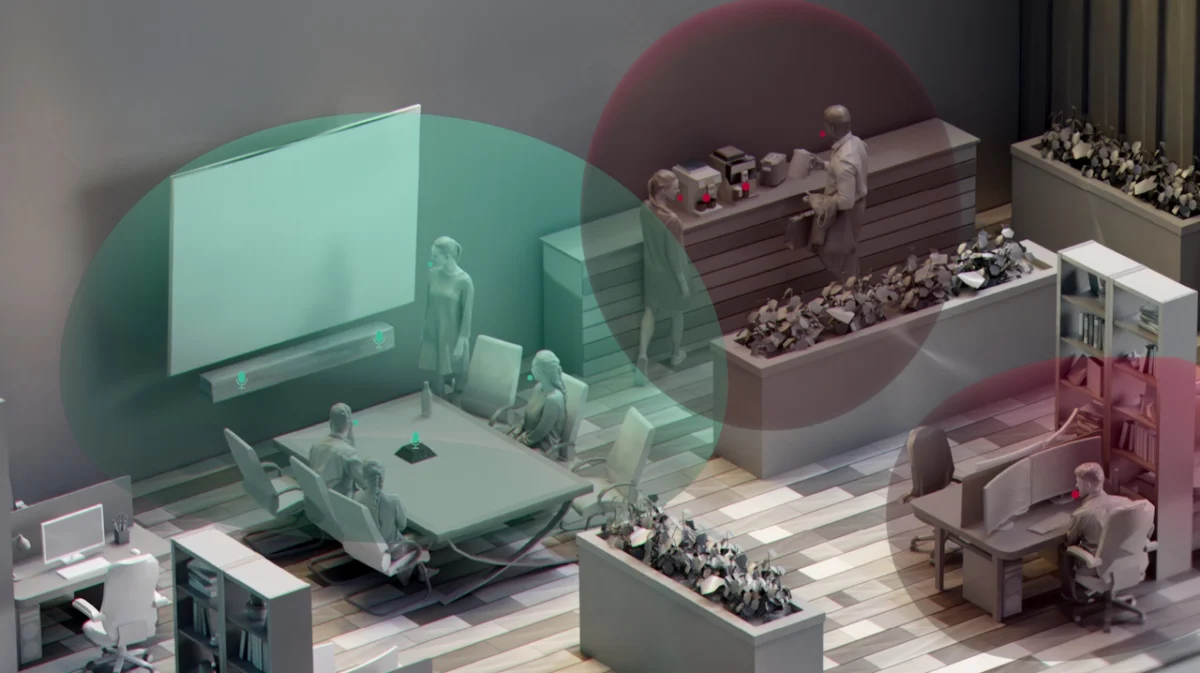
The current challenge in the field of Edge AI is the "laboratory-to-reality" gap. Many speech recognition systems perform with near-human accuracy in pristine, controlled settings. However, place these same systems in a bustling kitchen, a crowded conference room, or the interior of a moving vehicle, and their performance often craters.
Real-world environments introduce variables that laboratory benchmarks fail to capture:

- Reverberation: Sound waves bouncing off walls and furniture that smear the temporal clarity of speech.
- Signal-to-Noise Ratio (SNR): The encroachment of ambient noise (barking dogs, humming refrigerators, traffic) that buries the target signal.
- Competing Voices: The "cocktail party effect," where multiple, overlapping speakers create an acoustic minefield for AI processors.
As generative AI drives the demand for natural, conversational interfaces in smart glasses, robots, and industrial systems, the need to solve these acoustic challenges has become an industrial imperative.
Acoustic Intelligence and Digital Twins: The Treble Technologies Approach
Enter Treble Technologies, an Icelandic firm positioning itself at the forefront of "acoustic intelligence." In discussions with CEO Finnur Pind and US General Manager Vinnet Ganju, a clear paradigm shift emerges: the move from physical testing to "acoustic digital twins."
Treble’s platform allows developers to create hyper-realistic virtual replicas of physical spaces. These digital twins account for every variable: room dimensions, the acoustic properties of materials, furniture placement, sound sources, and even the movement of listeners. By simulating how sound behaves in these virtual environments, developers can generate millions of data scenarios in a fraction of the time it would take to conduct physical testing.
This is not merely about speed; it is about "measurement-grade" realism. By utilizing patented simulation technology, Treble can model acoustic scenarios 1,000 times faster than conventional methods. This enables the training of AI models on the messy, unpredictable reality of human life, rather than the sterilized data sets of the past.
Implications for the Future of Human-Machine Interaction
The industry-wide recognition that speech recognition is not a "solved problem" has led to significant collaborative efforts. A prime example is the partnership between Treble and Hugging Face to launch the Far Field Automatic Speech Recognition (FFASR) Leaderboard.
This initiative is a critical development for the future of AI. By providing an open, publicly visible framework, the leaderboard allows developers to measure progress against real-world acoustic conditions. Unlike static benchmarks that can be "gamed" by over-optimizing for specific test parameters, the FFASR leaderboard forces developers to build systems that are robust and versatile. The level of participation—ranging from industry titans like NVIDIA and IBM to academic powerhouses like Carnegie Mellon—underscores the gravity of the mission.
The Engineering Horizon
The implications of this technological leap are profound. As AI systems migrate from our smartphones to our physical environments, they must navigate the same "cacophony" that our brains have evolved to parse.
- Industrial Safety: Machines will be able to distinguish between the routine hum of a factory and the high-pitched metallic screech of a failing bearing, even in high-noise environments.
- Conversational Robotics: Robots will finally move past the "near-field" limitation, allowing them to understand commands given from across a room, even when multiple people are talking.
- Intelligent Vehicles: Advanced cabin acoustics will allow for seamless voice control and noise cancellation, regardless of road conditions or passenger chatter.
Conclusion: Understanding is Hard
Evolution spent hundreds of millions of years perfecting the auditory systems we possess today. It taught us a fundamental lesson that engineers are only now fully internalizing: hearing is easy, but understanding is profoundly difficult.
As we continue to develop sophisticated conversational interfaces, we are effectively trying to build a bridge between the sterile precision of silicon and the messy, vibrant, and unpredictable world of human sound. Through the efforts of companies like Treble Technologies and the collective intelligence of the research community, we are no longer just building machines that can detect sound. We are building machines that can listen, interpret, and participate in the acoustic reality of our daily lives. The "five senses" model may have been a useful start, but the future of technology lies in mastering the hidden complexities of the other fifteen—and perhaps, one day, even uxoriception.