In the heart of London’s bustling Strand, tucked away within the subterranean, brutalist expanse of 180 Studios, a quiet revolution in digital art is unfolding. Ryoji Ikeda, the Japanese multidisciplinary artist celebrated for his rigorous deconstruction of sound and data, has returned to the capital with data-cosm [n°1]. Following overwhelming public demand and critical acclaim, the installation—a sensory odyssey that bridges the chasm between raw information and the sublime—has been officially extended, now slated to run until February 1, 2026.
Commissioned specifically for 180 Studios, this new work serves as both an evolution and an escalation of Ikeda’s seminal data-verse project. It is not merely an exhibition; it is an environment—a total sensory encounter that transforms the invisible architecture of the universe into an immersive audiovisual landscape.
The Core Concept: Decoding the Fabric of Reality
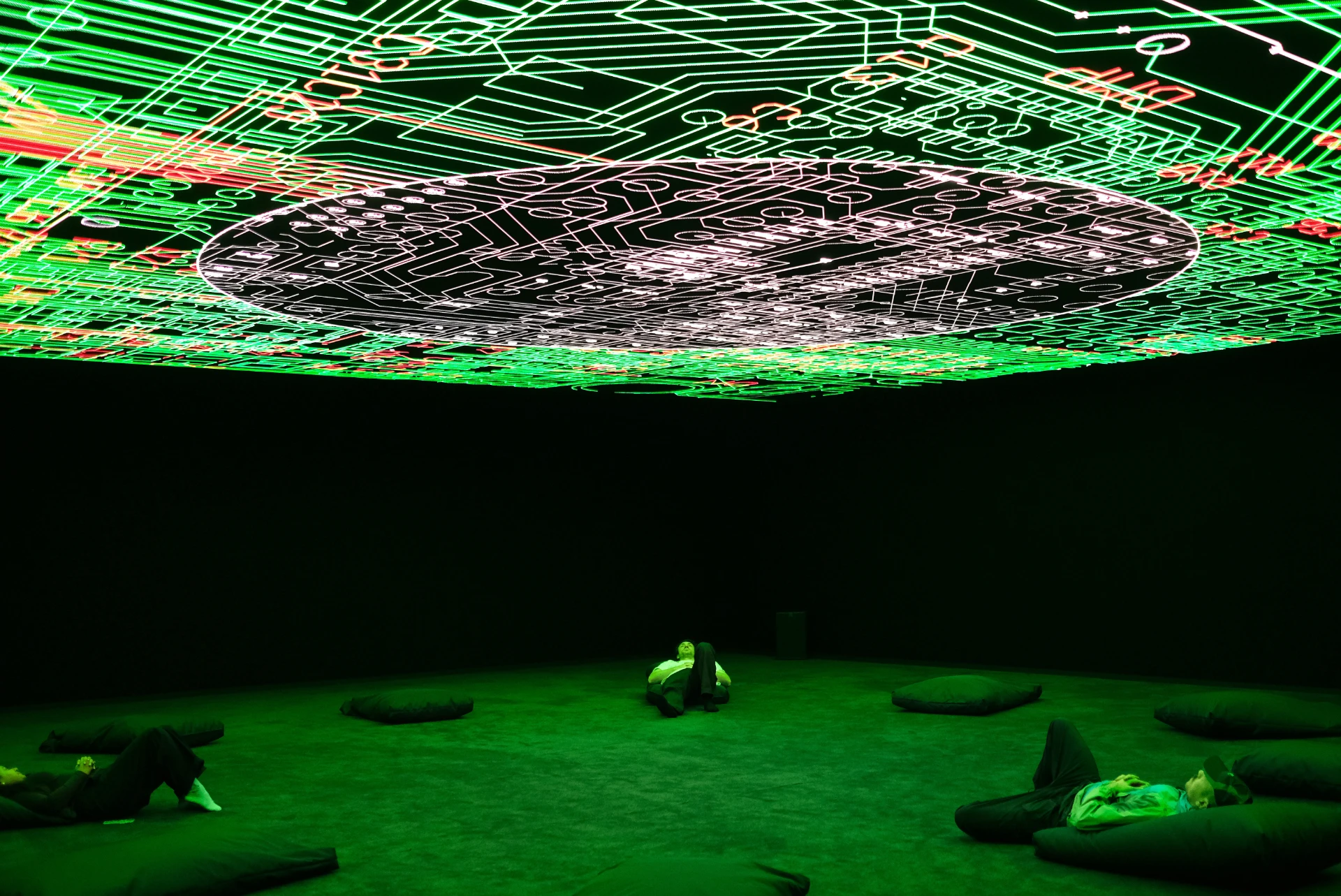
At its essence, data-cosm [n°1] is a philosophical inquiry into the nature of existence through the lens of mathematics and physics. Ikeda invites visitors to shed their traditional relationship with the gallery space, encouraging them to lie down beneath a sprawling, high-resolution LED ceiling. As the environment hums with Ikeda’s signature minimalist, glitch-inflected soundscapes, the viewer is suspended between the microscopic and the macroscopic.
The project seeks to "chart the full spectrum of data in nature." By translating complex datasets—ranging from the volatile behavior of particle physics to the celestial mechanics of astrophysics—into light and sound, Ikeda forces a confrontation with the sheer scale of the information that constitutes our world. He does not just visualize data; he aestheticizes the fundamental laws of physics, making the abstract tangible.
A Chronology of Artistic Evolution
To understand the weight of data-cosm [n°1], one must look at the lineage of Ikeda’s practice. His career has been defined by a transition from the purely sonic to the hyper-visual.
- The Early Years (1990s–2000s): Ikeda began his career as a sound artist, focusing on the "micro" level of audio—sine waves, white noise, and the physical properties of sound. His works, such as datamatics, were pioneering efforts in the field of data-visualization.
- The data-verse Era (2019–2021): The data-verse trilogy marked a turning point. It was here that Ikeda began collaborating with scientific institutions, including CERN, to source raw data that would serve as the "pixels" for his digital tapestries. The project was widely lauded for its ability to turn massive, overwhelming information into a poetic, rhythmic experience.
- The 180 Studios Commission (2025): The premiere of data-cosm [n°1] in October 2025 represented the next logical step. By integrating the physical architecture of 180 Studios—a space known for its industrial heritage—into the installation, Ikeda moved beyond the flat screen, opting for a fully enveloping, ceiling-mounted experience that renders the viewer a small, infinitesimal speck in a larger, digital cosmos.
Supporting Data and Technical Ambition
The technical prowess required to execute data-cosm [n°1] is staggering. The installation utilizes cutting-edge LED display technology that operates at a scale previously unseen in commercial gallery settings.
The Physics of the Display
The work functions on a massive scale, processing petabytes of information in real-time. Ikeda’s methodology involves a process of "data sonification and visualization," where the frequency of light waves and the pitch of sound are mapped directly to the mathematical values of natural phenomena. For instance, the flickering of a photon at a subatomic level is mapped to a specific strobe-like pulse of LED light, while the gravity of distant stars is represented by deep, resonant sub-bass frequencies.
Audience Engagement Metrics
Since its opening on October 15, 2025, the installation has seen unprecedented attendance for a digital art exhibit in London. 180 Studios reported a 40% increase in repeat visitors, suggesting that the complexity of the work requires multiple viewings to fully process. The decision to extend the run until February 2026 was a direct response to the sell-out nature of the initial booking window.
The Broader Context: 180 Studios and Paradigm Shift
data-cosm [n°1] does not exist in a vacuum. It is currently being presented alongside Paradigm Shift, a group exhibition that serves as a necessary historical counterpoint to Ikeda’s forward-looking digitalism.
![Ryoji Ikeda's data-cosm [n°1] extended at 180 Studios until 1 February](https://factmag-images.s3.amazonaws.com/wp-content/uploads/2025/12/data-cosm-ALubbock_180-14Oct-3554.webp)
While Ikeda looks to the future of data and physics, Paradigm Shift looks at the evolution of the "moving image" as a cultural force. The exhibition features luminaries who have fundamentally altered the way we perceive visual media, including:
- Andy Warhol: Representing the inception of pop-culture repetition.
- Arthur Jafa: Bringing a visceral, sociopolitical lens to moving image work.
- Martine Syms: Exploring the intersection of black identity and digital surveillance.
- Mark Leckey and Derek Jarman: Pushing the boundaries of collage and narrative structure.
The synergy between Ikeda’s pure, data-driven abstraction and the narrative-heavy works in Paradigm Shift creates a dialogue about the responsibility of the artist in an age of information overload.
Official Responses and Curatorial Insight
The curators at 180 Studios have noted that the goal of the commission was to "challenge the limits of the human sensory apparatus." In a recent statement, the studio highlighted that "Ikeda’s work acts as a mirror to our own digital existence. In a world where we are constantly bombarded by data, data-cosm forces us to pause, lie down, and reconcile with the beauty of that information."
Critics have been equally effusive. Writing in early reviews, arts commentators have described the experience as "a meditative purge" and "a terrifyingly beautiful glimpse into the machine code of the universe." By removing the distraction of a traditional art object and replacing it with pure sensory input, Ikeda has managed to create a work that feels both intensely personal and infinitely vast.
Implications for the Future of Digital Art
What does data-cosm [n°1] signify for the future of the medium?
- The Death of the Frame: Ikeda’s work suggests that the "frame" is a relic of the past. Future digital installations are likely to prioritize environment-wide immersion, where the architecture of the building and the digital content are indistinguishable.
- The Democratization of Science: By presenting complex physics in a gallery setting, Ikeda is playing an essential role in science communication. He bridges the gap between the lab and the public, making the most arcane theories of particle physics accessible to anyone willing to look up.
- The Shift Toward Minimalist Intensity: In an era of AI-generated maximalism, Ikeda’s strict, minimalist approach feels like a necessary recalibration. He proves that, even with the most advanced technology, the most powerful tool for an artist remains restraint and structural precision.
Visit Information
For those looking to experience the installation, tickets are available via the 180 Studios official website. Given the extension, the venue expects to accommodate thousands more visitors, but advance booking is highly recommended.
Exhibition Details:
- Location: 180 Studios, 6 Surrey Street, London, WC2R 2ND
- Dates: October 15, 2025 – February 1, 2026
- Hours: 12pm–7pm, Wednesday – Sunday (Last entry at 7pm)
As the digital age continues to reshape our reality, Ryoji Ikeda’s data-cosm [n°1] serves as a lighthouse. It is a reminder that beneath the noise of our digital lives, there is a rhythm—a cosmic, mathematical, and deeply poetic structure that connects us all. Whether you are a devotee of electronic music, a student of physics, or simply a seeker of profound aesthetic experiences, this installation stands as a defining moment in the contemporary art landscape.