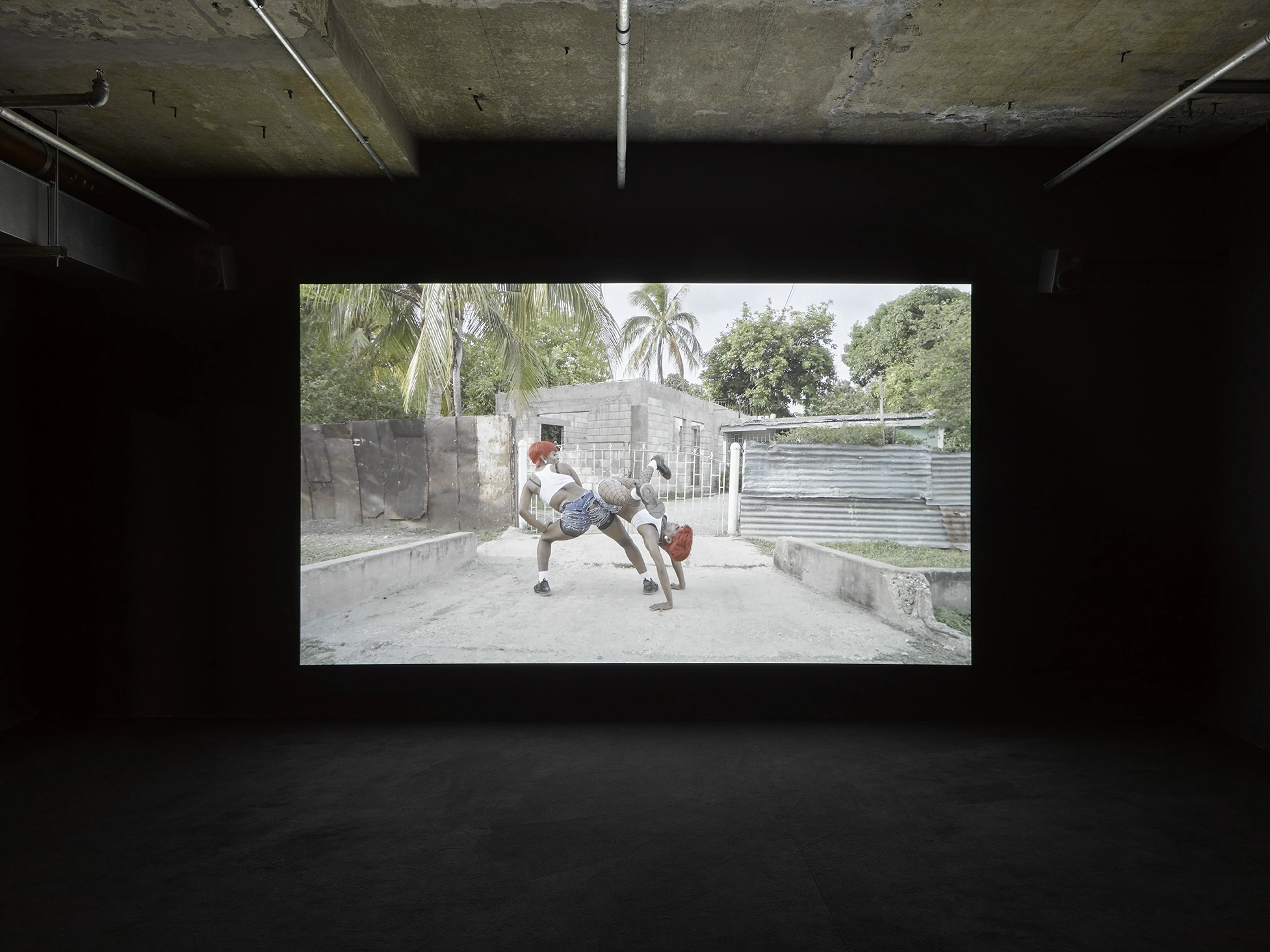
In the cavernous, industrial heart of 180 The Strand, London, a kinetic energy pulses through the walls. As part of The Vinyl Factory: Reverb exhibition—a sprawling multi-sensory survey of sound and image—Argentinian artist and choreographer Cecilia Bengolea presents Shelly Belly Inna Real Life. The video installation, filmed on location in Jamaica between 2015 and 2019, is more than a mere documentary of movement; it is a profound sociological inquiry into the dancehall culture of the Caribbean.
For those who have followed the trajectory of contemporary video art, Bengolea’s latest work serves as a homecoming of sorts. By centering the legendary dancehall icon Shelly Belly, the installation captures the friction between street-level artistic expression and the systemic constraints of the Jamaican state.
The Genesis of a Kinetic Dialogue: Main Facts
Shelly Belly Inna Real Life operates as a portal. It transports the viewer from the sterile, curated environment of a London gallery to the humid, high-octane streets of Kingston. At its core, the piece is an exploration of dancehall as a total language—a genre that encompasses music, fashion, vernacular, and, most crucially, choreography.
Bengolea, whose background spans the rigorous worlds of contemporary dance and performance art, has long been fascinated by the "choreographic vernacular" of street styles. In her collaboration with Shelly Belly, she avoids the pitfalls of the "outsider gaze." Instead, she embeds herself within the community, documenting not just the performances, but the social scaffolding that allows them to exist.
The work is currently on view at 180 Studios until March 2, 2025, serving as one of the anchor installations for the Reverb exhibition. It invites audiences to consider how dance serves as a form of non-verbal resistance, a way of reclaiming space in an environment that often seeks to regulate the bodies of its inhabitants.
A History of Movement: The Chronological Arc
To understand the significance of Shelly Belly Inna Real Life, one must look back at the collaborative history between Bengolea, her peers, and The Vinyl Factory.
The Prelude: Bom Bom’s Dream (2016)
The seeds for the current installation were sown nearly a decade ago. In 2016, Bengolea partnered with British artist Jeremy Deller to create Bom Bom’s Dream for the landmark exhibition The Infinite Mix. That piece followed a Japanese dancer—the eponymous Bom Bom—as he navigated the Jamaican dancehall circuit. Even then, the presence of Shelly Belly was felt; he served as a mentor and an architectural pillar of the dancehall scene.

Bom Bom’s Dream was a revelation in the art world, proving that digital media could bridge the gap between disparate cultural spheres. However, where that piece focused on the intersection of Japanese subculture and Jamaican dance, Shelly Belly Inna Real Life is a more focused, intimate portrait of the source itself.
The Five-Year Field Study (2015–2019)
The production of the current piece was not a quick affair. Spanning four years, the filming process allowed Bengolea to move past the superficiality of "tourist discovery." By returning repeatedly to Jamaica, she established a rapport with the dancers that is evident in the film’s candidness. This long-form engagement allowed her to capture the transition of dancehall from a local pastime to a global phenomenon, while also documenting the specific pressures—economic, political, and social—that dancers face daily.
Supporting Data: The Anatomy of Dancehall
Dancehall is often misrepresented in Western media as a mere genre of music. In reality, it is a complex, ritualistic system of physical communication. Bengolea’s installation highlights several key data points regarding the dancehall ecosystem:
- The Choreographic Economy: Dancehall is a repository of history. Every movement—the "Shelly Belly," the "Bogle," or the "Willie Bounce"—carries a specific provenance. These moves are not just aesthetic choices; they are a living archive.
- The Spatial Conflict: A recurring theme in the work is the relationship between the Jamaican police and the dance floor. In many instances, the authorities have historically viewed large gatherings of youth—specifically those engaged in dancehall—as sites of potential insurrection or criminality. Bengolea’s film documents the "cat and mouse" nature of street dances, where the sudden arrival of the authorities can disrupt a community event, turning a celebration into a site of tension.
- Gender Dynamics: The film explores the "female" and "male" codes of the dancehall, examining how both sexes use the genre to assert power, sexual agency, and social hierarchy.
Voices from the Field: Reflections from the Artist
In a recent interview surrounding the exhibition, Bengolea spoke extensively on the concept of "choreographic sovereignty."
"Dancehall is not just about the steps," Bengolea explained. "It is about the ability to command space. When you watch these dancers, you are watching them rewrite the rules of their environment. The police intervention, the economic struggle—it’s all part of the choreography. The dance becomes a way of existing in spite of the obstacles."
She emphasizes that her role is not to "direct" the dancers but to create a frame through which their existing brilliance can be viewed by a global audience. The intimate nature of the camera work—often handheld, shaky, and immediate—is a deliberate choice to ensure the viewer feels the sweat, the bass, and the urgency of the moment.
The Implications: Why It Matters Now
The inclusion of Shelly Belly Inna Real Life in The Vinyl Factory: Reverb holds significant weight for the contemporary art world. By placing a gritty, street-level document of Jamaican culture inside one of London’s most prestigious exhibition spaces, the curators are challenging the traditional boundaries of what constitutes "high art."

Recontextualizing the Street
Historically, the art world has been accused of "stealing" or "extracting" from subcultures without providing a platform for the practitioners themselves. Bengolea’s work acts as a counter-narrative to this exploitation. By highlighting the dancers as the architects of their own culture, the installation elevates the dancer to the status of artist.
The Intersection of Sound and Image
The Vinyl Factory: Reverb is largely concerned with the relationship between sound and its visual representation. In the case of Shelly Belly Inna Real Life, the music and the movement are inseparable. The installation utilizes the architecture of 180 Studios to amplify the low-end frequencies of dancehall, forcing the viewer to feel the music in their chest—the same way one would feel it in a Kingston dance hall.
Exhibition Logistics and Legacy
For those planning to visit, the exhibition provides a comprehensive look at the intersection of media and performance.
- Location: 180 Studios, 180 The Strand, London, WC2R 1EA.
- Dates: May 22, 2024, through March 2, 2025.
- Important Note: The studio will be closed for the holiday period between December 23, 2024, and January 8, 2025.
- Public Hours: Wednesday through Saturday, 12:00 PM – 7:00 PM; Sunday, 12:00 PM – 6:00 PM.
The legacy of this work will likely outlive the exhibition itself. As dancehall continues to influence global pop culture, from the rhythms of Afrobeats to the choreographic choices of mainstream music videos, works like Shelly Belly Inna Real Life serve as a vital reminder of the genre’s humble, radical roots. It is a testament to the fact that, even in the face of institutional pushback, the human body, when set to a beat, remains one of the most powerful instruments of freedom.
By documenting this scene with such care, Cecilia Bengolea has ensured that the "real life" of the dancehall is not lost to the sanitization of time. She has captured a culture that is, above all else, an assertion of existence.