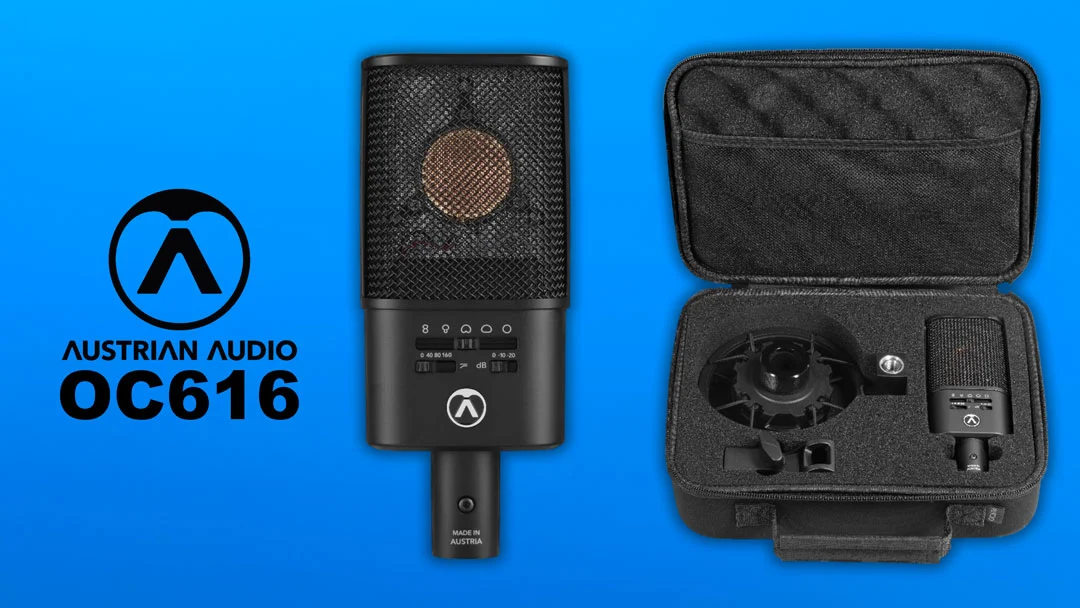
VIENNA, Austria — October 1, 2026 — In a move that reaffirms its position at the vanguard of modern microphone engineering, Austrian Audio has officially announced the launch of the OC616. This multi-pattern, large-diaphragm condenser microphone represents the latest evolution in the company’s storied lineage, combining high-precision manufacturing with the cutting-edge "Open Acoustic Technology" that has defined the brand since its inception.
Designed to address the multifaceted needs of contemporary recording environments—from high-pressure live stage capture to the nuanced requirements of intimate vocal performances—the OC616 is built around the company’s newly developed CKR12 capsule. As the industry shifts toward higher fidelity requirements and increasingly complex home-studio configurations, the OC616 arrives as a Swiss Army knife for audio engineers.
Main Facts: The Anatomy of the OC616
The OC616 is not merely an iteration of existing hardware; it is a meticulously engineered tool designed to bridge the gap between vintage tonal character and modern technical specifications. At the heart of the unit is the CKR12 capsule, which is hand-built in Vienna. This capsule is edge-terminated and utilizes a sophisticated ceramic isolator design, a feature specifically chosen to minimize the mechanical resonances that often plague lesser condensers.
Technical Specifications at a Glance:
- Capsule Type: CKR12 (Hand-built, edge-terminated)
- Polar Patterns: 5 selectable patterns (Omnidirectional, Wide Cardioid, Cardioid, Hypercardioid, and Figure-Eight)
- Max SPL: 157 dB
- Dynamic Range: 134 dB
- High-Pass Filters: 3 switchable settings
- Pads: 2 switchable settings (-10 dB and -20 dB)
- Build Philosophy: Open Acoustic Technology (OAT)
The primary "selling point" of the OC616 is its sheer ability to remain transparent yet assertive. Austrian Audio describes the sonic footprint as having a "clear, direct, and assertive character," a tuning choice intended to help instruments and vocals sit at the front of a mix without requiring heavy surgical EQ during post-production.
Chronology: The Development of the OC616
The trajectory of the OC616 is rooted in the "Open Acoustic Technology" (OAT) philosophy that Austrian Audio has been perfecting since its founding by former AKG engineers. The development cycle for the OC616 began nearly three years ago, with the objective of creating a successor that could handle higher sound pressure levels (SPL) than the company’s previous flagships without sacrificing the delicate high-frequency response required for classical or acoustic recording.
- Early 2024: Conceptualization of the CKR12 capsule begins. The engineering team prioritizes a ceramic mount to decouple the capsule from the chassis, aiming to eliminate internal reflections.
- Late 2025: Beta testing phase commences. Prototypes are sent to high-profile tracking studios in London, Nashville, and Los Angeles to test the microphone’s performance on diverse sources, ranging from aggressive tube-amp cabinets to delicate solo harp.
- Q2 2026: Final circuit refinements are made, focusing on the dynamic range and the noise floor of the internal amplification stage.
- October 1, 2026: Official global release and the opening of pre-orders for the OC616 Studio Set.
Supporting Data: Why "Open Acoustic" Matters
The technical prowess of the OC616 is largely attributed to Austrian Audio’s proprietary Open Acoustic Technology. In traditional microphone construction, the internal structure of the microphone body often creates unwanted reflections and "standing waves" inside the headbasket. These reflections can cause phase smearing, which results in a muddy high-end response.
By utilizing an open, minimalist internal design, the OC616 ensures that sound waves reaching the rear of the capsule are as "pure" as those reaching the front. This is particularly noticeable in the microphone’s Figure-Eight and Omnidirectional modes, where the off-axis response is remarkably linear.
The 157 dB Max SPL rating is a critical data point for the modern engineer. In an era where digital clipping is non-existent within the DAW, the "bottleneck" has moved back to the analog domain. By allowing the OC616 to capture sources as loud as a snare drum hit or a cranked guitar stack without distortion, Austrian Audio provides a microphone that is effectively "future-proofed" against the loudest sources in any studio.
Official Responses and Engineering Philosophy
Speaking on the launch, the design team at Austrian Audio emphasized that the OC616 was created in response to feedback from professional users who desired the flexibility of a multi-pattern mic but were wary of the "thin" or "brittle" sound often associated with affordable multi-pattern condensers.
"The OC616 is designed to be the only microphone you reach for, regardless of the session," stated a company representative. "Whether you are doing a Mid/Side setup for an acoustic guitar, tracking a full drum kit with two of these as overheads, or simply looking for the perfect vocal chain, the OC616 is built to be the constant in a variable environment."
The decision to include the OCS6 elastic suspension mount in the "Studio Set" bundle is a direct response to the needs of home and project studios, where ambient noise and floor vibrations can often ruin a take. By providing a high-end mounting solution out of the box, Austrian Audio is positioning the OC616 as a premium, ready-to-work solution.
Implications: The Impact on the Market
The introduction of the OC616 at the $749 price point creates a significant stir in the mid-to-high-tier microphone market. Historically, this price bracket has been occupied by a mix of imported, mass-produced condensers and older, used gear that often requires maintenance.
1. The Death of the "Starter" Mic
With the OC616, Austrian Audio is essentially making a play to capture the "prosumer" market. Engineers who might have previously purchased two cheaper microphones are now presented with a high-end option that offers the utility of five microphones in one. This shift may force competitors to rethink their own pricing structures.
2. The Return of Analog Precision
The focus on the CKR12 capsule—a component that is hand-built in Vienna—is a signal that the market still places high value on "Made in Europe" craftsmanship. In a digital-first world, there is a renewed appreciation for the mechanical engineering of transducers. The OC616 serves as a physical reminder that even in the age of plugins, the point of capture remains the most important part of the signal chain.
3. Workflow Efficiency
The inclusion of three high-pass filters and two pads directly on the microphone body suggests that Austrian Audio understands the modern "fast-paced" session. When a producer is working against the clock, the ability to make meaningful tonal adjustments at the source, rather than via plugin menus, is an invaluable feature. It encourages a "commit-to-the-sound" philosophy, which often leads to better final mixes.
Conclusion: A New Studio Standard?
As the professional audio landscape continues to evolve, the demand for gear that is both versatile and sonically transparent has never been higher. The Austrian Audio OC616 meets this demand with a combination of robust engineering, flexible polar pattern selection, and a sonic character that is intentionally designed to fit into modern mixes.
By integrating their Open Acoustic Technology with the new CKR12 capsule, Austrian Audio has created a tool that feels at home in a world-class tracking room while remaining accessible enough for the burgeoning home producer. As pre-orders begin to ship, the industry will be watching closely to see if the OC616 becomes the new "default" choice for a generation of engineers looking for a reliable, high-performance studio workhorse.
The OC616 Studio Set, comprising the microphone, OCS6 elastic suspension, OCH8 mic clamp, and the protective MSC616 carrying case, is currently available for pre-order through authorized dealers. For those looking to upgrade their primary microphone, the OC616 offers a compelling argument for why, in the world of audio, the quality of the capsule remains king.