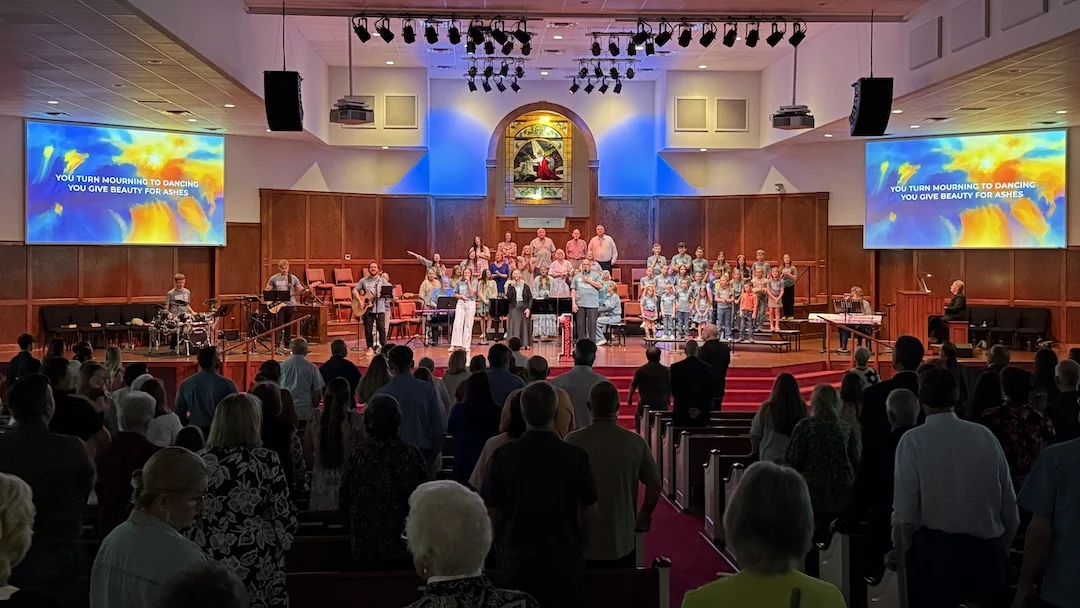
CARTHAGE, TX — In the realm of modern worship, the spoken word and musical praise serve as the dual pillars of the congregational experience. For First Baptist Church in Carthage, Texas, the ability to deliver these elements with crystalline clarity had become a growing challenge as their existing infrastructure reached the end of its functional lifespan. In a significant technological leap forward, the church recently completed a comprehensive audio overhaul, replacing a two-decade-old system with a state-of-the-art Martin Audio TORUS constant curvature array system.
The project, spearheaded by RP AVL, represents more than just a hardware upgrade; it signifies a shift toward high-fidelity, concert-grade audio solutions within the House of Worship (HoW) sector, ensuring that every seat in the sanctuary offers an identical sonic experience.
Main Facts: A Comprehensive Sonic Transformation
The centerpiece of the installation is the Martin Audio TORUS constant curvature array, a system specifically engineered for applications where a full-blown line array might be overkill, but where point-source speakers cannot provide the necessary coverage or consistency.
The System Architecture
The new configuration at First Baptist Church is designed to provide uniform Sound Pressure Levels (SPL) and tonal balance across the entire seating area. The technical specifications of the install include:
- Main Arrays: Two hangs consisting of four TORUS T820 elements per side. The T820 is a compact, high-performance constant curvature enclosure designed for medium-scale applications.
- Low-Frequency Extension: A pair of Martin Audio SX218 dual-18-inch subwoofers. These high-output subwoofers provide the deep, resonant low-end required for modern worship music.
- Outfill Coverage: A pair of Martin Audio CDD6 (Coaxial Differential Dispersion) loudspeakers. These were strategically placed to ensure that congregants seated at the far edges of the sanctuary receive the same clarity as those in the center.
- Amplification and Processing: The entire system is powered by two Martin Audio iKON IK41 four-channel power amplifiers. These amplifiers integrate high-power density with advanced DSP (Digital Signal Processing), allowing for precise tuning and system protection.
Replacing a Legacy
The previous system had been in continuous use since 2003. In the 23 years since that system was installed, audio technology has undergone several generational shifts. The transition from the 2003-era PA to the 2026 TORUS system has moved the church from aging, likely analog-driven technology to a sophisticated, software-optimized digital ecosystem.
Chronology: From Mega-Church Expertise to Community Impact
The story of the First Baptist Carthage upgrade is rooted in a professional journey and a long-standing relationship between a technician and a spiritual leader.
The RP AVL Origin
The project was managed by Ray Priszner, the founder of RP AVL. Priszner’s background is deeply rooted in the "mega-church" environment, having served as a Technical Director for a large-scale congregation in the Houston area. In 2022, Priszner founded RP AVL with the specific goal of bringing high-level technical expertise to a broader range of churches.
"I stepped away from a Technical Director role at a mega-church in the Houston area to found RP AVL in 2022," Priszner explained. "I missed helping churches and working alongside volunteer teams to increase their skill set in serving their local church."
The Connection
The catalyst for the Carthage project was the return of a local pastor to his home church. This pastor had previously worked with Priszner at a different location, where Priszner had installed a smaller Martin Audio system. The pastor’s positive experience with the brand’s reliability and sonic signature led him to seek out Priszner’s expertise when it became clear that First Baptist Carthage needed a modern solution.
Design and Installation
Upon assessing the sanctuary in Carthage, Priszner determined that a constant curvature array would be the ideal solution for the room’s geometry. Unlike traditional line arrays, which require complex rigging and can sometimes "over-shoot" smaller rooms, the TORUS system allowed for a more tailored approach. The installation was completed in July 2026, marking a new chapter for the church’s weekend services and special events.
Supporting Data: The Engineering Behind TORUS
To understand why the TORUS system was selected, one must look at the specific engineering challenges of house of worship environments. These spaces often feature high ceilings, reflective surfaces, and wide seating arrangements that can lead to "dead zones" or areas of excessive reverberation.
Constant Curvature vs. Line Array
The Martin Audio TORUS T820 is designed for "plug-and-play" coverage. While a line array’s vertical dispersion is adjusted by the splay angles between boxes, a constant curvature array has a fixed dispersion (20 degrees for the T820). By stacking four units, RP AVL was able to achieve a precise 80-degree vertical coverage pattern that perfectly matched the rake of the church’s seating.
The CDD Advantage
For the outfills, Priszner selected the CDD6. Martin Audio’s Coaxial Differential Dispersion technology is unique because it projects sound in a "rectangular" coverage pattern rather than a standard "cone." This ensures that the high-frequency energy reaches the back corners of the room without being overly harsh for those sitting directly under the speaker.
Single Box Resolution and Shading
One of the most technical achievements of this install was the use of "single box resolution." This refers to the ability to process and amplify each speaker element individually. By doing this, Priszner could "shade" the system—lowering the volume of the bottom speakers in the array that are closest to the front rows—without affecting the volume of the speakers throwing sound to the back of the room. This eliminated the need for front-fill speakers, which are often visually intrusive in a church setting.
Official Responses: Perspectives on the Upgrade
The feedback from both the technical team and the church leadership has been overwhelmingly positive, focusing on the system’s ability to bridge the gap between the pulpit and the pew.
Ray Priszner highlighted the practical benefits of the Martin Audio technology in a sanctuary setting: "Using the TORUS in single box resolution really helped with the coverage throughout the space. With the constant curvature design, shading to the front rows without the need for front fills was a huge win."
Priszner also emphasized the emotional and spiritual impact of the new system: "The overall project was a huge success for this client. They no longer have different areas in their room where the sound is louder or softer, and the clarity and fullness of the system is allowing them to experience worship and the word as never before."
While the church leadership focused on the message, they noted that the "distractions" of the old system—muffled speech and uneven music levels—had vanished, allowing the congregation to focus entirely on the service.
Implications: The Future of Worship Audio
The installation at First Baptist Church Carthage reflects several broader trends in the audio-visual industry and the ecclesiastical world.
1. The Democratization of High-End Audio
In previous decades, concert-level audio was reserved for touring acts and "mega-churches" with multi-million dollar budgets. The move by First Baptist Carthage shows that mid-sized community churches are now prioritizing high-quality audio as a necessary investment. As congregations become more accustomed to high-fidelity sound in their daily lives (via high-end headphones and home theaters), the "bar" for church audio has been raised.
2. The Volunteer-Centric Design
A critical aspect of RP AVL’s mission is supporting volunteer teams. Modern systems like the Martin Audio TORUS, when paired with iKON amplifiers and VU-NET software, offer a level of stability that is crucial for non-professional operators. Once the system is tuned and the limiters are set by a professional like Priszner, the volunteer team can operate the system with confidence, knowing the hardware is protected and the coverage is optimized.
3. Longevity and Stewardship
By replacing a 2003 system in 2026, First Baptist Carthage has demonstrated a commitment to long-term stewardship. Modern line-array and constant-curvature systems are built with more durable materials and more efficient power requirements than their predecessors. The move to Martin Audio suggests that the church is looking toward the next 20 years of service, ensuring that their message remains audible for the next generation.
4. Acoustic Equity
Perhaps the most significant implication is the concept of "acoustic equity." In many older church designs, the "best" sound was reserved for the center-middle seats. The use of TORUS and CDD technology ensures that a parishioner in the front-left corner has the same spiritual and auditory experience as someone in the center-back. This inclusivity is a growing priority for modern ministry.
As First Baptist Church in Carthage moves forward, the Martin Audio TORUS system stands as a testament to the power of modern engineering in the service of ancient traditions. Through the expertise of RP AVL, the church has successfully bridged the gap between 2003 and 2026, ensuring that their message is heard—clearly, fully, and without compromise.