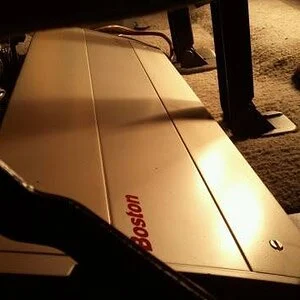
For automotive enthusiasts, few vehicles capture the essence of American performance quite like the 1979 Chevrolet Camaro. However, while these classic machines excel in aesthetics and raw mechanical power, their interior audio architecture often leaves much to be desired by modern standards. Integrating a contemporary sound system into a vehicle designed in the late 1970s requires a delicate balance between preserving the car’s integrity and achieving high-fidelity sound.
A common query among modern car audio hobbyists involves maximizing existing hardware—specifically, utilizing a 4-channel amplifier to drive both high-range speakers and a dedicated subwoofer. This article explores the technical nuances of bridging amplifier channels, the critical parameters for subwoofer selection, and the logistical challenges of installing audio equipment in a classic F-body platform.
Main Facts: The Bridge Configuration
The core of the inquiry involves an amplifier delivering 150 watts per channel across four channels. By utilizing two channels for a pair of 6×9-inch coaxial speakers and "bridging" the remaining two channels, the user intends to consolidate power to drive a 10-inch subwoofer.
Bridging is a method of combining two channels of an amplifier into a single, more powerful channel. In a standard 4-channel configuration, each channel operates independently. When bridged, the amplifier sees a combined load, effectively doubling the voltage swing and, theoretically, the power output. If an amplifier is stable at 4 ohms when bridged, it can drive a single subwoofer with significantly more authority than a single channel could provide.
For the 1979 Camaro owner, this configuration is an efficient way to achieve a "3-channel" setup (stereo front/rear speakers plus a mono sub channel) without the need for an additional dedicated monoblock amplifier. This saves valuable trunk space—a premium commodity in the tight confines of a classic Camaro.
Chronology of Audio Integration
The process of upgrading a classic vehicle’s audio system generally follows a disciplined timeline to ensure long-term reliability and performance:
- Phase 1: Planning and Measurement (Current Status): Identifying power requirements and physical space constraints. In the 1979 Camaro, this involves measuring the rear deck and the trunk cavity.
- Phase 2: Component Selection: Matching the subwoofer’s RMS (Root Mean Square) rating to the amplifier’s bridged output.
- Phase 3: Electrical Infrastructure: Upgrading power cables and grounds. Older vehicles often feature aging electrical systems that may require a "Big Three" upgrade (upgrading the battery-to-chassis ground, engine-to-chassis ground, and alternator-to-battery positive wire) to handle the increased current demand.
- Phase 4: Physical Installation: Securing the enclosure to the vehicle chassis to prevent movement during spirited driving.
- Phase 5: System Tuning: Setting gain levels, crossovers, and low-pass filters to ensure the subwoofer integrates seamlessly with the 6×9 speakers.
Supporting Data: Technical Parameters for Success
Subwoofer Selection and Impedance
When selecting a subwoofer, "bigger" is not always "better." In a compact classic like the Camaro, a 10-inch subwoofer is often the "Goldilocks" size—it provides enough displacement to produce visceral bass without consuming the entire cargo area.
The most critical factor is the relationship between the amplifier’s bridged output and the subwoofer’s impedance. If the amplifier outputs 300 watts RMS at 4 ohms when bridged, the user must select a subwoofer that can handle that load. If the sub is a Dual Voice Coil (DVC) 2-ohm model, it can be wired in series to present a 4-ohm load to the amplifier, perfectly matching the bridged configuration.
Enclosure Dynamics
Enclosure choice dictates the character of the bass:
- Sealed Enclosures: These offer the most accurate, "tight" bass response. They are generally smaller, making them ideal for the limited trunk space of a 1979 Camaro.
- Ported Enclosures: These utilize a vent to reinforce bass frequencies, resulting in higher output (decibels). However, they require larger box volumes and can be "boomy" or muddy if not calculated precisely for the specific subwoofer’s Thiele/Small parameters.
For the novice installer, a sealed enclosure is significantly more forgiving and provides a smoother frequency response.
Expert Recommendations and Official Industry Standards
Industry experts often point to three specific models when discussing 300-watt, 10-inch applications:
- Rockford Fosgate P10D2: Highly regarded for its versatility. The DVC 2-ohm configuration allows for flexible wiring options, and its build quality is designed to withstand the vibrations inherent in older vehicles.
- JL Audio 10W0V3-4: Known for sound quality (SQ) over sheer volume. The single 4-ohm voice coil is "plug-and-play" for most bridged 4-channel amplifiers, simplifying the installation process for beginners.
- Kicker 43CWR104: A powerhouse in the entry-level segment. With a dual 4-ohm voice coil, it can be wired in parallel for a 2-ohm load or series for 8 ohms (though 2 ohms may exceed the stable range of many 4-channel amps when bridged, so caution is advised).
Implications: Electrical and Physical Challenges
Installing audio in a 1979 Camaro carries unique risks. The vehicle’s original wiring harness was never intended to support high-draw aftermarket electronics.
Electrical Integrity
Before installing the amplifier, it is imperative to inspect the alternator output. A stock 1979 alternator may struggle to provide the current needed for a 4-channel system, leading to "light dimming" or voltage drops. Installing a capacitor or upgrading to a high-output alternator is often necessary to maintain system stability.
Acoustic Environment
The 1979 Camaro cabin is far from an acoustically perfect environment. Road noise, exhaust resonance, and thin metal panels can create unwanted vibrations. Sound deadening (such as butyl rubber sheets) should be applied to the rear deck and trunk floor. This not only improves the "tightness" of the bass by preventing metal rattles but also reduces interior noise levels, allowing the audio system to be heard clearly without excessive volume.
Safety Protocols
Bridging an amplifier incorrectly can lead to catastrophic failure of the output stages. The user must consult the manufacturer’s manual specifically for "Bridged Mode" wiring instructions. Typically, this involves using the positive terminal of one channel and the negative terminal of the other. Reversing these or attempting to bridge channels that are not designed for it will cause the amplifier to enter protection mode—or worse, suffer permanent damage.
Conclusion: Crafting the Final Soundstage
The transition from a basic factory setup to a custom-tuned audio environment in a classic vehicle is a rewarding project. By utilizing the 300-watt bridged channel to power a high-quality 10-inch subwoofer, the owner of a 1979 Camaro can bridge the gap between classic styling and modern sonic performance.
As with any project of this nature, patience is the most valuable tool. By properly matching impedance, calculating enclosure volume, and reinforcing the vehicle’s electrical foundations, the result will be a system that complements the car’s mechanical legacy rather than detracting from it. Whether cruising down the highway or showcasing the vehicle at a meet, a well-executed audio install serves as the perfect soundtrack to the driving experience.
Always verify local laws regarding noise levels and ensure all wiring is properly fused within 18 inches of the battery to prevent fire hazards—a non-negotiable standard in all automotive audio installations. With these considerations in place, the Camaro is ready to roar with a sound as powerful as its engine.