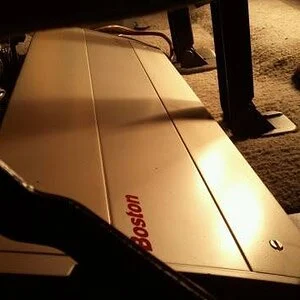
In the world of high-fidelity automotive audio, few challenges are as persistent as achieving deep, resonant bass within the acoustically isolated environment of a luxury sedan trunk. Recently, a discourse ignited on CarAudio.com, centered on a common enthusiast dilemma: how to best utilize an existing amplifier—specifically the DB Drive WDX 1000.1—to breathe new life into a BMW 3-series sound system. The conversation highlights the technical balancing act between electrical efficiency, driver size, and the physical constraints of a trunk-based installation.
The Core Technical Challenge: Matching Power to Performance
The crux of the inquiry, initiated by community member "EricF," revolves around the efficient deployment of the DB Drive WDX 1000.1 monoblock amplifier. This unit is rated to deliver 1,000 watts RMS at 1 ohm, 500 watts RMS at 2 ohms, and 250 watts RMS at 4 ohms.
From a purely technical standpoint, maximizing the amplifier’s output requires a 1-ohm load. This configuration allows the user to tap into the full 1,000-watt potential of the hardware. When selecting a subwoofer, the relationship between the voice coil impedance and the amplifier’s stable operating range is paramount. Failure to match these correctly often results in "headroom" issues, where an amplifier is either underutilized or pushed beyond its thermal limits.
Chronology of the Selection Dilemma
The debate unfolded as a classic comparison of engineering philosophies: the high-excursion, compact performance of specialized 8-inch drivers versus the traditional, displacement-heavy approach of a 12-inch subwoofer.
The Contenders
The proposed setups included:
- Memphis Mojo 8" (Ported): Rated at 900 watts RMS @ 1 ohm.
- Skar SVR 2 8" (Ported): Rated at 800 watts RMS @ 1 ohm.
- Kicker L7T 10" (Ported): Rated at 500 watts RMS @ 2 ohms.
- Kicker CompR 12" (Ported): Rated at 500 watts RMS @ 2 ohms.
The user’s dilemma reflects a broader shift in the car audio market: the rise of "super-8s." These small-diameter drivers are engineered with massive magnet structures and long-throw voice coils, allowing them to handle power levels previously reserved for 12-inch or 15-inch woofers.
Supporting Data: Understanding Subwoofer Physics
To understand why the choice is not as simple as "bigger is better," one must analyze the relationship between cone area (Sd) and excursion (Xmax).
Displacement and Efficiency
Bass production is essentially the displacement of air. A 12-inch subwoofer has significantly more surface area than an 8-inch subwoofer. To match the air displacement of a 12-inch sub, an 8-inch sub must move significantly further (higher excursion). This requires stiffer suspensions and more robust voice coils, which explains why the Memphis Mojo 8-inch carries an RMS rating that rivals larger woofers.
The Impedance Factor
The choice of the 1-ohm load is strategic. By selecting a 1-ohm capable sub (like the Mojo or the Skar), EricF is effectively doubling his available power compared to the 2-ohm options. In the enclosed environment of a BMW 3-series trunk, where the seat backs often act as a significant barrier to sound waves, having that extra 500 watts of headroom can be the difference between muddy, distorted bass and a crisp, authoritative low-end response.
Expert Analysis and Professional Perspectives
Responding to the inquiry, industry veteran "Hal" provided a breakdown that underscores the necessity of defining one’s goals before purchasing hardware.
The Case for the "Super-8"
For the enthusiast who values trunk utility, the Memphis Mojo 8-inch represents the pinnacle of current compact design. These drivers are designed to be "on steroids," utilizing high-density materials to produce frequencies that defy their footprint. They provide a transient response—the speed at which a speaker starts and stops—that is often superior to larger, heavier cones. This makes them ideal for complex, fast-paced music where "tight" bass is prioritized over "boomy" output.
The Case for the 12-Inch Standard
Conversely, the Kicker CompR 12-inch remains the industry benchmark for a reason. Its sheer surface area allows it to push more air with less effort at lower frequencies. While the amplifier will only be delivering 500 watts at 2 ohms, the 12-inch driver’s efficiency often results in a higher perceived volume (SPL) in the lower octaves (20Hz–40Hz). For those seeking that "earth-shattering" feeling, the 12-inch is historically the superior candidate.
Implications: The Role of Soundproofing and Cabin Gain
One of the most vital components of the discussion was the acknowledgment that hardware is only half the battle. A BMW 3-series, known for its refined cabin and relative isolation, presents unique challenges for bass propagation.
The Importance of Sound Deadening
Placing a high-output subwoofer in a trunk without addressing structural integrity is a recipe for resonance. The metal trunk lid, rear deck, and plastic trim panels act as secondary vibrating surfaces. When these surfaces vibrate, they absorb energy that should be directed into the cabin, leading to "trunk rattle."
The expert consensus suggests a multi-layered approach to soundproofing:
- Butyl Rubber Mats: Applied to the floor, sides, and lid of the trunk to add mass and dampen panel vibration.
- Closed-Cell Foam: Used to decouple plastic panels from the chassis, preventing the "buzzing" sound that often ruins the listening experience.
- Mass-Loaded Vinyl (MLV): The gold standard for blocking sound transmission, ensuring that the bass is felt in the driver’s seat rather than heard by pedestrians outside the vehicle.
Long-term Considerations for BMW Owners
BMW owners face a specific challenge known as "trunk isolation." Because the rear seat backs are typically well-insulated to provide a quiet ride, bass frequencies struggle to penetrate the cabin.
If EricF chooses the smaller 8-inch setup, he must ensure that the enclosure is ported in a way that allows the pressure waves to bypass the seat back effectively. If he opts for the 12-inch setup, the extra power might compensate for the isolation, but the physical size of the enclosure may leave him with little to no usable cargo space.
Conclusion: Synthesizing the Path Forward
The path to the ideal system is ultimately a personal one, governed by the trade-off between trunk utility and sonic ambition.
For the listener who prioritizes precision, speed, and the preservation of trunk space, the high-wattage 8-inch enclosure (specifically the Memphis Mojo) offers a modern solution that maximizes the 1,000-watt capability of the DB Drive WDX 1000.1. It turns a limitation (small size) into a performance advantage.
For the listener who demands the physical sensation of deep, subterranean bass and is willing to sacrifice trunk real estate and potentially deal with more vibration issues, the 12-inch Kicker CompR remains the tried-and-true choice.
Regardless of the selection, the project’s success will hinge not on the sub itself, but on the installation. Soundproofing is not merely an optional upgrade; it is a fundamental requirement for any high-output trunk system. By investing in quality dampening materials, the user will ensure that the money spent on amplifiers and subwoofers results in a clean, professional sound that elevates the BMW’s already sophisticated interior.
As the community continues to weigh in, the consensus remains clear: define your sonic signature, respect the electrical limitations of your amplifier, and never underestimate the transformative power of a properly sound-proofed vehicle. Through careful planning and an understanding of the physics at play, even a challenging space like a BMW trunk can be transformed into a high-fidelity concert hall on wheels.