In the rapidly evolving landscape of personal audio, the "Chi-Fi" (Chinese Hi-Fi) market has transitioned from a race for budget dominance to an aggressive pursuit of flagship-level engineering. Among the brands at the forefront of this evolution is CVJ. Having built a solid reputation with accessible, high-value models like the CS8 and the Aria, CVJ has now set its sights on the enthusiast tier with its latest release: the CVJ Mythera.
Priced at $368.00, the Mythera is a bold statement of intent. It utilizes a sophisticated 7-driver tribrid architecture, attempting to marry the raw power of a dynamic driver with the precision of balanced armatures and the transient speed of a micro-planar unit. But does this complex configuration translate into a coherent high-end experience, or is it a case of technical overreach?
Technical Specifications and Architecture
The Mythera’s hardware list is an ambitious collection of components designed to cover the full frequency spectrum. Each shell houses:
- Low End: A 9.5mm Diamond-Like Carbon (DLC) dynamic driver.
- Midrange: A quad-balanced armature array (arranged in two pairs).
- Highs/Ultra-Highs: A single dedicated Knowles balanced armature, complemented by a custom micro-planar unit.
To manage this complex array, CVJ has implemented a four-way crossover system. This involves both an electronic circuit and a series of acoustic tubes with internal damping filters. The brand claims this "golden-ratio" routing improves phase coherence, while a dual-damping scheme and integrated pressure-relief venting are intended to stabilize the diaphragm and reduce unwanted background resonance. Despite these claims, CVJ remains tight-lipped regarding the specific model numbers of its drivers, keeping the focus on the internal tuning philosophy rather than supplier transparency.

A Design Philosophy of Ornate Contrasts
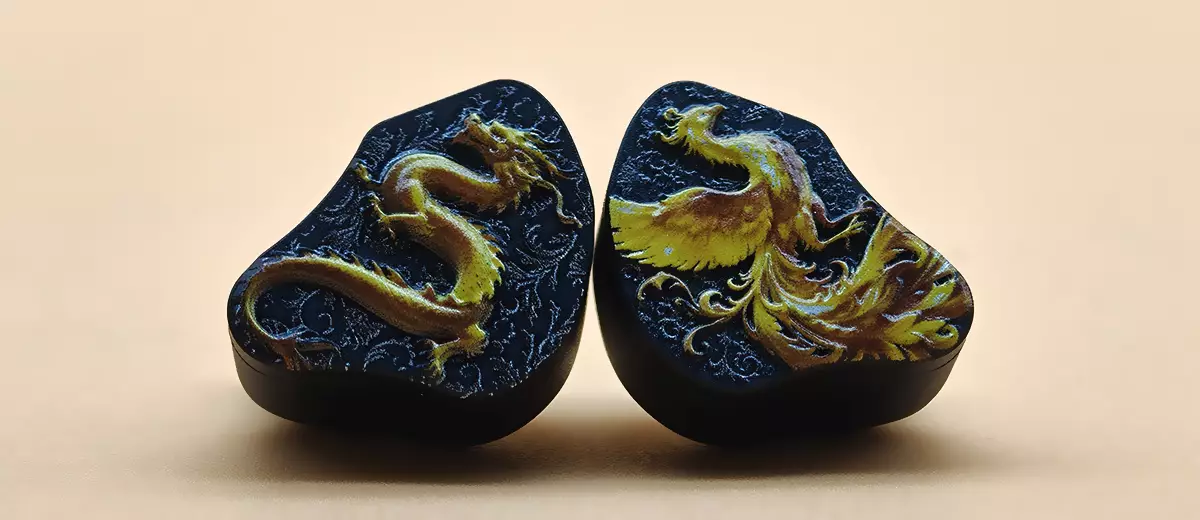
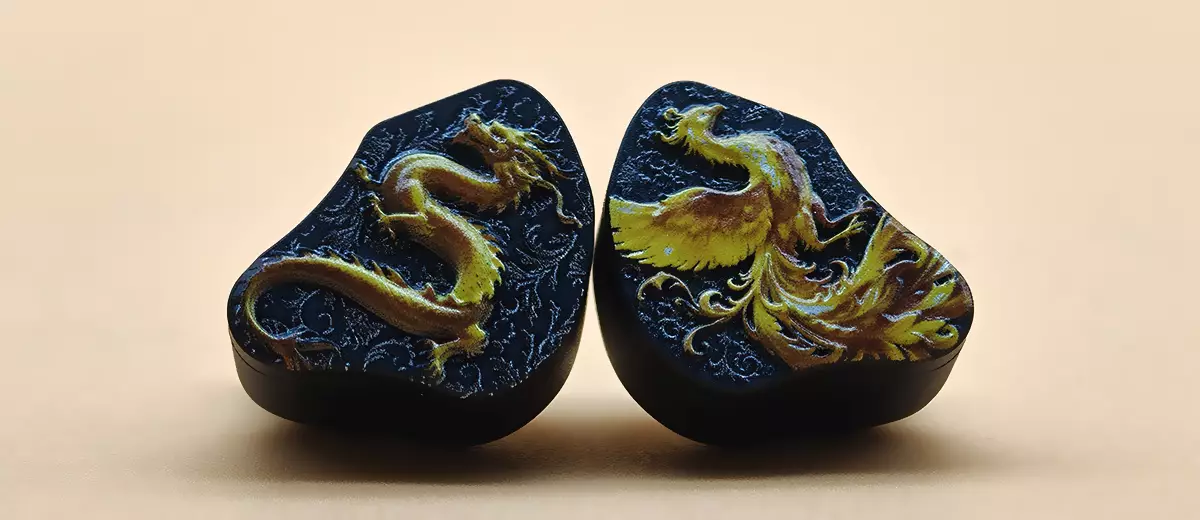
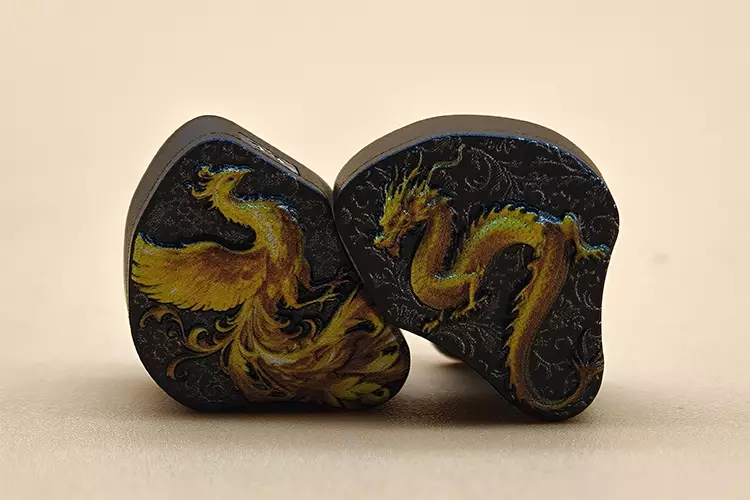
Visually, the Mythera demands attention. The faceplates serve as a canvas for a "color micro-engraving" process that creates a relief-like depth. The Obsidian edition—the unit reviewed here—features a dark, textured background adorned with a golden dragon on the left shell and a phoenix on the right.
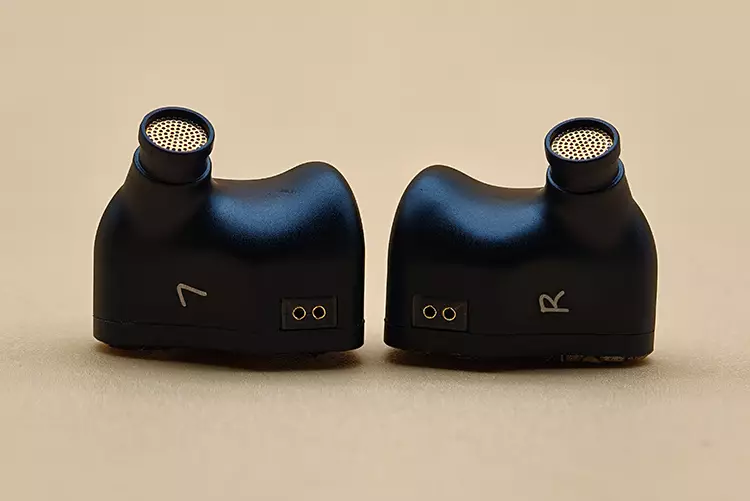
Beyond the aesthetic, the build quality is undeniably premium. The shells are crafted from CNC-machined aluminum alloy with a matte black finish. Despite containing seven drivers, the housing remains impressively compact. By utilizing 3D ear modeling, CVJ has achieved an ergonomic, medium-small form factor that sits flush in the ear, providing excellent passive isolation. The weight distribution is balanced, making the Mythera a surprisingly comfortable companion for extended listening sessions—a rarity for high-driver-count metal IEMs.

Packaging: The Jewelry Box Treatment
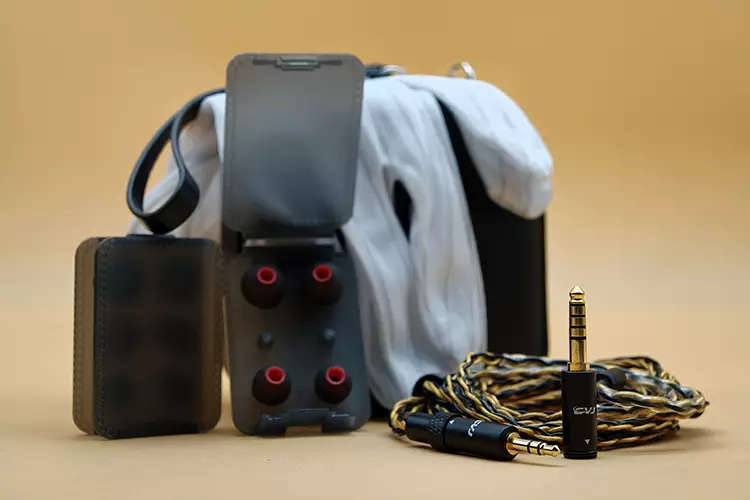
CVJ has opted for a presentation style that pushes the Mythera into the realm of luxury goods. The unboxing experience begins with a weighty, blind-embossed floral box. Beneath the outer sleeve, the interior is organized into distinct "Wire" and "IEM" compartments.
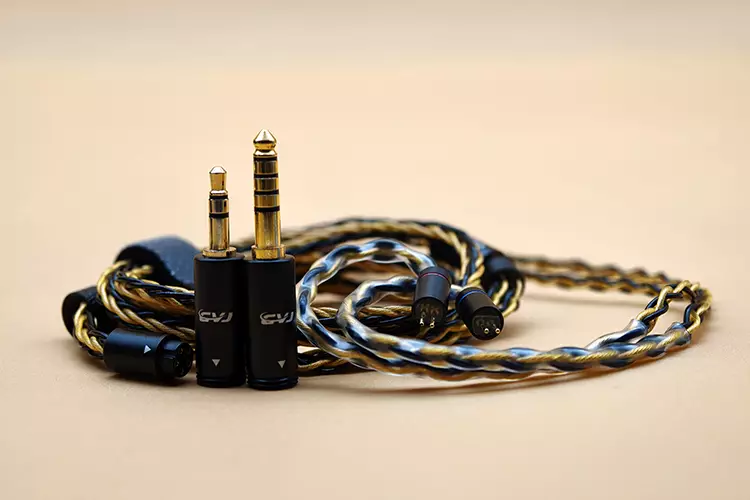
Most notably, the inclusion of a pair of textured gloves is a stylistic flourish that underscores the company’s intent to position the Mythera as a premium artifact rather than just a piece of consumer electronics. The accessory suite includes a high-end, 1000-core Furukawa copper cable featuring a modular 3.5mm/4.4mm plug system, reflecting a genuine commitment to high-fidelity connectivity out of the box.
Sound Impressions: The Bass-Heavy Paradigm
The sonic signature of the Mythera is defined by its low-end dominance. It is, by all accounts, a "bass-first" IEM.
The Low-End Authority
The 9.5mm DLC dynamic driver delivers a sub-bass rumble that is both physically visceral and all-consuming. It provides a level of kinetic energy that is immediately engaging for bass-heavy genres. However, this power comes at a cost. The bass is somewhat unrefined, lacking the surgical control found in more expensive, top-tier monitors. While it provides immense "slam" and drive, it often spills over into the lower midrange, creating a muddied, thick texture that can obscure vocal clarity.
Midrange and Vocal Performance
The midrange is where the Mythera faces its stiffest challenge. Due to the aggressive low-end bleed, male vocals often feel recessed or "choked." The fundamental body of the sound is there, but the lack of definition makes for a somewhat flat presentation. Female vocals fare slightly better, possessing a brighter, more forward quality, though they are occasionally tempered by the sheer volume of the bass below them.
Treble and Technicalities
The high end is handled by a combination of a Knowles BA and a micro-planar unit. On paper, this should offer crystalline detail and expansive air. In practice, the result is a sharp, aggressive, and sometimes fatiguing treble. While the Mythera avoids outright sibilance, the top end feels closed-in rather than airy. The soundstage is remarkably narrow; instruments are placed with functional precision, but the sense of "space" and layering is compromised when the music becomes complex.
Implications for the Market
The CVJ Mythera represents an interesting case study in the current state of audio engineering. By packing seven drivers into a sub-$400 shell, CVJ has proven that technical complexity does not always equate to a balanced or "flagship" sound.
The Mythera is clearly tuned for a specific demographic: the "basshead" who prioritizes physical impact and energetic, slammy rhythms over neutral transparency or orchestral layering. For those listeners, the Mythera offers a thrilling, if occasionally messy, ride. However, for those seeking a reference-grade monitor with natural timbre and expansive staging, the Mythera’s technical trade-offs—specifically the bass bleed and limited stage width—may prove difficult to overlook.
Competitive Positioning
When compared to rivals like the ZiiGaat Luna or the InAwaken Twilight-DS, the Mythera struggles to match the cohesive tuning of its peers. While it beats many competitors in build quality and accessory presentation, the "v-shaped" tuning leans so heavily into the sub-bass that it undermines the delicate work of the quad-BA midrange array.
Final Verdict
The CVJ Mythera is an ambitious, beautiful piece of hardware that showcases how far the brand has come in terms of manufacturing, design, and packaging. It is a stunning visual achievement that feels as premium as any flagship in the market.

However, from an acoustic standpoint, it is a polarizing device. It is a loud, energetic, and aggressive performer that puts the listener in the middle of a bass-heavy storm. It is not for the purist, but for the thrill-seeker who wants their music to have a palpable, physical presence, the Mythera delivers that in spades. As CVJ continues to move upmarket, the Mythera serves as a reminder that the final hurdle in audio design is not the number of drivers, but the harmony with which they work together.
Rating: 8.3/10 (Performance & Features)

Disclaimer: This sample was provided by CVJ and Linsoul for the purpose of this review. Headfonics maintains complete editorial independence.