In an era defined by open-concept office spaces, bustling collaborative hubs, vibrant hospitality venues, and multi-use public areas, the modern architectural movement has largely traded physical barriers for visual connectivity. Glass, steel, and polished concrete have replaced drywall and carpeting, creating airy, light-filled environments that prioritize aesthetics. Yet, as architects and interior designers celebrate these transparent, open footprints, a silent friction is degrading the human experience within them.
That friction is acoustic failure.
In busy workplaces and high-traffic shared spaces, poor speech intelligibility has become a pervasive, invisible epidemic. It quietly erodes comfort, spikes daily stress levels, and profoundly drains productivity. While occupants often blame a vague sense of fatigue on long hours, flickering fluorescent lights, or demanding workloads, neuroscientists and acoustic engineers point the finger at a different culprit: the cognitive overload required to parse speech through layers of uncontrolled environmental noise and reverberation.
Main Facts: The Anatomy of Acoustic Fatigue
At the core of the issue is a fundamental misunderstanding of how sound behaves in large, hard-surfaced rooms. When people gather to converse, or when sound reinforcement technologies—such as public address systems or background music—are introduced, sound energy radiates outward in all directions.

The primary battleground for this sound energy is the ceiling. As the largest uninterrupted surface in virtually any architectural layout, the ceiling acts as a massive acoustic mirror. When uncontrolled sound waves strike this surface, they bounce back down, creating early reflections that arrive at a listener’s ears mere milliseconds after the direct sound from a speaker.
This micro-delay creates a phenomenon known as acoustic smear. Rather than hearing crisp, easily decipherable words, the human brain receives a chaotic mix of direct and reflected sound waves.
[Direct Sound] --------> Listener's Ear (Clear)
                              ^
[Reflected Sound] ----> Ceiling ----> Listener's Ear (Delayed / Smear)
Crucially, experts emphasize that speech clarity is fundamentally an acoustic problem, not a volume problem. A common instinct in loud environments is to speak louder or turn up the sound system. However, pumping more sound energy into a reflective space achieves the exact opposite of what is intended. Higher volume translates to more sound energy hitting hard surfaces, generating heavier reverberation, compounding echoes, and further obscuring phonetic detail.
The result? An environment where occupants hear plenty of noise, but understand very little.

Chronology: The Evolution of Architectural Acoustics and the "Ceiling-First" Paradigm
To understand how contemporary spaces reached this acoustic impasse, one must examine the chronological shift in interior design over the past several decades.
- The Mid-20th Century (The Enclosed Era): Traditional workplaces and public areas were dominated by private offices, heavy drapery, acoustic drop-ceilings (such as mineral fiber tiles), and carpeted floors. While acoustically functional, these spaces often felt dark, rigid, and compartmentalized.
- The Late 20th to Early 21st Century (The Open-Plan Revolution): Driven by a desire for collaboration, democratic layouts, and cost-efficiency, corporate and public architecture shifted toward open-plan offices and wide-open hospitality venues. Walls came down, and glass conference rooms went up.
- The Mid-2010s (The Aesthetic Priority): As minimalist design took hold, architects stripped away dropped ceilings to expose raw concrete decks, industrial ductwork, and structural steel. Wall space became prime real estate for branding, expansive windows, digital displays, and artistic installations. Acoustic treatments on walls were increasingly squeezed out of the design equation.
- The Present Day (The Acoustic Reckoning): Modern facility managers and designers are facing the cumulative fallout of decades of wall-centric design constraints. With walls occupied by glass and decor, the industry has experienced a "ceiling-first" revolution. Innovations in recycled materials and suspended engineering have transformed ceilings from sound reflectors into primary acoustic canvases.
Supporting Data: High Ceilings, Low Ceilings, and the Physics of Reflection
The behavioral dynamics of sound vary drastically depending on vertical clearance, yet both high and low ceilings present distinct acoustic hurdles that require specialized intervention.
High Ceilings: Distance and Reverberation
In expansive spaces like atriums, industrial-style cafes, or modern open-plan headquarters, high ceilings significantly increase the distance and travel time for sound waves. A single vocalization hits multiple reflective points at staggered intervals, creating multi-directional paths that result in prolonged reverberation and overlapping echoes.
Because ceilings in these spaces are typically constructed from dense, non-porous materials like concrete or sheet metal, sound bounces off them unhindered before cascading downward to strike walls and floors. This creates a compounding cycle of secondary reflections.

Low Ceilings: Early Reflections and Low-Frequency Buildup
Conversely, low ceilings return sound waves to the listener’s ears almost instantaneously. While reverberation times may be shorter, the proximity of the boundary creates intense early reflections. Furthermore, low-ceilinged rooms are prone to "standing waves"—destructive acoustic frequencies trapped between the floor and ceiling—along with an uncomfortable buildup of low-frequency pressure.
In either scenario, partial wall treatments rarely suffice. Because sound fills a three-dimensional volume, treating a ceiling provides comprehensive mitigation that absorbs early reflections, stops vertical echoes, and tames background noise across the entire footprint of a room rather than localized pockets.
Official Perspectives: The Cognitive Toll and Human Cost
From a psychological and physiological standpoint, operating in an acoustically compromised space extracts a heavy toll on human performance.
Dr. Emily Vance, an environmental psychologist specializing in workplace ergonomics, notes that speech processing is an active cognitive function. "We take for granted how much mental heavy lifting our brains do when we listen," she explains. "When you introduce background chatter, HVAC hums, machinery clatter, and ceiling reflections, your brain is forced to work overtime to isolate the primary voice from the noise floor. That subconscious filtering manifests as acute listening fatigue by mid-afternoon."
For speakers, the implications are equally draining. In untreated spaces, individuals naturally raise their voices to combat the ambient noise—a phenomenon known as the Lombard effect. Over time, this leads to chronic vocal strain, fatigue, and an overall reluctance to engage in spontaneous collaboration or extended communication.
Facility executives and human resource directors are increasingly recognizing that acoustic comfort is not a luxury; it is a core component of indoor environmental quality (IEQ). Poor acoustics directly undermine employee retention, customer satisfaction in hospitality venues, and overall operational efficiency.
Implications: Marrying Acoustic Performance with Modern Design
Implementing sound control in shared spaces historically presented a major design dilemma. Traditional acoustic panels were often utilitarian, industrial-looking, and visually disruptive. Furthermore, modern spaces rely heavily on perimeter windows for natural light, accent walls for corporate branding, and gallery spaces for art—leaving zero square footage available for wall-mounted sound absorption.
This spatial constraint has pushed the industry toward advanced ceiling-mounted acoustic solutions. By utilizing the overhead plane, designers can achieve superior sound mitigation without sacrificing wall aesthetics or natural daylight.

Innovative Engineering: Blades vs. Baffles
Manufacturers at the forefront of this movement, such as Primacoustic with their EcoScapes line, have developed sophisticated, design-forward products tailored to specific ceiling architectures:
- Blades: Typically mounted adjacent to or suspended closely beneath the ceiling surface, blades are ideal for spaces with lower ceilings where vertical hanging clearance is limited. By deploying multiple shapes and formats, designers can create clean, angular lines, establish a rhythmic wave-like visual effect, or carve out functional architectural zones.
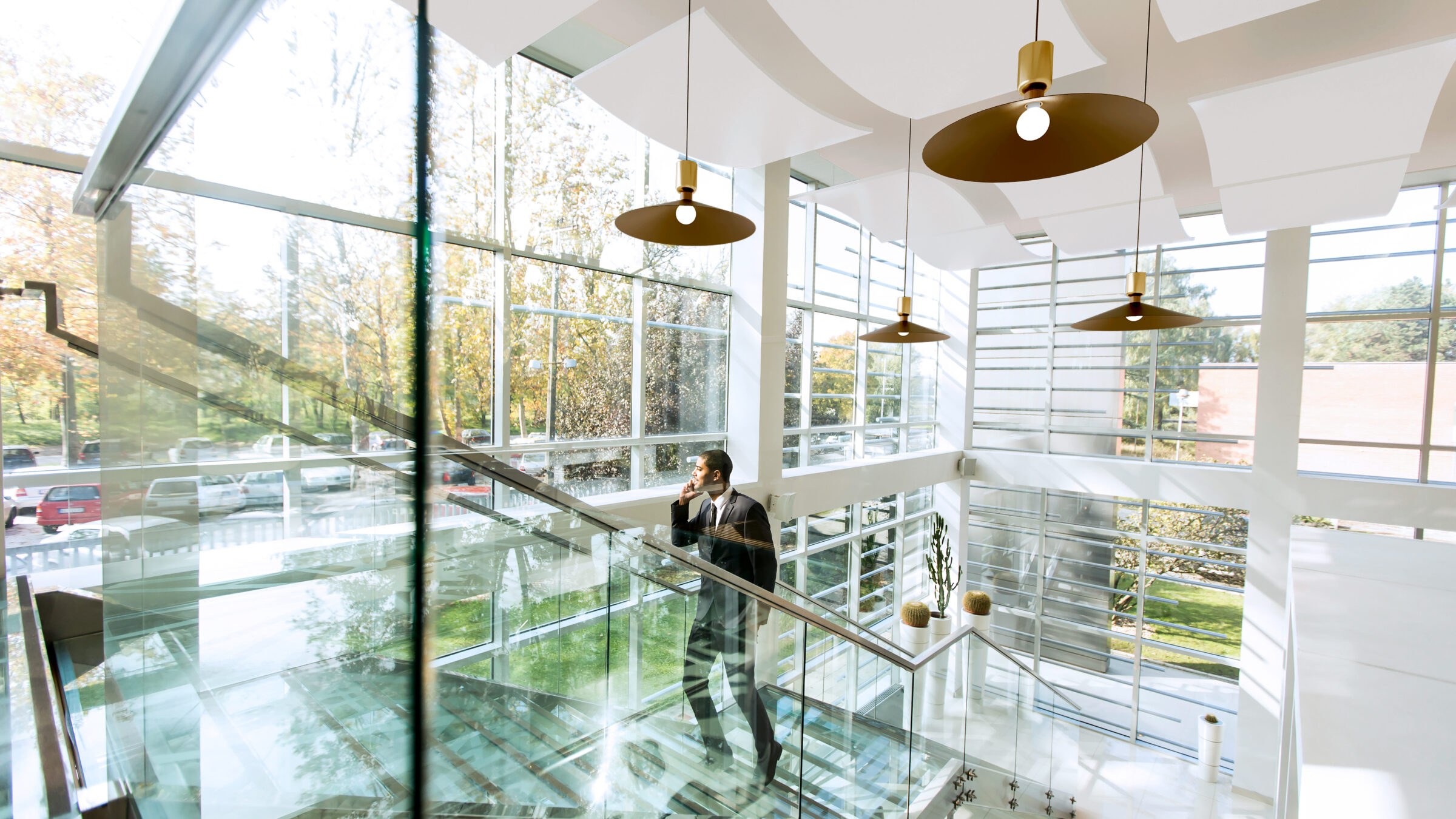
- Dimensional Baffles: Operating as 3-dimensional suspended elements, baffles are exceptionally striking and effective in large, high-ceilinged environments. Their 3-D configuration allows them to integrate seamlessly around existing infrastructure, such as exposed HVAC ducts, pendant lighting, and structural timber beams, introducing visual depth while trapping sound waves from multiple angles.
Material Science and Sustainability
The modern consumer and corporate buyer demand more than just performance; they demand ecological responsibility. Cutting-edge acoustic treatments are increasingly manufactured from post-consumer recycled polyethylene terephthalate (PET).
These advanced materials offer exceptional sound absorption coefficients while meeting rigorous sustainability benchmarks, actively contributing points toward green building standards like LEED and WELL certifications. High-grade PET solutions are engineered to be entirely free of harmful volatile organic compounds (VOCs), formaldehyde, and chemical glues or binders. Furthermore, they are highly durable, resistant to discoloration, and easily maintainable, ensuring decades of reliable service without structural degradation.
Conclusion: Designing for the Human Ear
As architecture continues to embrace openness, transparency, and connection, the invisible architecture of sound can no longer be treated as an afterthought. Poor speech intelligibility and runaway reverberation are design failures with measurable human and financial costs.
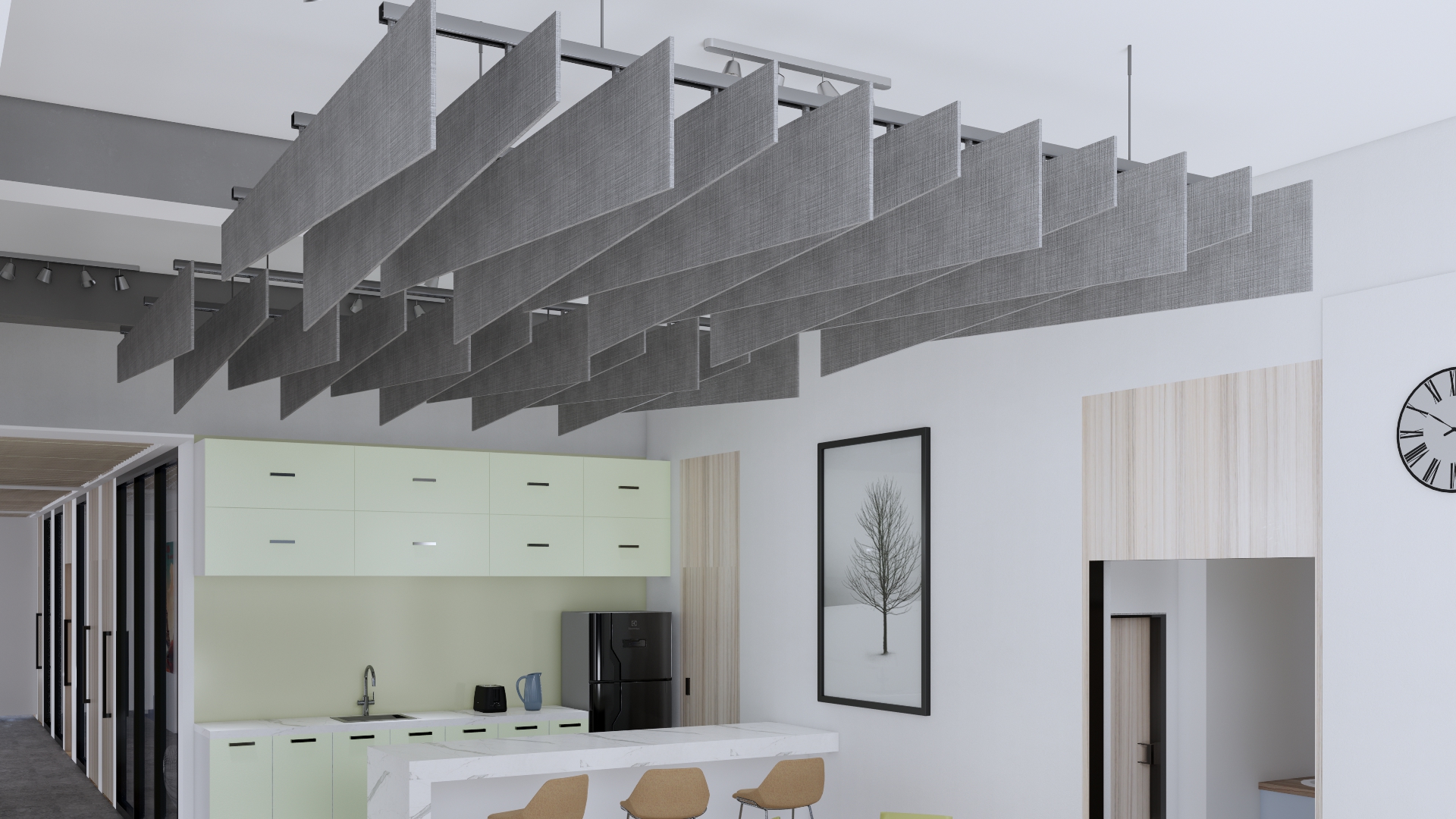
By adopting a "ceiling-first" approach to acoustic engineering, architects and facility managers can reclaim control over their environments. Utilizing design-forward solutions like PET acoustic blades and dimensional baffles allows spaces to maintain their visual identity, preserve natural light, and showcase interior artwork—all while creating an acoustically balanced atmosphere.
Ultimately, a well-designed space does not just look exceptional; it feels exceptional. By prioritizing acoustic comfort, we build environments that reduce cognitive fatigue, protect vocal health, and genuinely support the human connection, communication, and focus that modern shared spaces were built to achieve.