FRANKLIN, MA – In an era where the fidelity of live sound is increasingly dependent on the digital architecture preceding the first note, Eastern Acoustic Works (EAW) has taken a significant step toward empowering its user base. On October 22, 2026, the company announced a comprehensive expansion of its online training curriculum for the Resolution modeling and control platform. This update is not merely an addition of modules; it represents a strategic shift in how EAW envisions the relationship between acoustic prediction and real-world system execution.
For sound system designers, engineers, and integrators, the gap between a software simulation and the actual performance of a rig on-site has historically been a point of friction. By evolving its educational offerings, EAW aims to harmonize these two phases, turning its Resolution platform into a unified ecosystem that carries a project from the initial architectural drawing to the final phase of system tuning.
The Evolution of Resolution: Main Facts and Strategic Objectives
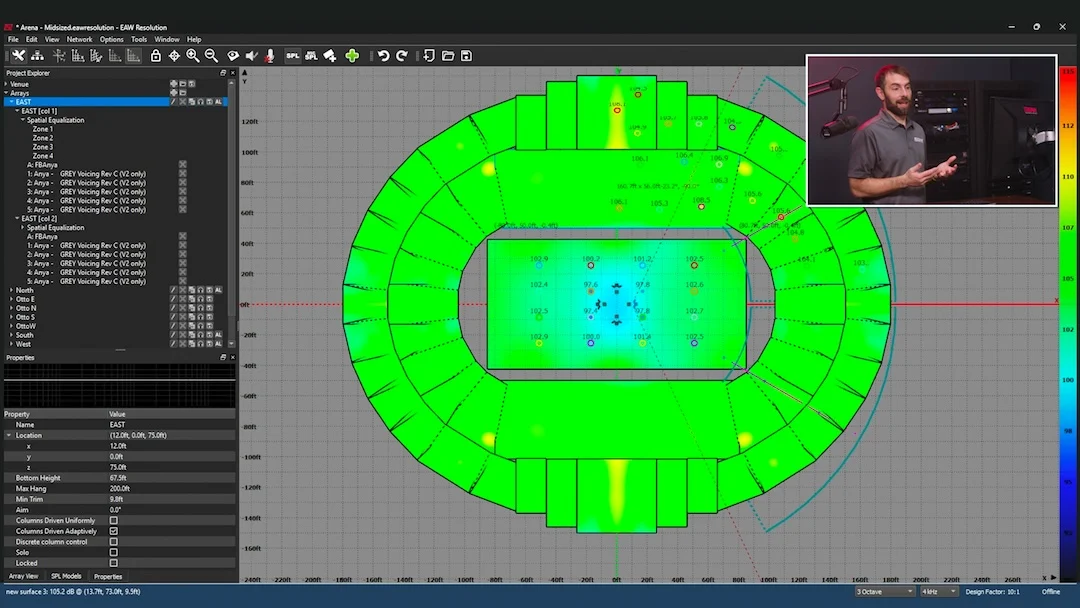
At its core, EAW’s Resolution is a powerful, multi-purpose software suite designed for the modeling, prediction, and control of EAW loudspeaker systems. Since its inception, it has served as the industry standard for users tasked with navigating the complexities of line array deployment and point-source optimization.
The primary objective of this course expansion is to democratize high-level system design. By offering this instruction for free, EAW is lowering the barrier to entry for professionals who wish to achieve "studio-grade" accuracy in large-scale live sound environments. The course has been restructured to guide users through the software’s interface, proprietary algorithms, and overall workflow with a focus on real-world application rather than abstract theory.
The training program is built around three pillars:
- Acoustic Modeling: Mastering the art of predicting system performance within complex, acoustically challenging spaces.
- Product Integration: Moving beyond simulation to direct hardware control and real-time management.
- System Optimization: Applying best practices in tuning and alignment to ensure consistent coverage across a venue.
Chronology: From Static Modeling to Dynamic Integration
The trajectory of EAW’s software development mirrors the broader trends in the professional audio industry. Over the past decade, the transition from analog-controlled systems to network-integrated digital platforms has necessitated a more robust approach to user education.
- Phase 1: Foundational Modeling (The Early Years): Initially, the Resolution training focused primarily on the "predictive" side of the software. Users learned how to import architectural drawings, define surface materials, and place arrays to estimate coverage patterns. The goal was to minimize "guesswork" before a truck was even loaded.
- Phase 2: Workflow Refinement: As Resolution matured, the training incorporated more complex geometry modeling. Instructors introduced sessions on how to handle balconies, irregular room shapes, and varying audience demographics, ensuring the predictive model could account for the real-world obstacles encountered in modern touring and installation environments.
- Phase 3: The Unified Ecosystem (October 2026 Update): The current update marks the most significant evolution to date. It removes the wall between "design" and "control." Historically, designers would model a system in one piece of software and tune it in another. With the new curriculum, EAW is teaching users to connect to their hardware directly via the Resolution interface, allowing for seamless transitions from prediction to deployment, optimization, and daily system management.
Supporting Data: Why Precision Matters
The reliance on advanced modeling software is not a luxury; it is a necessity driven by the increasing complexity of modern sound systems. According to industry data on sound reinforcement, a poorly optimized system can result in a 20% to 30% degradation in speech intelligibility and musical clarity.
EAW’s Resolution platform utilizes high-resolution data sets to account for individual loudspeaker dispersion patterns. The new training curriculum dives deep into the metrics that matter:
- SPL Distribution: Understanding how to balance loudness without sacrificing tonal consistency.
- Phase Response: Managing the overlap between arrays and subwoofers to prevent destructive interference.
- Latency Management: Synchronizing complex distributed systems to ensure the audience experiences a cohesive soundstage regardless of their proximity to the stage.
By teaching users to leverage these metrics through the Resolution platform, EAW is essentially teaching them to act as acoustic architects, ensuring that the sound profile of a venue is consistent from the front row to the very back of the mezzanine.
Industry Perspectives and Official Responses
Industry reaction to the update has been positive, with many professionals noting that the shift toward integrated control is a vital step for the future of the brand.
"The goal has always been to provide our users with a ‘single-pane-of-glass’ experience," said a representative from EAW’s education department. "We don’t want our engineers to be bogged down by switching between different programs while the clock is ticking on a load-in. By expanding the Resolution course to include direct product control, we are helping our users save time, reduce human error, and achieve a higher level of precision than ever before."
The decision to keep the training free and accessible via education.eaw.com is also a deliberate move to foster a stronger community of EAW-proficient engineers. By standardizing the workflow, the company ensures that any EAW system—whether in a house of worship, a stadium, or a touring rig—is operated to its highest possible potential.
Implications: The Future of System Deployment
The implications of this update are profound for both the freelance engineer and the permanent installation contractor.
Bridging the Gap
The most immediate impact is the shortening of the "tuning window." In a live event setting, time is the most expensive resource. By streamlining the workflow from prediction to deployment, the new training allows engineers to spend less time configuring network parameters and more time listening and making creative adjustments.
Scalability and Best Practices
The new lecture series on EAW’s current product lines is equally significant. It provides a blueprint for loudspeaker selection that moves beyond subjective preference. By focusing on data-driven coverage planning, EAW is helping designers justify their equipment choices to clients. Whether choosing a point-source system for a theater or a massive line array for a festival, the principles taught in this course—best practices for selection, placement, and specification—are designed to provide a defensible, professional foundation for any project.
The Human Element
Finally, the educational initiative underscores the reality that even the most sophisticated software is only as good as its operator. By providing high-quality, free education, EAW is investing in the human capital of the audio industry. As technology continues to advance, the demand for highly skilled technicians who can navigate these digital tools will only increase.
Conclusion: How to Get Started
The updated curriculum is designed to be self-paced, allowing busy professionals to integrate the learning modules into their own schedules. The modules are structured to accommodate both beginners, who may be new to acoustic modeling, and veteran users looking to master the latest features of the Resolution platform.
To access the training, users are encouraged to visit education.eaw.com. The site offers a range of resources, including documentation, video tutorials, and the core training program itself. As the audio industry continues to push the boundaries of what is possible in live performance, EAW’s commitment to providing the tools and knowledge necessary to master their technology ensures that their users remain at the forefront of the field.
In an era of rapid technological change, EAW has chosen a path that prioritizes user success through comprehensive education. By bridging the gap between design and deployment, they are not just providing a product; they are providing the expertise required to make that product shine. Whether you are a seasoned veteran or an aspiring engineer, the updated Resolution training is an essential resource for anyone looking to master the art and science of professional sound reinforcement.