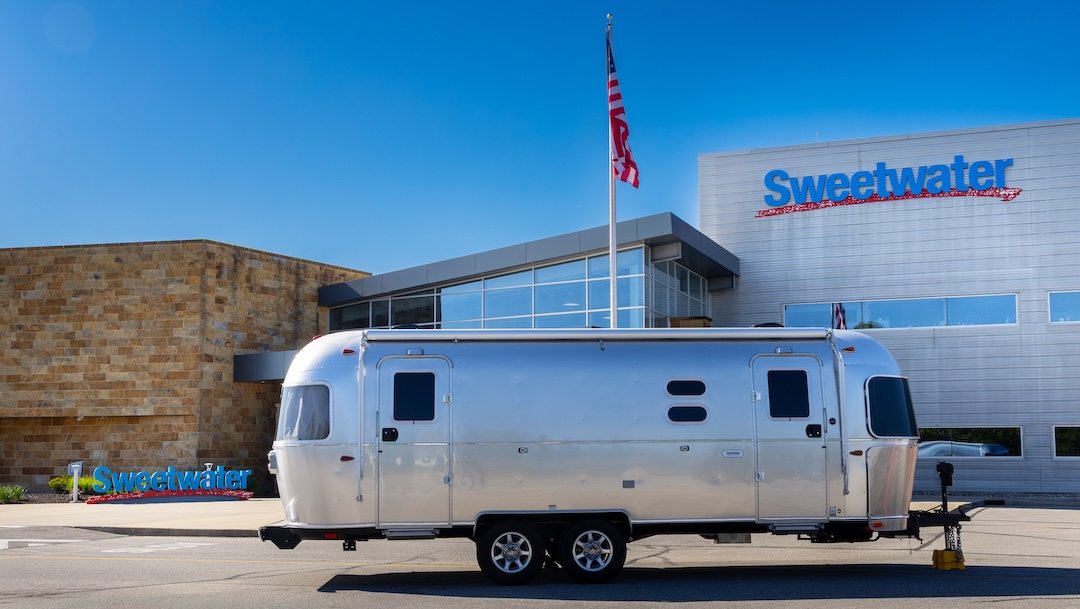
In the evolving landscape of modern audio production, the "studio" is no longer a static, brick-and-mortar sanctuary. It is increasingly becoming a fluid, adaptable environment that meets the artist where they are. This shift in philosophy has culminated in a landmark project: the Sweetwater Airstream. Unveiled during a modest event in Fort Wayne, Indiana, this 25-foot, aluminum-clad trailer represents the world’s first fully immersive Dolby Atmos mobile recording studio.
Designed in a unique collaboration between industry giant Sweetwater, the iconic Airstream company, and the architectural masters at Russ Berger Design Group (RBDG), the project is far more than a marketing stunt. It is a high-fidelity, professional-grade production facility capable of traversing the country to bring immersive education, recording, and mixing capabilities to festivals, universities, and houses of worship.
A Legacy Reimagined: From Microbus to Mobile Masterpiece
To understand the magnitude of the Sweetwater Airstream, one must look at the company’s humble beginnings. In 1979, Sweetwater founder Chuck Surack launched his business as a 4-track mobile recording venture, operating out of a 1960s-era Volkswagen Microbus. Surack spent his formative years in the audio industry traveling from gig to gig, recording local bands in and around Fort Wayne, and setting up temporary rigs in churches and schools. Every dollar earned was funneled back into gear, laying the foundation for what would eventually become the world’s leading music retailer.
As the company approached its 50th anniversary, leadership began brainstorming ways to honor that mobile legacy. The initial instinct was to restore a vintage VW Microbus, echoing the company’s origin story. However, as the project evolved, it became clear that a retro build would lack the necessary performance metrics for modern professional audio.
"Steve Dwyer and Phil Rich from Sweetwater called us, and the conversation started with, ‘What if we did the van again?’" recalls Mark Hornsby, president of RBDG, who previously served as a leader in Sweetwater’s internal studio development. "I said, ‘Guys, you could do the van, but you’re not going to mix anything in it. It’s too small, and it’s loud and it’s noisy—but if you want to do a mobile studio in an Airstream, I know those guys and they happen to be right down the road from you.’"
The suggestion to pivot to an Airstream was both practical and poetic. Airstream, founded by Wally Byam in 1931 in Jackson Center, Ohio, maintains a legendary reputation for durability and structural integrity. By leveraging Airstream’s proximity to Sweetwater’s Indiana headquarters, the teams were able to integrate the specialized acoustic requirements of a world-class studio with the structural precision of a premier travel trailer.
Engineering the Impossible: The Technical Challenges of Atmos on Wheels
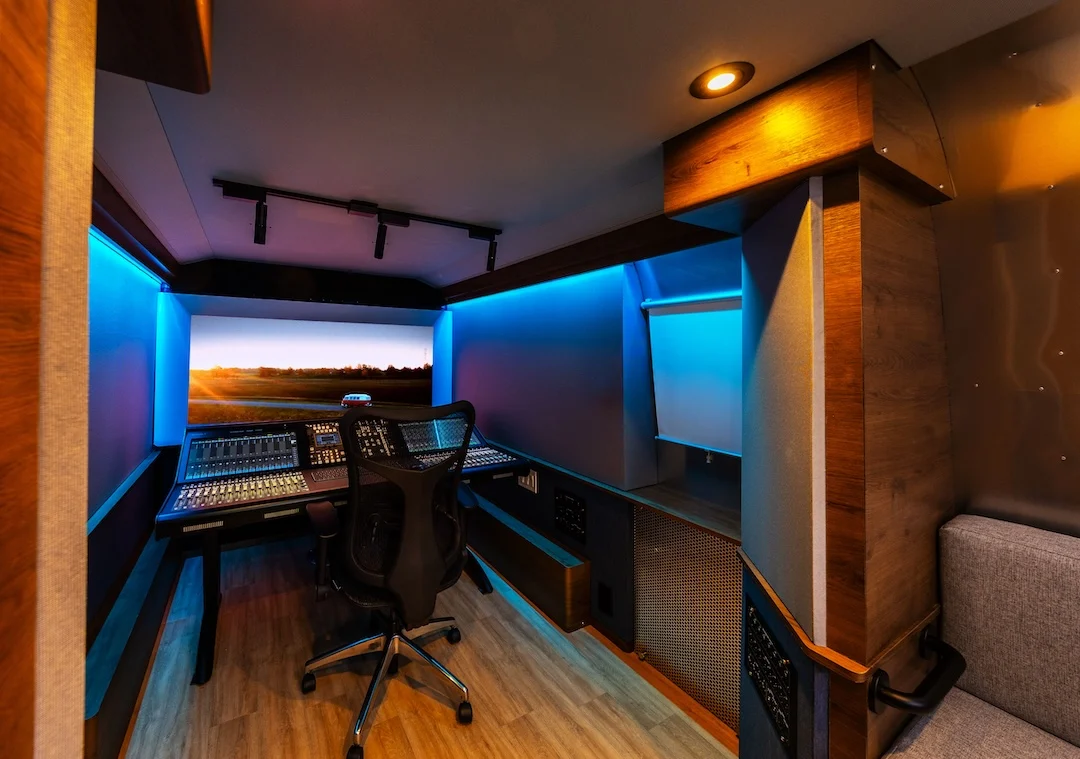
Achieving a Dolby Atmos 7.1.4 immersive mix environment within the curved, metallic shell of an Airstream is a feat of modern engineering. The standard interior of an Airstream trailer—complete with kitchens, bathrooms, and sleeping quarters—was completely gutted to make room for a high-performance control room, a machine room, and professional-grade acoustic treatments.
The project required extensive collaboration between RBDG and the Airstream production team in Ohio. Each 25-foot trailer usually requires 350 hours and roughly 3,000 rivets to assemble; the Sweetwater project necessitated an even more complex build-out. Modifications included the relocation of structural doors and windows, the integration of a rear hatch for equipment transport, and the complete optimization of the ceiling height to accommodate a 7.1.4 speaker array.
"A lot of testing was done early on in Ohio, basically shooting out the shell, figuring out what resonates and what’s doing what in there acoustically," explains Mike Picotte, Sweetwater’s VP of Sales, Commercial. "The air conditioning ducts became a cavity, so we removed that to get more height for the ceiling speakers. We figured out how we were going to build the PMC monitors into the walls, and then we just made fine adjustments."
The result is a space that defies the limitations of its size. The interior houses an SSL System T console, widely regarded as a benchmark in broadcast and immersive production. The monitor system, provided by PMC, offers the precise, clinical clarity required for professional mixing, ensuring that engineers working inside the trailer hear exactly what they would hear in a multi-million-dollar fixed-facility studio.
The Evolution of the Mobile Workflow
The implications of this project for the broader audio industry are significant. For years, mobile recording has been relegated to either large, expensive broadcast trucks or small, compromised "laptop-and-headphones" setups. The Sweetwater Airstream bridges this gap by providing a "Goldilocks" solution: a facility that is compact enough to be towed by a standard truck, yet sophisticated enough to host a full-scale Dolby Atmos mix session.
This mobility allows for a democratization of high-end production. By taking this unit to trade shows, academic institutions, and regional festivals, Sweetwater is providing an immersive education experience that was previously inaccessible to many aspiring engineers. Students at universities can now sit in a world-class control room, witnessing the workflow of a top-tier immersive mix in real-time.
Furthermore, the vehicle serves as a real-world testing ground for complex production scenarios. "I remember at one of the early meetings, I leaned over to Russ [Berger] and said, ‘So, do you think you can do Atmos in an Airstream?’ And Russ being Russ, he just smiled and said, ‘Well, we’ll find out,’" Picotte notes. The successful implementation of the system proves that acoustic excellence is no longer bound by geography.
Official Perspectives: A Catalyst for Future Innovation
For Sweetwater, the project represents a bridge between their past and their future. While it is not being marketed as a retail product for consumers to purchase, the Airstream serves as a massive proof-of-concept for the capabilities of modern acoustic design and digital audio integration.
Industry analysts suggest that the "mobile-first" approach to professional audio will continue to gain traction as the demand for immersive content—in gaming, film, and music—rises. The Sweetwater Airstream is, in many ways, the flagship for this movement. It signals to the industry that high-end production is becoming increasingly decentralized.
From a logistical standpoint, the partnership between Sweetwater and Airstream has also paved the way for future specialized vehicle builds. The ability to integrate sensitive electrical and acoustic equipment into a mobile, climate-controlled environment provides a blueprint for other production houses, touring artists, and educational bodies looking to expand their footprint.
Looking Ahead: The Road to AES Nashville
As the Sweetwater Airstream prepares for its arrival at the AES (Audio Engineering Society) convention in Nashville at the end of October, the team is reflective of the journey. The trailer has already spent the summer months acting as a roving ambassador for the brand, engaging with creators and showcasing the capabilities of Dolby Atmos in environments as diverse as urban music festivals and rural community centers.
The success of this endeavor highlights a fundamental truth about the audio industry: innovation is rarely about building something completely new from scratch, but rather about reimagining existing tools in a way that serves the current needs of the creative community. By taking the spirit of the original 1979 VW Microbus and injecting it with the cutting-edge technology of 2026, Sweetwater has managed to pay homage to its history while simultaneously pushing the boundaries of what is possible in mobile production.
Whether it is acting as an educational tool for the next generation of engineers or as a functional, high-end studio for a touring artist, the Sweetwater Airstream stands as a testament to the power of creative collaboration. It serves as a reminder that with the right design partners and a commitment to acoustic integrity, the studio can truly be anywhere.
As the project continues its journey, the industry will be watching to see how the mobile studio concept influences the next generation of production facilities. One thing is certain: for Sweetwater, the road ahead is as much a part of their identity as the equipment they sell. And for the audio community, the ability to pack a world-class, immersive mix room into a trailer is a development that changes the rules of the game entirely.